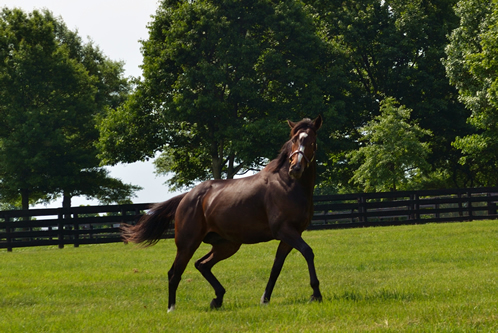
Some say Rachel did not look like the Rachel of last year following a six-month layoff and no workouts in the first five of those months.
When a horse doesn’t work for five months, it’s usually more than the weather that is to blame. It was obvious watching Rachel on Saturday that this was not the same filly we saw last year, at least not right now.
Gary West invokes (as I did on Twitter) the record of the great gelding Kelso, the only five-time Horse of the Year, in appraising Rachel Alexandra’s loss in the New Orleans Ladies Stakes last Saturday:
Very few horses could have performed so well returning from a six-month layoff. The effort, in fact, could have been an ideal start, a solid foundation, for an outstanding season. Kelso was named Horse of the Year five consecutive years, 1960-1964, and four times he began the following year’s campaign with a loss.
And in every year but 1964, he followed that first loss with a win. Whether Rachel Alexandra will manage the same remains to be seen, but let’s look back at Kelso, a fine example of an elite horse who was — in keeping with the times — annually raced into form without much second-guessing of either his honors or connections.
The one year Kelso won his first start back as reigning Horse of the Year was 1961, when he made his 4-year-old debut in a seven-furlong allowance race at Aqueduct, carrying 124 pounds to runner-up Gyro’s 115. “Drew out with ease,” reads the chart note.
His 1962 return in the Metropolitan Handicap was a stiffer test, with 1961 Kentucky Derby winner Carry Back among the nine starters. Carry Back, making his ninth start of the year, won brilliantly, equaling the track record time. It was the “greatest race of his career,” wrote Joseph Nichols in the New York Times of the 4-year-old’s effort. Kelso, however, coming off a lengthy layoff in which he had been recuperating from injuries suffered while finishing second in the 1961 International, was termed no threat. Carrying 133 pounds to Carry Back’s 123, the gelding “showed no inclination to run, even with Willie Shoemaker to urge him.” Of the race, Shoemaker said, “No excuses at all. That 133 pounds on him and his idleness made the difference.” In his next start, Kelso won a Belmont allowance, then finished second in the Suburban. He didn’t win his first stakes race of the year until the Stymie Handicap in September, which he followed with a win ten days later in the Woodward and another win three weeks later in the Jockey Club Gold Cup.
In 1963, off a brief eight-week rest, Kelso returned in the seven-furlong Palm Beach Handicap at Hialeah, losing to the favored Ridan, who was the runner-up to Jaipur in the 1962 Travers and a horse believed best at shorter distances. The results were considered unremarkable all around, and Kelso soundly defeated Ridan by 2 3/4 lengths in his next start two weeks later, the nine-furlong Seminole Handicap at Hialeah.
On his return in 1964, Kelso lost again, this time in the Los Angeles Handicap at Hollywood, a race in which he lugged 130 pounds to the 124 carried by winner Cyrano. “Dull effort,” notes the chart. He came back in the Californian two weeks later, finishing sixth by eight lengths as the 1.40-1 favorite. This was the year that rumblings Kelso might be finished began, as he followed the Californian with a win in a $15,000 handicap at Aqueduct (toting 136 to the runner-up’s 114) and then seconds in the Suburban Handicap and Monmouth Handicap. In the Brooklyn Handicap, won by Gun Bow, he finished fifth by 14 lengths after stumbling badly as he came out of the starting gate. Disappointed, trainer Carl Hanford packed Kelso away for a few weeks on the farm, a respite that seemed to restore the 7-year-old gelding, who came back to win an allowance over the Aqueduct turf, and then — “in the most emotion-packed horse race since the opening of Aqueduct in 1959,” as Nichols wrote in the Times — defeated Gun Bow by three-quarters of a length in the Aqueduct Stakes, paying $6.40 to loyal backers. Second by a nose to Gun Bow in the Woodward, his next start, Kelso came back to win the Jockey Club Gold Cup by four lengths, setting two records — all-time money-earner and a new track time of 3:15 1/5 for two miles — in doing so.
From the Thoroughbred Record, November 7, 1964:
“You really think he won’t run here no more?” the fat man asked. “They said that about Carry Back and all them others, but they run again. Hell, it won’t seem like Saturday without Kelso, will it?”
Kelso was not supposed to run in 1965. The campaign he closed with an annihilating 4 1/2 length victory over Gun Bow in the 1964 International at Laurel was to be his last, but his late-season dominance had Hanford and owner Allaire duPont wavering in their plan to retire the gelding. And so Kelso, Horse of the Year for the fifth consecutive year, came back on June 29, finishing third in an allowance at Monmouth. He returned to win the Diamond State at Delaware, flashing a bit of his old form. Lightly raced that summer, the 8-year-old ended the year with an eight-length win in the Stymie on September 22. Horse of the Year was shared in 1965, going to the undefeated 2-year-old filly Moccasin and Jockey Club Gold Cup winner Roman Brother.
The champion made only one more start, in a six-furlong allowance at Hialeah in March 1966 in which he finished fourth. Suffering a minor sesamoid fracture, Kelso was retired with more than $1.9 million in earnings and a career record of 63-39-12-2, his losses — and perhaps especially those incurred in his intense rivalry with Gun Bow — as much a part the story of his greatness as his many accomplishments.
From the archives: Readings: Alexander and Kelso at Aqueduct.
Oaks prep, Derby preps, and two big stars making their first starts of the year:
The NTRA, which unveiled a fresh new web site look last Friday, launches a new feature, NTRA Live!, a series of webcasts hosted by Randy Moss, this Saturday. Beginning at 6:00 PM, racing fans with an Internet connection anywhere in the world will be able to watch a live video stream — free! — of both the New Orleans Ladies and Santa Margarita Handicap. Very cool. (And not just because the video venture was inspired by “Take Back Saturday!“)
Also Saturday: 2009 Tampa Bay Derby winner Musket Man tries something new, starting in the five furlong Turf Dash Stakes at Tampa (4:57 PM). Musket Man, making his second start off a long layoff, has never finished out of the money, but he’s also never raced at less than six furlongs or on turf. [9:50 AM: Just saw this post on PaceAdvantage, in which someone familiar with the connections' intentions reports Musket Man has breezed over turf once before and that the race is a prep (a prep they expect to win) for the Carter at Aqueduct. DRF shows trainer Derek Ryan with a .38 percentage (out of eight starters) in turf sprints; Musket Man is the 5-2 morning-line favorite.]
Three potential Omnisurface Stars to watch: In the New Orleans Ladies, Zardana — trained by John Shirreffs, shipped in to take Rachel Alexandra’s measure — makes her first start on dirt [in the US]. The 6-year-old mare won the 2009 G2 Bayakoa Handicap at Hollywood (Cushion Track) and the Swingtime at Santa Anita (turf). Also trying dirt for the first time is Noble’s Promise, who makes his first start of the year in the Rebel Stakes. Noble’s Promise won the G1 Breeders’ Futurity last fall at Keeneland (Polytrack), and broke his maiden over the Ellis Park turf. At Santa Anita, Interactif makes the move to synthetics in the San Felipe Stakes. The Todd Pletcher-trainee won his maiden debut on the Monmouth dirt and boasts two 2009 turf stakes wins, the G3 With Anticipation at Saratoga and G3 Bourbon at Keeneland.
It’s a bit of whirlwind trip, but I made it to Beverly Hills for tonight’s Eclipse Awards ceremony. After following Rachel Alexandra and Zenyatta this year, and having had the good fortune to be at both of their emphatic final 2009 races, it seemed foolish not to head to California — especially when a non-stop plane ticket could be had for a small price — to hear which super distaffer would win Horse of the Year.
I’ll be doing the live blog thing (and occasionally tweeting) throughout the evening on Raceday 360 beginning around 4:00 PM PT/7:00 PM ET. Since TVG is airing the awards show, and online sources for updates on who-won-what abound, breaking news won’t be my focus. Instead, it’ll be glimpses of what’s happening backstage, literally and otherwise.
I’ll leave it to others to debate whether it’s sexist or even right that Zenyatta finished second to tennis star Serena Williams in the Associated Press’ Female Athlete of the Year poll and instead merely note that the mare has been running second in quite a few rankings of late, such as the decade-in-review pieces compiled by Tim Layden for Sports Illustrated and Joe Drape for the New York Times, or first, as in the annual Thoroughbred Times readers’ poll. Is this the recency effect, as Ed DeRosa suggests, or are these considered placings, all lengths ahead of Rachel Alexandra, harbingers of how the Horse of the Year vote will tally? I’m beginning to suspect an upset on January 18.
The year almost past was rich in surprises and storylines, making 2009 not only a superb year in racing, but a good year in turf writing, a reminder that although the industry may be struggling and there may be fewer correspondents on the beat, greatness remains as possible on track as keen reporting does in print (even if only online). Amid the abundance of the last 12 months, here are 10 stories, columns, and blog posts that stand out:
Balance’s Little Sister (Steve Andersen/DRF Inside Post)
“Her career will end soon. She may not start again. Shirreffs knows that.”
Death of a Horseman (Bill Christine/Horserace Insider)
“You got it wrong … I’ve never fired Frankel. He’s always firing me. We don’t call him George Steinbrenner for nothing.”
Rubin Recalls Her Tough Ride to the Finish Line (Bill Finley/New York Times)
“I think they felt there would be a stigma if a woman rode, that if a woman could ride, how hard could it possibly be?”
Where Calvin Learned to Ride (Matthew Futterman/Wall Street Journal)
“At the bush tracks in Cajun country where Calvin Borel learned to ride horses for $4 a mount, standards weren’t much higher than the pay.” [A fine complement last spring to Maryjean Wall's reminiscence, "Calvin Borel: The Early Years," which appeared on May 15 and is unfortunately no longer online. "Long before Borel became the go-to jockey of this Triple Crown season, I came across him quite by happenstance at the bush races in Louisiana. He was not yet a licensed jockey. He was 14 years old."]
On Zenyatta, Rachel Alexandra, and Memory (Lisa Grimm/Superfecta)
“… our collective memory will do them a better sort of justice …”
A Glorious Reminder (Paul Hayward/Guardian)
“This was not a bloodstock deal, a betting coup or a prize-money grab. It was flesh and blood and beauty.”
Horse Slaughter: Don’t Ask, Don’t Tell (Matt Hegarty/Daily Racing Form)
“On the issue of horse slaughter, few people take the middle ground …”
High Noon for the Gunslingers (Chris McGrath/The Independent)
“Sheikh Mohammed must have looked at these deadpan men, up from the banks of the Rio Grande, and pondered his own, unrequited craving for this prize. Who are those guys?”
Old School (Claire Novak/ESPN)
“The legend schools the rookie on a cloudy day at Churchill Downs.”
The Final Furlong (Seth Wickersham/ESPN Magazine)
“She took off on foot, walking the track with her medical tool kit, squinting through the mist until she saw a shadowy figure, already a ghost …”
Do you have a favorite piece of turf writing from 2009 not included above? Please share: Leave a comment (and a link, if available) below.
Owner Jess Jackson said on Sunday that it is unlikely Rachel Alexandra will race again this year following her superb Woodward Stakes win:
“She had a campaign since winter, this is the fall. She’s raced more races in two years than most fillies ever run. She’s done things that no fillies have ever done. She deserves a rest.”
After Saturday, who could argue? This campaign needs no embellishing:
I haven’t watched the Woodward replay yet; like Maryjean Wall, I’m still in “a dreamy state” brought on by being at Saratoga to witness such an astounding performance of heart and talent. I’ll surely watch the replay soon (the better to comment on the race and what it means), but for now, I want my memories of Saturday only to be of her in the lead and the crowd rising and roaring as the field streaked down the stretch, as I saw and felt those intense seconds.

9/7/09 Addendum: More from Jackson on the likelihood that Rachel Alexandra will not race again this year: “She needs, I think four or five months off.”
Claire Novak is fed up with Jess Jackson’s coy refusals to announce yet where Rachel Alexandra is starting next. Enough, she writes:
Set a date for a press conference, make up your mind, and make the announcement. That’s what a true sportsman would do.

Rachel Alexandra and Calvin Borel win the Haskell. (Uploaded by Rock and Racehorses to Flickr.)
She’s beaten the winners of the Illinois Derby, Arkansas Derby, Santa Anita Derby, Kentucky Derby, Belmont Stakes, and Tom Fool Handicap. She’s won eight consecutive races, four of those Grade 1s, one a Classic, at six different tracks, and she’s done so by a combined 69 3/4 lengths. Her winning time of 1:47.21 for nine furlongs in the Haskell Invitational came within one-fifth of a second of the Monmouth stakes record; her preliminary Beyer speed figure for the race is 116, which is the highest yet given this year to any horse of any age at any distance over any surface in North America. The leading contender for Horse of the Year, she’s the best of her generation, male or female, and quite possibly, the best American thoroughbred in training.
She’s Rachel Alexandra, and she’s great.
Superlatively speaking: Her Haskell win was preternatural … awesome … surreal … easily the most scintillating seen this year … spine-tingling. (For more, including photos and the race replay, visit R360.)
Meanwhile: Earlier in the day and across the ocean, Breeders’ Cup Mile winner Goldikova turned in a flawless front-running performance winning the Fr-1 Prix de Rothschild. Writes Sue Montgomery in the Independent,
Unlike those commercially driven, demeaning occasions now prevalent at feature race meetings, yesterday was a ladies’ day with a degree of dignity attached. At Deauville, the four-year-old filly Goldikova won the European weekend’s most valuable prize because of her deeds, not her looks. Her class as an athlete was being judged, not the style of her plaits or the colour of her saddlecloth.
Sing it, sister.
The brilliant Goldikova is expected to return to Santa Anita this fall to defend her title. “We’ll follow the same plan as last year,” said trainer Freddie Head.
And at Del Mar: Perfect Zenyatta breezed five furlongs in 1:00 in prep for the Clement Hirsch (video). Could the champion beat Rachel Alexandra, if the two meet? That’ll be the question for the rest of the racing year.
- Racing has a new Omnisurface Star: Colonel John, winner of the 2008 Santa Anita Derby (Pro-Ride) and Travers Stakes (dirt), made his 2009 debut a winning one, taking the ungraded Wickerr Stakes (turf) at Del Mar by two lengths in a fast 1:32.77 (just missing the track record). Trainer Eoin Harty now has some options for the 4-year-old Tiznow colt: “He can do anything.”
- The lack of TV coverage for this weekend’s fantastic racing “amounts to a blackout,” says Steve Crist. Count it also as a lost opportunity.
- Maybe part of the problem with getting coverage is that apparently even the NTRA doesn’t follow the sport that closely. “The Haskell Invitation is today at 6:15PM … http://bit.ly/grQoo,” reads an official tweet. Dear NTRA tweeter, note: The Haskell Invitational is scheduled for tomorrow, Sunday, August 2.
- Bill Finley sees into the future: “Munnings is going to beat her.” [Oops!]
- Monmouth photos: There’s something in the air, and check out that filly.
- Jess Jackson may have the best 3-year-old running, and his wife, Barbara Banke, the best 2-year-old: Hot Dixie Chick was given a Beyer speed figure of 103 for her visually impressive Schuylerville Stakes win on Wednesday. Backtalk, an undefeated son of Smarty Jones attracting some attention, received a BSF of 82 for his hard-fought Sanford win on Thursday.
- Discreetly Mine, a half-brother to Discreet Cat who made an impression on me in his debut, returns in the sixth at Saratoga this afternoon. The 3-1 morning line favorite in a field of 13, he gets blinkers on and boasts a bullet work for trainer Stanley Hough. Also entered is Krypton, a first-time starter by freshman sire Rock Hard Ten (one of my old favorites) out of Kiaran McLaughlin’s barn. Rock Hard Ten is off to a decent start with his offspring: Of the seven that have run so far, two have won, both in their debuts.
Copyright © 2000-2010 by Jessica Chapel. All rights reserved.
Site credits: WordPress / DePo Skinny Theme / Dreamhost.