‘Note Possible for Travers?
Reports Ed Fountaine in the New York Post this morning:
Godolphin Stables is considering a run in the “Midsummer Derby” for Music Note, coming off an 11-length romp in the July 19 Coaching Club American Oaks at Belmont Park, when she ran the mile-and-a-quarter, the distance of the Travers, in a sparkling 2:01.66.
Now, this is an interesting possibility. As much as I’d like to see a rematch between Music Note and Proud Spell in the historic Alabama (and agree with commenter Ed that it could well be the race that determines year-end 3YO filly honors), the Travers does have a $1 million purse, it gives the filly an additional week of rest off the CCAO, and the field, headed by Jim Dandy winner Macho Again, isn’t exactly shaping up as all that strong. [Thanks to Brooklyn Backstretch, not quite as enthusiastic about the idea, for the alert.]
Slow Thursday
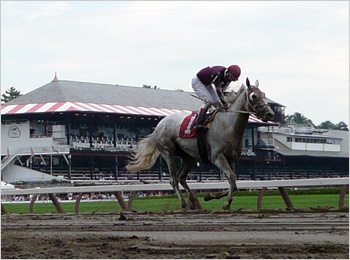
Prominent (2nd) gallops out after the fourth on Thursday.
– Maybe it was the stifling heat and humidity that began early, but everything about Saratoga on Thursday felt slow and muted, from training hours on through the card. The eighth felt especially so, perhaps because pace for the 1 1/8 mile N1X was :47.48 and the final furlong :14.28. This was the first race of the meet run under the new bonus conditions for routes, and it drew 10 starters, swelling the purse to $100,000, but it also highlighted the problem the scheme aims to correct, with early leader Spring Elusion wilting towards the wire and 11-1 Borrowing Base, “outrun for six furlongs” (PDF), grinding to the lead over exhausted rivals in the stretch. Not to complain though — rewarding horsemen for prepping and entering their charges to run at a distance is a worthy effort. There’s only so many one-turn sprints, dirt or grass, any handicapper can take.
– On Saturday, Adirondack winner More Happy returns in the fourth, the ungraded Flanders Stakes, her first start since finishing fifth in the Spinaway nearly a year ago. She at least makes it back to the races (after throat surgery and a bout of pneumonia). Former stablemate Maimonides, another precocious Vindication baby who debuted last summer for trainer Bob Baffert and attracted much attention, was pulled from training with an injury after finishing third in the Hopeful, transferred to trainer Bill Mott in February, and hasn’t been heard from since.
– Out west: Rumors are fanned that Curlin might start in the Pacific Classic and mighty Zenyatta faces eight, including Tough Tiz’s Sis (the closest thing to a challenger the undefeated filly has these days), in the Hirsch on Saturday. Trainer John Shirreffs is posting training videos on YouTube (not via Jay Hovdey’s recent DRF+ column, since there was no link), including this one featuring Zenyatta’s July 26 work, in which she went five furlongs in 1:01 at Del Mar. The images are fuzzy at the start, but her pricked ears and gorgeous, fluid stride are clear in the final 100 yards or so.
That’s Racing
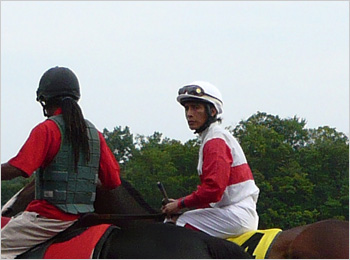
Edgar Prado on Carriage Trail before the De La Rose Stakes.
– A bad beat for Trouble Maker, on the inside and barely edged out in the De La Rose by 3-1 Carriage Trail. Her Majesty the Queen’s horse, Medley, finished a length back in third. “She ran a winning race,” said trainer Tom Albertrani of the mare, winless since July 2007 and sent to post at 10-1. “It’s a tough photo, but that’s racing.”
– It’s not quite like the good old days when every Todd Pletcher and John Velazquez 2-year-old starter looked live, but the pair did find themselves in the winner’s circle after the fifth race with Double Domino, a juvenile by Stormy Atlantic making his first start. Pletcher is now 2-for-5 with first-time babies at the meet. Random fact: According to Formulator, Double Domino is the first 2-year-old to win for Pletcher at 5 1/2 furlongs over the Saratoga turf in the past five years (out of six such starters — the turf sprint isn’t a common move for the trainer’s juvenile firsters at the Spa). Personal aside: Double Domino gave me my first win of the meet, which was a welcome result.
– Proud Spell, returned from a well-earned turn-out following her Delaware Oaks win, is training for the Alabama, where she could meet CCAO winner Music Note. Trainer Larry Jones is thinking positive. “Music Note ran a huge race the other day. Looks to me like she’s setting up for a bounce, we’ve got to play that factor…. And if she does, we sure would hate for her to bounce, and us not be there” (Daily Gazette).
Ladbrokes Favorite
Here’s one Euro possible for a synthetic Breeders’ Cup:
Henrythenavigator, at 4-11, just held off Raven’s Pass in the Sussex Stakes, adding to his impressive record. “He won’t be beaten this year,” declared rider Johnny Murtagh after, to which Chris McGrath responds in the Telegraph:
That acquired the look of a very bold assertion when John Magnier, his owner, included the Breeders’ Cup Classic among the colt’s potential targets. The Coolmore boss reasoned that the race’s transfer to a new, synthetic surface this year made it even more tempting than when O’Brien had tried his luck with Giant’s Causeway, second in 2000, and, rather less successfully, with Galileo and Hawk Wing. As for the new distance, all concerned seem confident that Henrythenavigator will stay 10 furlongs. Ladbrokes make him 7-2 favourite for Santa Anita, but you can get 6-1 with Coral.
New distance to challenge, but what competition? Curlin may close his career elsewhere, Big Brown may or may not be in training, the remaining 3-year-old male and handicap horses struggle to distinguish themselves (except, of course, for awesome Commentator, also doubtful for the Breeders’ Cup). Henrythenavigator could be the best thing going in the Classic at Santa Anita. As for Sussex runner-up Raven’s Pass, connections are considering the Breeders’ Cup Mile.
Synthetic Notes
It was inevitable that a synthetic surfaces forum convened by the New York Task Force on Retired Racehorses would have its dry bits, but for the most part, the Tuesday event was lively and informative, with panelists going in-depth on several subjects of interest to (and much speculation among) handicappers and fans. A couple of themes emerged through the day: Whether talking about maintenance, cost, benefits, or safety, too much of the debate over synthetics is driven by anecdote, more data and long-term studies are required on both dirt and artificial surfaces, and that when it comes to starts and breakdowns, track condition is only one factor in a complex problem.
A few interesting points and observations:
Props to Turfway president Bob Elliston for a fair presentation. After telling the Task Force that the track had experienced a 60% decrease in breakdowns, a 53% decrease in maintenance costs, and a significant increase in handle since it switched from dirt to Polytrack in late 2005, Elliston cautioned that a synthetic surface was not a panacea for eliminating catastrophic injuries. He also noted that the decline in maintenance costs was largely due to the track requiring less work in winter, savings other tracks might be less likely to see, and that increased handle could be attributed to fewer cancellations. He also isn’t convinced synthetics should be required by any jurisdiction, emphasizing a need for accountability, regardless of surface:
“Whatever the benchmarks, we have to hold all tracks accountable — but that doesn’t mean mandating going synthetic. We need to hold all track officials and track superintendents to standards of safety across all surfaces.”
One thing Elliston said about the breakdown rate — that Turfway’s decline was so dramatic the first meet following Polytrack installation that it probably helped create an “unrealistic expectation” as far as safety — was echoed in the panel featuring jockeys later in the day, when Richard Migliore admitted taking a horse who wasn’t warming up well to the gate, believing the track was “a safety blanket,” only to have the horse suffer an injury while running. “I should have followed my instincts,” he said ruefully. A point that all the jockeys made was that horses hit the artificial surfaces so much differently than they do dirt that it was difficult at times to tell how a horse was going over the track. Mark Casse, quoting his regular rider Patrick Husbands, said something similar during the trainers’ panel. “They hit so sweet on it, it’s hard to tell if they’re sound,” and Todd Pletcher added, “Dirt, to me, exposes weaknesses.”
There is little chance that any New York racetrack will install a synthetic surface, but NYRA president Charlie Hayward appeared open to the idea of an artificial training track and was careful to say, “where NYRA is going will be led by the data,” although the lack of any such troubled him:
“It’s a little scary as an industry, making things up as we go along. There’s no science behind it … no real track maintenance protocols. We need more research, more metrics.”
Also of concern to Hayward was the “entrepreneurial, thinly-capitalized” nature of the businesses that currently offer synthetic surfaces. Citing the problems Santa Anita had with Cushion Track last winter and the disappointing response from the company when officials there sought help repairing the drainage problems that plagued the track, Hayward told the Task Force, “You should be concerned [about these vendors] when you’re talking about the backbone of the industry.”
A Task Force member followed up on that issue by asking Sally Goswell of Fair Hill, who had said earlier the Maryland training facility chose Tapeta due to its relationship the surface’s developer, Michael Dickinson, what would happen if Dickinson retired or returned to training. “We’d be in trouble,” Goswell replied.
Track condition and injuries were the focus for vets and horsemen, and both groups saw problems with dirt tracks, or rather, with how dirt surfaces are sometimes maintained. “My biggest concern is that tracks are oversealed to protect the races,” said Pletcher. The trainer called Belmont problematic this spring and said there were an increased number of injuries among his horses stabled there. “Hard tracks create injuries and orthopedic lesions,” confirmed Dr. Mark Cheney.
As for soft-tissue injuries, rumors of which have dogged any discussion of synthetics since the surfaces have been installed, there was no consensus on whether there was a change in occurrence. Trainer Dale Romans reported a rash of “tibias” in his barn at Keeneland and said that he sent a dozen horses to Del Mar last summer, “and ended up with a dozen sore horses.” Casse, who came across as one of the strongest supporters of synthetics, told the Task Force that any rise in such injuries had to do with better veterinary care. “We’ve become more aware of hind-end issues in the last five years,” he said. “Now that we have different ways of diagnosing, we’re finding injuries where we might not have before.” Pletcher sensibly suggested that “tracks are cyclical” when it comes to injuries and that it might take 10 years of data to draw any conclusions about which, dirt or artificial, are safest.
Nick Zito — “I don’t have turf horses, I have dirt horses” — was adamant in his support of tradition:
“I want to stay with dirt. Period. I like dirt … there are good dirt tracks around America and we need to preserve them. If you went to a Polytrack situation, you would change history.”
And that might be the crux of the issue. If studies are done and the data comes back that artificial surfaces are safer, kinder, yield more starts and more handle, but that the same results can be attained with properly-maintained dirt, then the question will be about sticking with tradition or abandoning history for the future. “Dirt tracks aren’t consistent either,” one panelist sniped at another complaining about Del Mar last year, and we have only to think back to the rain that swamped opening day at Saratoga to know that’s true. Still, there are many like Zito who would take slop over rubber, and even I — who can think of 45 good reasons from just that one day for why synthetics might prove preferable to dirt — take pause at the thought of jettisoning the records of horses like Secretariat, Kelso, and Dr. Fager for a track that never changes.
About
Jessica Chapel writes and edits in Massachusetts. Railbird is a Thoroughbred horse racing blog published from June 2004 to July 2019. More / Contact
Elsewhere
Find Jessica on Pinboard and Instagram, Railbird on LibraryThing and Twitter.
Etc.

Links
Search
Boston Racing
Spreadsheets/Data
← Home
Copyright © 2000-2026 by Jessica Chapel. All rights reserved.