The Must-Reads, 2010
It’s no exaggeration to say that every year I bookmark, tweet, or link here to hundreds of horse racing features, columns, and blog posts — stories and opinions that catch my attention for a turn of phrase, the quality of storytelling, the depth of research, an unusual argument, or a striking insight. A few each year — like the 10 pieces below — are especially memorable.
The Making of ‘Legends’ (Pat Forde/ESPN)
“The present is another matter. The present stings a bit. The present is Kentucky Derby week, and it offers vivid evidence of how brutally hard it is even for learned horsemen with a lot of money to win a Derby — or to simply reach the starting gate.”
The Linemakers (John Scheinman/Pimlico)
“It is no secret the man gambles with gusto, a word that derives from the Latin gustus, or tasting. Carulli is all appetite and, like the bear he resembles, doesn’t like to be disturbed while concentrating.”
The Best Broodmare of All Time? (Alicia Wincze/Lexington Herald-Leader)
“Though Hasili was a stakes winner on the track and had a solid pedigree in her corner, nothing in her form could have indicated the impact she would have on the sport once she entered the breeding shed.”
What Makes the Great Ones Great? (Jay Hovdey/DRF)
“No question, in terms of personality type, the great ones appear to be happy in their work.”
Why We Love Secretariat (Meghan O’Rourke/Slate)
“In the moment when he pulls away from Sham, his brilliant archrival (who would’ve been a champion in any other year), we have the sense of an animal exceeding the boundaries of the category of animal.”
Forlorn Filly Comes from Nowhere (Bill Finley/NY Times)
“A few days after he bought a modestly bred horse from a friend named Don Hunt, Tim Snyder took a moment to reflect. He had no money, no horse trailer to get his new acquisition to where he needed to go and a filly that had been rejected by nearly everyone else who had come in contact with her. The horse had a clubfoot, a bad shoulder, a reputation for being slow and was blind in one eye, reason enough for Snyder to second-guess what he had just done.”
Who Really Invented Race Charts? (Kevin Martin/Colin’s Ghost)
“Whatever the case might be, it was Brunell who had the foresight to put race charts and later past performances into a daily publication dedicated to racing. While the above puts his role as ‘originator’ in doubt, no one can deny that he popularized the tools that all horseplayers have been dependent on for more than a century.” [See also, Martin’s follow-up post.]
Rachel’s Place in History (Gary West/West Points)
“Most of us had never seen anything like Rachel Alexandra, and for having seen her, I’m grateful.”
Frankel’s Rise No Romantic Dream (Chris McGrath/Independent)
“Despite the present, witless tendency to treat them as characters in search of an author, men such as Frankie Dettori and Henry Cecil could never be adequately prefigured by a script.”
A Vote for Horse Racing (Claire Novak/ESPN)
“For now, suffice it to say it is the opinion here that a vote for Zenyatta is, simply put, a vote for horse racing. To recognize this kind of runner as vital to the sport’s survival is common sense, not emotional gibberish as some would choose to believe.”
What’s missing? Add your must-reads from the year past in the comments …
In the Red
How the pool totals looked through the card at Santa Anita on Wednesday:
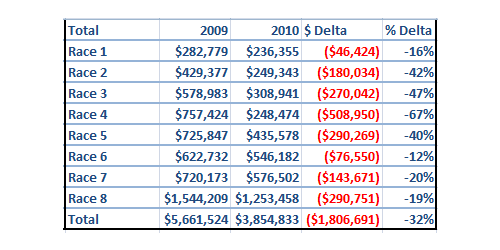
Edited screenshot from an anonymous player forwarded by Pull the Pocket. Player’s figures vary in amount, not trend, from the totals posted on Equibase.
There was a Super 5 carryover of $32,444 in the nightcap, to which bettors added $111,054, but that didn’t much help the day’s total. Only $4,038,178 was wagered on the eight-race card, 28.1% less than the $5,617,017 that was wagered on last year’s comparable eight-race Wednesday card. Reviewing the numbers, Bill Finley concludes:
There can be only one reason why Santa Anita has gotten off to such a wretched start — the takeout increase. It looks like horseplayers actually can be pushed too far.
I think he’s right that horseplayers are feeling pushed too far, although not to the extent that handle is off by so much due mainly to horseplayer action, which is likely magnified by several other factors influencing wagering. There were 50 betting interests at Santa Anita on Wednesday, for instance, compared to last year’s 60, a decline of 16.7%. Yesterday’s fourth race was scratched down to three starters — on which Santa Anita bizarrely allowed trifecta wagering — reducing the pool totals on that race to a third of what the fourth race took in last year. There also hasn’t been a ton of value in the pools since the opener: Favorites have won 13 of 26 races, at an average price of $4.50, and finished in the money in 20 of 26. I didn’t play Santa Anita on Wednesday, and it wasn’t because I was protesting — it was because there was nothing to play. Never mind the boycott — like the SoCal track surface argument of the past three years, the takeout debate obscures a deeper problem — for the most part, California racing just isn’t that compelling.
12/31/10 Update: Steve Davidowitz says it much better: “Given smaller fields dominated as they are by heavy wagering favorites, it even can be argued persuasively that the prescribed takeout increase will prove to be an unfair price for the product on display…. The net effect at the windows is sending a stronger message than any boycott.”
Tax Break
Get a FREE racehorse in 2011, courtesy of the IRS. From an analysis of the recently passed federal tax bill in today’s TDN:
Bonus Depreciation was increased to 100 percent for eligible horses or farm equipment placed in service after September 8, 2010 and before January 1, 2012. In other words, the entire cost of eligible horses or farm equipment purchased and place [sic] in service during that period can be written off. For example, two yearlings purchased and placed in service in 2011 at a total cost of $1 million can be entirely written off that year.
Just in time for Keeneland January shopping. (And a reminder that there are more ways to support ownership than increasing takeout for purses.)
I haven’t done more than skim the sale catalog online, but @irish_1 pointed out on Twitter this morning that Antoniette, dam of G1 La Brea winner Switch, is up for auction next month as hip #267 in foal to Roman Ruler.
One Way to Spin
The weather* continued to hammer Santa Anita on Monday, with total handle for the second day of the meet totaling $5,529,285, down 34.5% from the $8,443,017 taken in on the second day of last year’s meet. For the first two days of the meet, total handle is down 26.2% compared to last year. “There is no way to spin this,” Bill Christine quotes bettor Andy Assaro saying of the opening day decline. I’m a bit disappointed Santa Anita didn’t even try to give the numbers a positive gloss. (Were they not paying attention to Del Mar and NYRA this past summer?) After all, the first two days last year fell on Saturday (usually the best day of the week for handle anywhere) and Sunday, this year on Sunday and Monday. Comparing opening day Sunday 2010 to second day Sunday 2009 yields an increase of 38.7% in handle. Comparing the first two days this meet to Sunday and Monday 2009 delivers an increase of 22.2% in handle. A brazen publicist could really run with those percentages.
*There is no horseplayers’ boycott, comrades. In fairness, though, Monday was a snow day for much of the frozen northeast, with no simulcasting at several tracks, and no betting through NYRA’s online or telephone services. [Also, left out above, comparing Monday 2010 to Monday 2009 shows a modest decline of 2.3% in handle. That’s with one additional race on the card.]
11:20 AM Addendum: Here’s a question: How much of Santa Anita’s opening weekend interstate handle did NYC OTB account for in 2009?
Speed Up, Handle Down
So, was the horseplayers’ boycott a success before it even began? I was among those who thought that anticipation for the first day of racing at Santa Anita in eight months and pent-up dirt demand would lead to a surge in opening day handle. That’s not what happened. From every angle (opening day last year, the last opening day on Sunday, the last opening day with a dirt track), handle was down across the board. Compared to 2009, attendance was off 4% (from 35,292 to 34,268), on-track handle down 15% (from $4,531,236 to $3,851,594) and total handle down 21.5% (from $14,913,953 to $11,707,276). Several factors surely affected the numbers: The track ran nine races this year, 10 in 2009; all the turf races were moved to the main track; there was no handle from now-closed NYC OTB; rain in California and snow on the East Coast may have kept some bettors away. But it also seems likely that a notable percentage of players held back bets, whether to protest the takeout increase or to watch how the reconstructed surface performed.
Santa Anita gave a brave spin to the day’s numbers, issuing a press release in which track president George Haines said, “I think it’s safe to say that we again demonstrated in a very profound way that our fans will continue to support Santa Anita in a big way on our big days. We’re very hopeful we can build on the momentum we generated today and carry it through the entire meet.” That might be difficult, if there are too many cards like Wednesday’s nine-race 61-horse line-up ahead. For comparison, Tampa drew 100+.
The new track looked like the Santa Anita dirt of old on Sunday, with California speed back in style and favorites winning four of nine races (and finishing in the money in eight of nine). “Southern California racing has been a soap opera the past few years,” writes Jay Privman. “Sunday made it feel even more so, as if the past three years at Santa Anita, under a controversial synthetic surface, had merely been a dream.” Trainer Bob Baffert, who might be more inclined to call the past three years a nightmare, was in the winner’s circle after the fourth race, posing next to a freakishly fast 2-year-old named The Factor. “If he’d have lost today, I would have quit training,” said Baffert. Going gate-to-wire, as did the winners of all three six furlong races on the card, The Factor set a new track record of 1:06.98 for the distance while winning a maiden special by 8 1/4 lengths as the 3-2 favorite, his time good for a Beyer speed figure of 102. Switch, the first of trainer John Sadler’s three stakes winners on the day, bested the stakes time of 1:20.45 posted by Mamselle Bebette in 1993 by winning the G1 La Brea Stakes in 1:20.33. Twirling Candy, finishing a nose in front of Smiling Tiger, broke the track record of 1:20 for seven furlongs set by Spectacular Bid in 1980 by winning the G1 Malibu Stakes in 1:19.70. That the Bid’s record was in danger was anticipated early in the day, and not with much joy. “I kind of have a problem with that,” said one of the house handicappers on the track’s feed, talking about Santa Anita’s decision to restore the old dirt track records, ignoring the differences in the surfaces and the synthetic interlude, and I kind of agreed. Twirling Candy is no Spectacular Bid, even if he — like Sir Beaufort winner Sidney’s Candy — is now an Omnisurface Star.
1:45 PM Addendum: Jay Hovdey posts re: Sunday’s lickety-splits: “Meanwhile, up in his booth at the top of the stretch, track superintendent Rich Tedesco was banging his head against the desktop, knowing full well that too fast is just plain too fast when it comes to protecting the frail infrastructure of the Thoroughbred racehorse from his own natural instincts to flee. He also knows that horses like Spectacular Bid don’t come along every 30 years.”
About
Jessica Chapel writes and edits in Massachusetts. Railbird is a Thoroughbred horse racing blog published from June 2004 to July 2019. More / Contact
Elsewhere
Find Jessica on Pinboard and Instagram, Railbird on LibraryThing and Twitter.
Etc.


Links
Search
Boston Racing
Spreadsheets/Data
← Home
Copyright © 2000-2026 by Jessica Chapel. All rights reserved.