About a Lasix Ban …
It would undoubtedly require major changes in training patterns and, ultimately, in breeding patterns as well. Is it possible?
It’s not that complicated and doesn’t require a whole new series of summits or meeting. In fact, it’s a no-brainer. Do it.
Goldikova: That’s It?
While recognizing that once Triple Crown season is over, it’s the handicap horses that take up the Glamour Division mantle, I think Vic Zast is being a little dismissive of Goldikova as a story for promoting the Breeders’ Cup:
It would be fun to be a bug on the wall in the Breeders’ Cup offices. Having a star to promote your event provides you a leg up. But, right now, at least, there doesn’t seem to be any available. If you think the three-year-old division, the main source of Breeders’ Cup promotional currency, is weak, then you probably believe the handicap division is bankrupt. If the Breeders’ Cup was smart it would send representatives to England today to talk the owners and trainers of Royal Ascot runners to plan ahead for Louisville this November. The unbeaten Frankel, of course, would serve ideally to sub for Zenyatta as publicity fodder. As of now, nonetheless, what the Breeders’ Cup has is Goldikova — that’s it.
Not “that’s it,” but “that’s it!” A globe-trotting champion and three-time Breeders’ Cup Mile winner on track for a fourth consecutive victory, she’s a huge story, with a terrific international hook. She’s a gift, not an also-ran.
(Disclosure: I’m working with the Breeders’ Cup on a BC Classic website, set to launch early in July. The opinions here are my own.)
What the Winners Paid
Another 2011 classic, another upset.
Considering the Triple Crown season just ended, I thought it’d be interesting to look back at the win prices for the five Grade 1 Derby preps (Florida Derby, Santa Anita Derby, Wood Memorial, Blue Grass Stakes, Arkansas Derby*), and the Kentucky Derby, Preakness, and Belmont for the past 10 years:
Winning favorites are indicated with a gray background.
This year stands out for the both the highest average win mutuel ($34.01) of the past decade and for being the sole year in which no favorite won in the five preps or a classic. The next highest average ($32.05) was 2004, when Smarty Jones dominated Oaklawn and the first two legs of the Triple Crown, while Friends Lake and Castledale sprung upsets in the Florida Derby and Santa Anita Derby, respectively, and Birdstone shocked everyone in the Belmont.
Price-wise, 2006 was the least surprising year, with the lowest average win mutuel ($11.68); chaos still had its moment, when Kentucky Derby winner Barbaro broke down shortly after the start of the Preakness Stakes. The $27.80 paid to Bernardini backers was the highest price of the season.
Of the three classics, the Preakness has the lowest average win pay ($10.40), with six winning favorites, four of those Derby winners. The other two winning favorites were Rachel Alexandra in 2009 and Afleet Alex in 2005, contenders rightly tabbed as superior to upset Derby winners Mine That Bird and Giacomo.
Only one favorite has won the Belmont Stakes in the past 10 years, and that was Afleet Alex in 2005. Handicappers look for longshots in the Derby, but the Belmont has delivered a higher average price ($43.61) and a healthy ROI in recent years — if you had bet $2 to win on all 110 Belmont starters since 2002, you would have almost doubled your money.
*Grade 2 through 2009.
Lost in the Fog
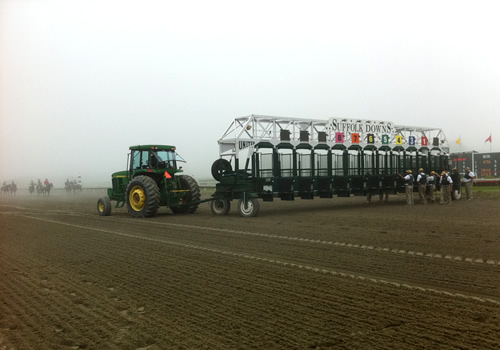
Opening day at Suffolk Downs started sunny and warm, then the fog formed by the marine layer rising from the nearby coast rolled through minutes before the seventh race, clouding the card’s last three races. Despite the turn in the weather, the meet began on a hopeful note and with a crowd of 11,372.
This Again?
OMG:
“They’ve turned the Kentucky Derby into a guessing game,” [Thoro-Graph proprietor Jerry Brown] fumed. “The introduction of synthetic tracks has created mass confusion among handicappers. In the Derby, you’re left to guess whether a horse can handle dirt after running on synthetics.
“This is an absurd situation to create for people who bet the game seriously. It’s tough enough to beat it with good information and rational thinking, but now you have situations where it turns a race into pure guesswork.”
Actually, the synthetic-to-dirt surface switch seems to be one of the more predictable elements in handicapping the Kentucky Derby in recent years.
1:30 PM Addendum: Dean smartly notes on Pull the Pocket that when it comes to assessing surface changes, handicapping principles still apply, but “the questions you have to analyze just might be a little different.”
About
Jessica Chapel writes and edits in Massachusetts. Railbird is a Thoroughbred horse racing blog published from June 2004 to July 2019. More / Contact
Elsewhere
Find Jessica on Pinboard and Instagram, Railbird on LibraryThing and Twitter.
Etc.

Links
Search
Boston Racing
Spreadsheets/Data
← Home
Copyright © 2000-2026 by Jessica Chapel. All rights reserved.