… to help support Kentucky Confidential, a shiny new website dedicated to capturing the essence of the Kentucky Derby in words, photos, and video.
Why support KYC?
The Kentucky Derby is one of the most heavily covered events in horse racing, but rare is the news outlet that treats it as one of the greatest storytelling platforms in American sports.
That’s how Kentucky Confidential will cover the 2011 Kentucky Derby.
What you’ll get:
True (and not-necessarily true) stories from the backstretch
Tall tales and little-known historical marvels from the Derby’s rich past
Kinky stats and contrarian handicapping
Straight-shooting, expert contender profiles and news
Lures and snares of Louisville nightlife and bourbon culture
Video from one of the underground’s best filmmakers
And that’s not all! If you back KYC, you’ll get goodies such as a Jeff Krulik Derby DVD or the chance to submit questions to Derby connections.
If you need another reason:
“… the opportunity is there to create something new. People who think race writing is a dying art, this is your opportunity to support it.”
We begin publishing April 26, and we’ll continue through May 9, running features and stories from writers such as Pete Denk, Claire Novak, Brendan O’Meara, and John Scheinman, illustrated by photos from Scott Serio.
We’ll be at Churchill in 11 10 days, and we’d love it if you joined us.
Posted by JC in Miscellany on 04/15/2011 @ 7:25 am / Tagged Kentucky Confidential, Kentucky Derby, Kickstarter, Media / Follow @railbird on Twitter
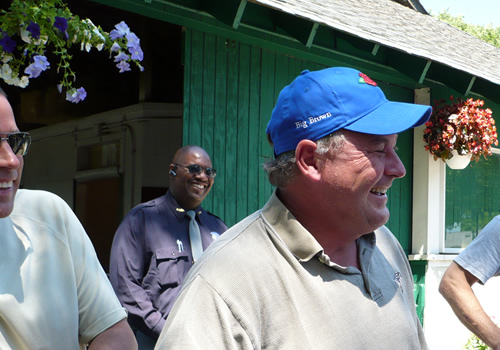
Dutrow in happier days.
“RICK DUTROW DONE,” was the search term that led someone to Railbird this morning, presumably seeking more on yesterday’s shocking news that the KHRC denied the trainer a Kentucky license because of his lengthy list of violations and license application inconsistencies. “I never thought I’d see the day when a big-name trainer was held to task for his misdeeds,” tweeted Ryan Goldberg. Regardless of what happens next, there’s no denying, as the Racing Post put it so well, that “controversial trainer Rick Dutrow hit a new career low” on Wednesday. He has a chance to hit another in May, when New York reviews his license, or possibly when his biggest client, IEAH, pulls its stock from his barn. “Obviously, we can’t be in a position where our horses can’t run in certain jurisdictions,” Michael Iavarone told DRF.
A restraining order will make it possible for Amen Hallelujah, entered by Dutrow before his hearing, to start in the Vinery Madison today*.
Brooklyn Backstretch has posted a timely interview with RCI president Ed Martin on Dutrow’s record and the letter Martin wrote to the NYSRWB in February calling for an examination of his license: “His record is his record.” That’s just it, and Dutrow doesn’t help himself when he makes excuses:
He also said any misinformation on his license applications were not intentional but were due to the fact others completed the paperwork for him, and he just signed it.
Or refuses to take responsibility:
Dutrow said that was because he could not remember whether the incident occurred within the time frame stipulated on the application, but the committee could get copies of his criminal record in order to get the specifics.
What made the KHRC decision all the more interesting was the context. It’s spring, and racing seems to be in the mood to clean house. The movement to ban raceday medications is suddenly gaining real momentum. The latest group to sign on is the Breeders’ Cup, which announced today that its board:
… also endorsed in principle the recently announced recommendation of the Association of Racing Commissioners International (RCI) to eliminate the use of race-day medications in North American racing and decided to appoint a sub-committee with the objective of developing a plan and a timetable for the elimination of race-day medication in the Breeders’ Cup World Championships.
American racing is going drug-free! I don’t see what could stop … oh, right:
Saying they support efforts to limit race-day medications, two prominent Thoroughbred trainers said they hope the initiatives do not go so far as to ban use of the anti-bleeder drug known as Salix.
The horsemen are going to take to some work to win over:
The Kentucky Horsemen’s Benevolent and Protective Association, which represents all licensed owners and trainers, hasn’t discussed stricter medication rules, said president Rick Hiles, a trainer.
“We believe in therapeutic medications to help the animals,†he said, “so we’re probably not going to endorse it.â€
But what about the celebrity owners, Mr. Hiles? Spare them a thought, as TDN publisher Barry Weisbord does in a column appearing yesterday:
When a prominent t.v. personality such as Bobby Flay or a successful young businessman like Mike Repole or Kevin Plank — any of whom could participate in any sport they’d like — decides to spend his free time participating in Thoroughbred racing, what do we do? We make it tougher on him by forcing him to continually answer this question: Why do you spend your time in an industry which drugs its athletes?
Asking them to answer that question, be it in the lead-up to a major race, or when they’re receiving some other recognition in their professional lives and the topic of racing comes up, is not only unfair, but has to diminish their enjoyment of their participation in racing.
Actually, I get this. When I talk to people who don’t know much about racing, the question of drugs often comes up, and I find myself choosing my words carefully and trying to tell the truth but not make it sound so, so bad. There’s a perception of shadiness attached to even the legal medications, regardless of their therapeutic qualities. Banning raceday drugs is about doing right by horses, and giving horseplayers and casual fans reason to trust in the integrity of the game — which is why all the meds, including Lasix, must go.
*Turns out, Amen’s start took a last-minute trainer change, an unusual move with implications for trainer responsibility (via @o_crunk).
4/15/11 Addendum: This is pretty funny:
Sallusto was not on the grounds for the [Vinery Madison], leaving jockey John Velazquez as the sole person to answer questions in the wake of the filly’s runner-up effort.
“No one,” was Velazquez’s response when asked who gave him pre-race instructions.
When asked whether he had talked with the trainer after the race, Velazquez replied, “Who is the trainer?”
Posted by JC in Racing on 04/14/2011 @ 4:03 pm / Tagged Kentucky, KHRC, Licensing, Raceday Medications, RCI, Richard Dutrow, Trainers / Follow @railbird on Twitter
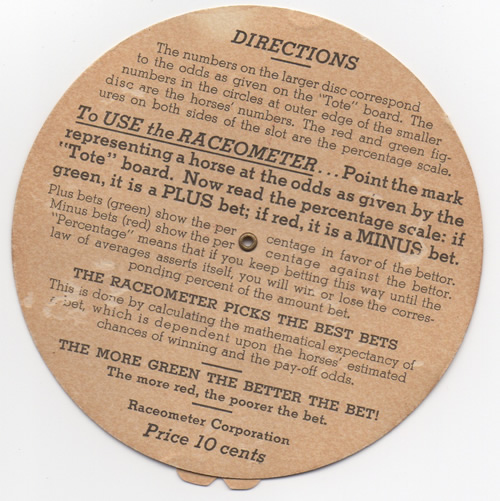
Bill Christine’s search for a Kelco put me in mind of my favorite piece of handicapping ephemera, a volvelle for assessing value called the Raceometer:

“The more green the better the bet!” Handy, but at 10 cents a race, pricey.
I’ve been on the lookout for more Raceometers, but all I’ve found so far is a similarly named wheel chart, the Race-o’Meter (note the odd apostrophe), produced by the Southern California Research Company in 1948:

Unlike the Raceometer, a tool for betting, the Race-o’Meter considers eight factors to create individual horse ratings. “Be sure you have a racing form before you when use you the Race-o’Meter,” advises the instructions:

It’s science! Beginning in the 1930s and continuing into the 1970s, “scientific” and “scientifically” were favored adjectives of marketers hawking handicapping systems and methods. In 1933, as defined in “Systology: The Science of Wagering Upon Horse Races,” a compendium of eight chart-heavy betting systems, “scientific” meant the complete eradication of individual judgment. “By the use of ‘Systology,’ the human equation is removed from wagering,” wrote the authors. “It leaves nothing to the imagination.” (How dull.) In 1961, “Science in Betting” assured its readers that it would tout no “miraculous betting-system,” instead, it would teach bettors how to use “scientifically collected” data, “which if applied intelligently can work consistently and accurately.” Just like the Race-o’Meter claimed, and most likely, the Kelco.
Posted by JC in Miscellany on 04/13/2011 @ 6:58 am / Tagged Handicapping, Horseplayers, Race-o'Meter, Raceometer, Racing History, Volvelles / Follow @railbird on Twitter


