Arthur Hancock III:
… “therapeutics” given to horses that don’t need them are abusive.
Let’s put aside Lasix, the subject of Hancock’s phrase above, and talk about thyroxine, the synthetic thyroid hormone supplement trainer Bob Baffert admitted dosing his entire stable with during a period in which seven horses under his watch died suddenly. Trainer Steve Asmussen did the same, a practice that became public knowledge following a PETA expose. Both were cleared of doing anything illegal or improper in investigations that largely dismissed indiscriminate thyroxine use as acceptable, rule-abiding care.
“I haven’t found a barn that uses it on all their horses,†said California equine medical director Dr. Rick Arthur of the Baffert barn regimen, yet: “[The thyroxine] was legally dispensed and reported as labeled. It was within their right to do so. There is no violation of any rules.”
“The KHRC also did not uncover evidence of a rule violation with respect to thyroid hormone supplementation,” determined Kentucky re: Asmussen (PDF).
It’s a measure of how thoroughly the discussion about dispensing therapeutic drugs like carrots has been shut down following both investigations that I feel it’s in bad taste to bring the issue up right now, when Baffert is going for the Triple Crown with American Pharoah in a bit more than a week. I mean, even the Paulick Report — the publication that most aggressively chased the Baffert sudden death story — is running a piece lauding the trainer’s “horse sense” and speculating that he might be “the chosen one” to win racing’s most elusive prize. Ed Zieralski worried that “a lynching party” would pursue Baffert in 2013 if he made it to the Kentucky Derby that year (he didn’t) — he doesn’t have to be concerned about that this year, when even an inquiry about a case of colic in a Baffert Derby contender “wasn’t a question that could be asked,” in the words of Daily Racing Form correspondent Marcus Hersh.
Baffert told reporters at Churchill Downs earlier this week that dealing with the media in New York before the Belmont Stakes would be a challenge:
“To me, that’s the hardest part. You have to deal with everybody. This is easy — today with you guys. But when we get up there, everybody is going to want to push the race and all that.”
And all that. I hope it’s all that. I hope some reporter breaches etiquette.
Posted by JC in Racing on 05/29/2015 @ 11:17 am / Tagged Bob Baffert, California, Drugs in Racing, Kentucky, Media, R360, Steve Asmussen, Thyroxine / Follow @railbird on Twitter
Johnny Weir hadn’t even been born when the modern Kentucky Derby telecast was conceived. The challenges of 1982 look a lot like 2015:
Many were dubious at the time about the value of an extended telecast, but ABC stood fast. “There are very few sports that the American public follows so little, but becomes so interested in for one race,†host Jim McKay told the Dallas Morning News. “There’s a tremendous amount of familiarization to do on the day of the race. There’s the horse, the owner, the jockey, and the trainer, and it’s important to do as much as possible on who they are and where they came from.â€
Sportscaster Howard Cosell summarized ABC’s production strategy a bit more bluntly to the Washington Post: “You have to be willing to alienate — or at least talk at a sophisticated level they’re not at all pleased with — the serious horseplayer,†he explained. “You can’t be concerned with them. You have to worry about the 99 percent who are watching just because it’s the Derby.â€
It’s interesting how much the televised approach to the Derby has spilled over into year-round racing marketing (for example: America’s Best Racing).
Posted by JC in Racing on 05/28/2015 @ 8:47 am / Tagged Kentucky Derby, Marketing, Telecasts, TV / Follow @railbird on Twitter
Credit: Churchill Downs/Reed Palmer Photography
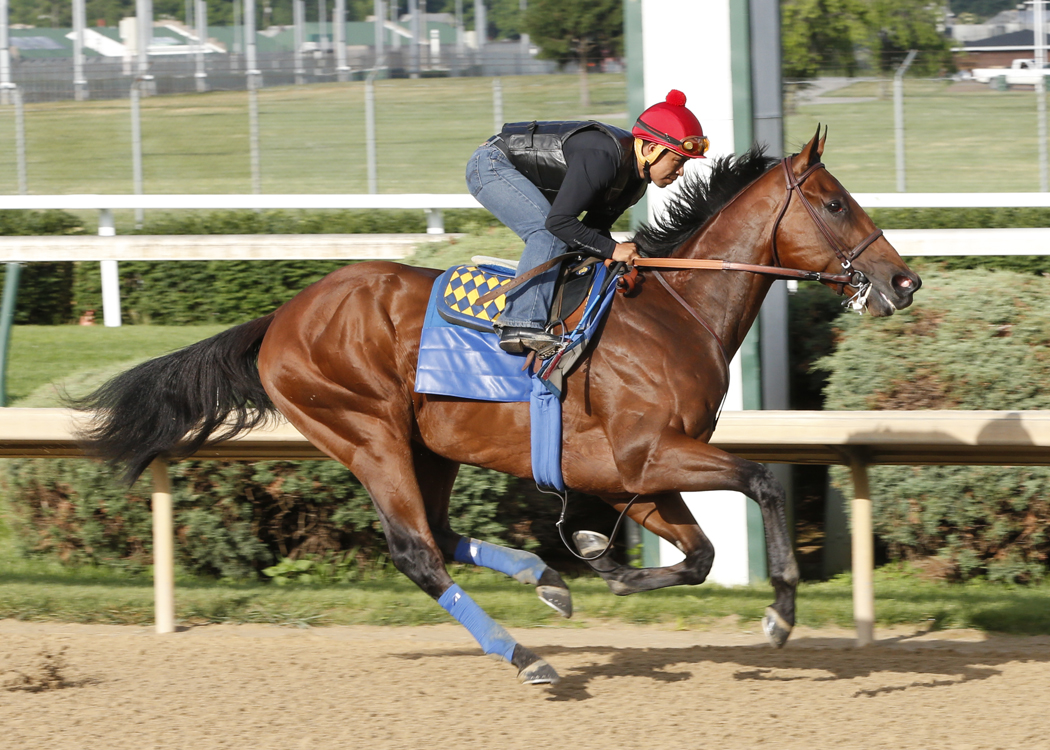
American Pharoah breezed four furlongs in :48 flat at Churchill Downs on Tuesday morning, galloping out five furlongs in 1:00.40 and six furlongs in 1:13.20. Martin Garcia, who flew into Louisville along with trainer Bob Baffert for the work, could be heard shouting “Whoa” as he tried to pull up the Pioneerof the Nile colt on the backstretch. “I told Martin to just let him keep going,” said Baffert. “I really liked the way he went.” Here’s video of the work.
The trainer is happy with the dual-classic winner’s apparent energy level:
Baffert has brought three colts to this stage before, and he has said this is the point where one would usually start noticing any fatigue from the five-week Triple Crown grind.
Both Baffert’s body language and that of his Kentucky Derby and Preakness-winning charge Tuesday signaled that was not the case as American Pharoah cruised along under Garcia. The colt’s ears pricked the entire way around.
DRF clocker Mike Welsch gave the work a positive review (subscription only):
Even on the live feed provided by the track, it was clear to see American Pharoah looked every bit as good on Tuesday breezing over the Churchill Downs surface as he did in the final week leading up to his victory in the Kentucky Derby. With jockey Martin Garcia aboard, American Pharoah appeared a picture of health and was about as relaxed as could be as he made his way around to the half-mile pole alongside the pony …
American Pharoah just cruised through a steady series of 12-second eighth-mile splits before galloping out with a ton of energy around the turn. The gallop-out was perhaps the most impressive part …
American Pharoah is expected to work again on Sunday or Monday*, and then ship to New York on Tuesday for the Belmont Stakes. “We won’t do much with him up there,” said Baffert. “We’re just going to stay focused, keep the weight on him and keep him happy like the way he looks today.”
Dealing with the media at Belmont will be the trainer’s challenge next week: “I can’t go into Marshawn Lynch mode, but it’d be nice.”
It’s likely, if he wins the Triple Crown, that we’ll have seen the last of American Pharoah on track. His stud plans are set. Ed DeRosa breaks down the deal:
The deal started out at $8-million with another $7-million available if American Pharoah hit certain benchmarks like become champion two-year-old male and win certain races such as the Kentucky Derby. Presumably there are other incentives still in play such as win the Triple Crown, become champion three-year-old male, and earn Horse of the Year.
So, don’t fall in love.
And don’t get too excited if he’s on the cover of Sports Illustrated.
Experts estimate Pharoah would be at the high end of the market with a Triple Crown win: “[H]e’s likely to command approximately $100,000 per live foal.”
*2:30 PM Addendum: I had to look this up — it turns out, American Pharoah will be the first Triple Crown contender to go into the Belmont Stakes gate with two works between the Preakness and the Belmont since Funny Cide in 2003. Both California Chrome in 2014 and Big Brown in 2008 had one work.
Posted by JC in Racing on 05/27/2015 @ 10:38 am / Tagged American Pharoah / Follow @railbird on Twitter


