Suffolk Downs opens for 2013 on Saturday with a nine-race card that drew the usual assortment of horses who spent the winter racing in Florida or Maryland, and those who are making their first starts since Suffolk closed for the season in October. A small band of New York shippers also appear in the entries — trainer David Jacobson sends two, Christophe Clement one.
Jacobson’s first starter is Broadway Hat in race two, a five-furlong maiden claimer. A $220,000 purchase by Todd Pletcher at the March 2012 OBS sale, the Ready’s Image colt is making his $5,000 tag debut after going winless in seven starts — he finished second first time out last May, and second again in his third start on January 21, which is when Jacobson claimed him for $25,000. He ran back six days later and finished seventh. He comes into Saturday’s race off three starts, the last a maiden $16,000 at Belmont on Sunday in which he finished fifth (one of the few races Jacobson hasn’t won recently), and he’s 8-5 on the morning line. I’m going to bet that Broadway Hat finishes second again, maybe to Let’s Be Glad, who’s only winless in five races and has been running steadily at Gulfstream and Pimlico since his first start in January.
Temecula Creek, coming off two wins since May 18 at Belmont, is entered for Jacobson in race eight, a $20,000 OC/N2X going six furlongs that also includes the 2011 New England juvenile male champion Mighty One. He’s coupled with stablemate Gold Bear; both look overmatched.
Race six is the meet’s first turf race, and it’s a two-turn maiden special weight. Elusive Son makes his first career start for Clement off a string of solid works. He’s an $80,000 Keeneland September purchase, a colt by Elusive Quality out of the graded-stakes winner Go Go. She’s had four prior winning foals, the most impressive being the stakes-placed Miss Mittagong. As impeccable as Elusive Son’s credentials are for a Suffolk grass start, though, Caristo looks like an interesting longshot prospect in the same race — the John Botty trainee is making his third start, his first on the turf, a promising switch for a son of Langfuhr out of a dam who won and was stakes-placed on the Belmont turf.
Posted by JC in Suffolk Downs on 05/31/2013 @ 6:11 pm / Follow @railbird on Twitter
The top three finishers in the Preakness Stakes were making their 10th or 11th career starts — it’s been a while since anything like that’s happened in a Triple Crown race, as Superterrific confirmed by compiling 2007-2013 results. What will be interesting to see, going forward, is how this year’s classic contenders perform over the next few months (will they stick around for fall campaigns?), and if this is the beginning of a trend toward more starts for classic prospects.
Posted by JC in Racing on 05/23/2013 @ 9:30 am / Tagged Career Starts, Derby Preps, Oxbow, Preakness Stakes, Training, Trends, Triple Crown / Follow @railbird on Twitter
Left at the Gate posted a Preakness Stakes pace analysis that you should read in full, but the upshot is that on a slow track Oxbow:
… was a running fool and bottomed them all out, the way I see it.
Which is why Oxbow’s Preakness Beyer speed figure is 106, something Bill Oppenheim writes about in today’s Thoroughbred Daily News:
When I first saw the time of Saturday’s Preakness S. — 1:57:2/5, the slowest in 51 years … I thought the Beyer speed figure was sure to come back in the nineties. But when I looked at the times for the other dirt races — 1:10 and change for two six-furlong stakes, and 1:46 and change for and older filly-and-mare Grade III — it did look like the track was slow, and Andy Beyer confirmed there was a stiff headwind against the horses in the stretch.
Oppenheim also publishes a table (PDF), with data provided by Andrew Beyer, of the Beyer speed figures for all the Triple Crown races from 1987 to 2013 (minus this year’s Belmont Stakes, of course), documenting the decline in figures over those years, and in particular, the sharp decline in figures over the past five years, especially in the Belmont Stakes. “That has to be the result of lack of stamina in pedigrees,” Beyer tells Oppenheim.
Trends in breeding can’t be ignored, but the data suggest that there may be additional factors at work, such as changing training practices and the elimination of routine steroid use. If you look at the Belmont Stakes figures, until 2005, the Belmont speed figures are generally in line with or higher than the figures for the Kentucky Derby and Preakness. Starting in 2006, the Belmont Stakes figure is consistently lower than both the Kentucky Derby and the Preakness figures; from 2006-2012, no Belmont winner earns a higher Beyer than the winner of the Derby or the Preakness.
The most striking thing about the table, though, is that Belmont Stakes figures essentially collapse in 2008. That was the year Da’Tara earned a 99 after Big Brown faltered; no winner has been given better than 100 since. It may be chance, but the period beginning with 2006 coincides with a fresh-is-best training approach to the Triple Crown and a string of Kentucky Derby winners with two preps, and the period beginning with 2008 coincides with a Kentucky Derby winner weaned off Winstrol and an industry-wide steroids ban.
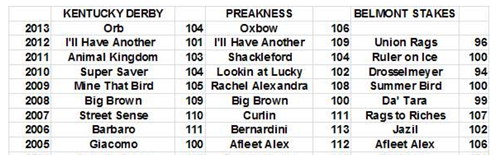
3:45 PM Addendum: Dick Jerardi explains how the 106 given Oxbow was determined: “The key horse in the Preakness was Itsmyluckyday …” (He was given a Beyer of 103 for finishing second.)
Posted by JC in Racing on 05/22/2013 @ 11:52 am / Tagged Beyer Speed Figures, Breeding, Pace, Preakness Stakes, Stamina, Trends, Triple Crown / Follow @railbird on Twitter


