American Pharoah
With the connections saying the Triple Crown winner will run again — so long as he’s sound, happy, and healthy — and that a start in the Breeders’ Cup Classic at Keeneland will be his career finale, tracks are bidding for an American Pharoah appearance. The Haskell at Monmouth Park seems the most likely spot for his return (the locals are asking), which leaves a late summer, early fall race open. Del Mar would like to get him for the Pacific Classic:
“If they decide the Breeders’ Cup Classic is the goal for his last race, then they’ll need some races before that,†Del Mar’s Craig Dado said. “Backing up from the BC Classic, there’s the [Awesome Again Stakes vs. older horses] at Santa Anita in September or early October. But why not the Pacific Classic…. He’s the Triple Crown winner so he doesn’t have anything to prove against 3-year-olds. Why not go against older horses and not have to ship?â€
And Parx, which drew California Chrome and Bayern for the 2014 Pennsylvania Derby, plans to be aggressive in courting Pharoah for this year’s race:
Elliott said the existing conditions of the Pennsylvania Derby are already written to pay a $100,000 appearance bonus, split between the owner and trainer, to any horse that wins any one of the Triple Crown races, the Haskell, or the Travers. The per-race bonuses are cumulative, so American Pharoah’s connections, Elliott said, could be in line for at least a $300,000 base payday just for showing up at Parx, or $400,000 if the horse wins the Haskell.
“And I believe we intend to make a little better offer than that,” Elliott said, without disclosing how much more Parx would be willing to pay above the announced bonuses. “I’m going to try in the not-too-distant future to go to wherever Mr. Baffert is and meet with him to talk about it.”
Canterbury Park is a longshot, but they’re throwing themselves into the mix:
Wednesday, the Shakopee track doubled down on its grand idea, announcing it would offer a $2 million purse for the late August race if American Pharoah shows up. And according to Halstrom, owner Ahmed Zayat and trainer Bob Baffert didn’t consider it crazy, either. Halstrom said both men told him Tuesday that they were willing to listen to offers, leading track officials to begin assembling a proposal that will convince Team Pharoah to bypass prestigious races in New York and California in favor of Minnesota.
Saratoga can’t be ruled out, for either the Jim Dandy or Travers, and New York Senator Charles Schumer is making an appeal via letter and press release:
U.S. Senator Charles E. Schumer today urged the owner and trainer of recent Triple Crown winner from the Belmont Stakes, American Pharoah, to bring their champion to the historic Saratoga Race Course this summer. Schumer urged owner Ahmad Zayat and trainer Bob Baffert, to bring the legendary colt to one of the most historic and renowned race tracks in the country.
Speaking at a press conference on Wednesday, trainer Bob Baffert told the crowd: “When he comes back, I want him to really bring his fastball … I’m not going to embarrass him because somebody made some offer or whatever.”
Mike Vaccaro on American Pharoah:
In one magical romp around the Belmont Racetrack oval, he elicited a level of fanaticism the sport hasn’t known, quite literally, in decades.
Or, since Zenyatta, in certain quarters. A corner of Twitter lit up when the weekly NTRA Thoroughbred Poll appeared Monday and American Pharoah was #1, but one vote short of unanimity. Someone had voted Shared Belief on top.
“Inane,” said a turf writer, demanding an explanation.
Shared Belief was the #1 horse last week. He’s the #2 horse this week.
The voter doesn’t need a defense. I mean, “over a weekly list? LOL.”
It’s a funny argument, except it’s also representative of an orthodox tendency within racing media, a group increasingly dominated by trade-affiliated outfits (Blood-Horse, Daily Racing Form, TVG, etc.) and freelancers, who move between journalism and public relations within the industry out of necessity. It’s a tendency that makes room for unchallenged narratives — that portray trainer Bob Baffert as transfigured by his Triple Crown horse, smoothing the complicated edges of his story; that deny criticism of marketing initiatives such as America’s Best Racing or the “Big Day” trend by dismissing the heterodox as “haters.” It makes it hard to hold a contrary opinion. Who wants to be the odd person out, especially when we share one love — the horse?
More about American Pharoah’s Belmont Stakes fractions from Matt Gardner, admiring the Trakus times for the Triple Crown winner:
Look at that consistency because it’s a thing of beauty.
American Pharoah churned out :12 after :12 after :12. He came home the last quarter mile of the mile and a half Test of Champions in 24.17 after setting all the early fractions. He did the dirty work early and still had something left in the tank …
I don’t want to lose sight of the horse for the numbers, but, yeah — his :12 second furlongs from start to finish are gorgeous in their symmetry.
Bob Barry of Around Two Turns has written a lovely appreciation:
American Pharoah’s seemingly effortless yet ruthlessly efficient action, which lends to that appearance of him seeming to glide above the racetrack, was the basis of his early fame and almost certainly his armor against the rigors of the Triple Crown season. That certain je ne sais quoi which first caught all the eyes at Clocker’s Corner, enabled him, at the end of three hard races in five weeks, to somehow run the last half mile of his Belmont faster than he ran its first. He is the very model of a modern Triple Crown winner.
Brian Hoffacker expresses the effect of such visual ease well: “Here’s how efficient and talented American Pharoah is: He hasn’t done anything to shock me yet, and I thought I’d never see a Triple Crown.”
Don’t call the Triple Crown winner great yet, writes Sam Walker:
The problem at present for American Pharoah is that while he may be clearly the best three-year-old in America, the standard of his rivals is not yet clear. He’s essentially flying high above unknown terrain.
But he is important, says Daniel Ross:
At a time when the sport has never had to work as hard for recognition and relevance, American Pharoah reminded a nation that widely regards horse racing in this country as overtly cruel, and callous, and uncaring, that the same spectacle can still produce transcendental moments.
The Atlantic decided to remind people of both the transcendent and the brutal on its homepage. Here’s what was there on Monday at approximately 8:00 AM:

I think I’m mostly grateful other publications haven’t posted similar pairings.

The crowd at Belmont Park celebrates. Credit: Chelsea Durand/NYRA
The Triple Crown winner isn’t sticking around — New York, at least. American Pharoah met the media, charmed the “TODAY” show audience, and boarded a van leaving Belmont Park around 7:30 AM, arriving back at Churchill Downs by 1:30 PM, less than 19 hours after he won the Belmont Stakes and became the 12th Triple Crown winner in American racing, the first in 37 years.
The first in 37 years.
Like a lot of horse racing fans, I don’t remember the last one. I’m not quite sure what to do with this one. He’s marvelous! It’s wonderful! The minutes before the race were nerve-wracking, the seconds it took him to cross the wire — 5 1/2 lengths ahead of runner-up Frosted — thrilling.
There is satisfaction in discovering that a Triple Crown is still possible.
“After seeing what we saw on Saturday,” writes Jason Gay, “can we all agree that stubborn old horse racing had this the right way all along?”
The Triple Crown just needed a racehorse who could take one of the hardest things we ask a young horse to do and make it look easy.
American Pharoah completed the 1 1/2-mile race in 2:26.65, and he did it by going to the lead and reeling off steady :24 quarters, running the first half in :48.31, the first six furlongs in 1:13.41, and the first mile in 1:37.99:
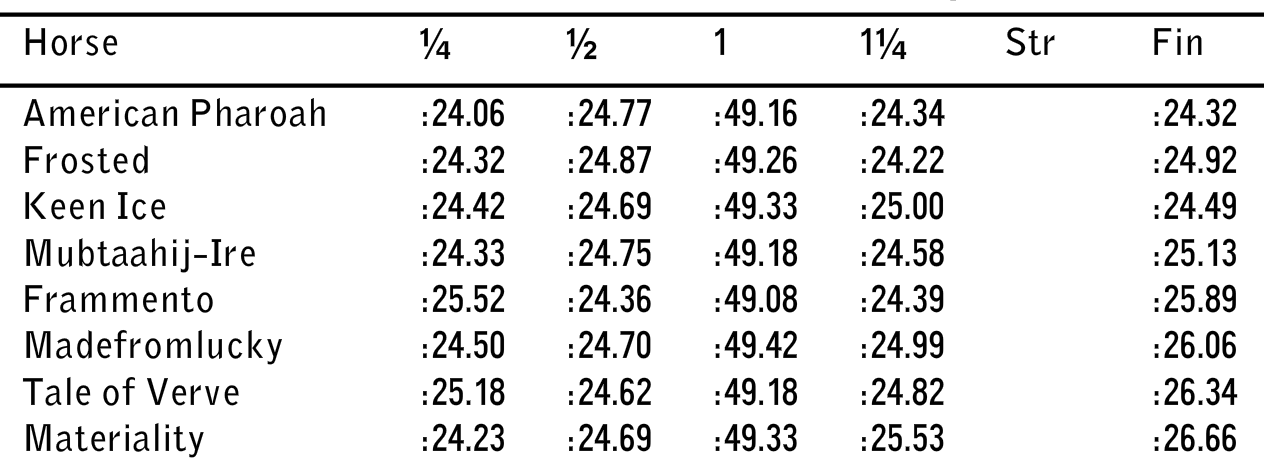
DRF incremental times above. View the official Equibase chart (PDF).
He was never pushed, never threatened. Materiality, tasked with keeping the 3-5 favorite honest on the front, was out of contention before the mile. Frosted looked like a challenger at the top of the stretch — for a stride. American Pharoah gave him no ground. He was going to get away with it all.
“I’m telling you,” said jockey Victor Espinoza afterwards, “in the first turn it was the best feeling I’ve ever had.” Watch the replay:
The 12th Triple Crown winner was given a Beyer speed figure of 105 for the Belmont Stakes. TimeformUS gave him a speed figure of 128. His figures are as consistent as his fractions — American Pharoah’s Preakness and Kentucky Derby Beyers were 102 and 105, his TFUS numbers 125 and 127.
Trainer Bob Baffert reported on Sunday morning that American Pharoah came out of the Belmont in good shape. “Looking at the horse today, he looked pretty darn good for a horse that just ran a mile and a half,” said Baffert. “He’s a tough horse. Today he looked like he could run back in three weeks.”
Per the NYRA press office notes, the plan is for the colt to race again:
“After we freshen him up, we have options,” said Baffert, who mentioned the Grade 1 Haskell Invitational at Monmouth, the Grade 2 Jim Dandy and the Grade 1 Travers Stakes at Saratoga Race Course, and a “little race” at Del Mar, most likely the Grade 1 Pacific Classic.
Jay Privman explains why he believes the Pacific Classic is likely: “it would certainly be an endorsement by Zayat of the return to dirt at Del Mar to run there this summer, and there’s no bigger ‘get’ right now than American Pharoah, who — remember — hasn’t raced in California this year. Yet.”
The Breeders’ Cup Classic at Keeneland is the goal for his final career start.
Recaps! Tim Layden recounts the Belmont Stakes and the weeks before, when the word chingon became code for the confidence of the American Pharoah camp … Joe Drape captures the moment the Triple Crown became real to the 90,000 at Belmont Park … Brendan Prunty writes about the build-up.
More recaps and reactions are bookmarked on this page; I’ll be adding to it.
There’s only one question today: Can American Pharoah win the Triple Crown?
The numbers are in his favor, Gary West writes:
The 11 Triple Crown winners emerged from crops that averaged 10,922 foals. The 13 horses since 1978 whose bids failed in New York came from crops that averaged 36,418 foals, and among so many, nobody’s talent was so superior that he could overcome circumstances and vicissitudes, as well as rivals. In 1970, on the other hand, 24,361 racehorses were foaled, and one of them was Secretariat. In 1974, Seattle Slew was in a crop of 27,586; and in 1975, Affirmed in a crop of 28,271.
Steve Haskin says he fits the profile of a Triple Crown winner.
Jon White has 10 reasons he will win (and five concerns).
Seven are lining up against American Pharoah in the Belmont Stakes gate. If he wins, he’ll have defeated 31 challengers, one fewer than War Admiral in 1937.
Picks for the Belmont Stakes card are up on Hello Race Fans.
About
Jessica Chapel writes and edits in Massachusetts. Railbird is a Thoroughbred horse racing blog published from June 2004 to July 2019. More / Contact
Elsewhere
Find Jessica on Pinboard and Instagram, Railbird on LibraryThing and Twitter.
Etc.
Links
Search
Boston Racing
Spreadsheets/Data
Copyright © 2000-2026 by Jessica Chapel. All rights reserved.
