Great Horses
It’s no exaggeration to say that every year I bookmark, tweet, or link here to hundreds of horse racing features, columns, and blog posts — stories and opinions that catch my attention for a turn of phrase, the quality of storytelling, the depth of research, an unusual argument, or a striking insight. A few each year — like the 10 pieces below — are especially memorable.
The Making of ‘Legends’ (Pat Forde/ESPN)
“The present is another matter. The present stings a bit. The present is Kentucky Derby week, and it offers vivid evidence of how brutally hard it is even for learned horsemen with a lot of money to win a Derby — or to simply reach the starting gate.”
The Linemakers (John Scheinman/Pimlico)
“It is no secret the man gambles with gusto, a word that derives from the Latin gustus, or tasting. Carulli is all appetite and, like the bear he resembles, doesn’t like to be disturbed while concentrating.”
The Best Broodmare of All Time? (Alicia Wincze/Lexington Herald-Leader)
“Though Hasili was a stakes winner on the track and had a solid pedigree in her corner, nothing in her form could have indicated the impact she would have on the sport once she entered the breeding shed.”
What Makes the Great Ones Great? (Jay Hovdey/DRF)
“No question, in terms of personality type, the great ones appear to be happy in their work.”
Why We Love Secretariat (Meghan O’Rourke/Slate)
“In the moment when he pulls away from Sham, his brilliant archrival (who would’ve been a champion in any other year), we have the sense of an animal exceeding the boundaries of the category of animal.”
Forlorn Filly Comes from Nowhere (Bill Finley/NY Times)
“A few days after he bought a modestly bred horse from a friend named Don Hunt, Tim Snyder took a moment to reflect. He had no money, no horse trailer to get his new acquisition to where he needed to go and a filly that had been rejected by nearly everyone else who had come in contact with her. The horse had a clubfoot, a bad shoulder, a reputation for being slow and was blind in one eye, reason enough for Snyder to second-guess what he had just done.”
Who Really Invented Race Charts? (Kevin Martin/Colin’s Ghost)
“Whatever the case might be, it was Brunell who had the foresight to put race charts and later past performances into a daily publication dedicated to racing. While the above puts his role as ‘originator’ in doubt, no one can deny that he popularized the tools that all horseplayers have been dependent on for more than a century.” [See also, Martin’s follow-up post.]
Rachel’s Place in History (Gary West/West Points)
“Most of us had never seen anything like Rachel Alexandra, and for having seen her, I’m grateful.”
Frankel’s Rise No Romantic Dream (Chris McGrath/Independent)
“Despite the present, witless tendency to treat them as characters in search of an author, men such as Frankie Dettori and Henry Cecil could never be adequately prefigured by a script.”
A Vote for Horse Racing (Claire Novak/ESPN)
“For now, suffice it to say it is the opinion here that a vote for Zenyatta is, simply put, a vote for horse racing. To recognize this kind of runner as vital to the sport’s survival is common sense, not emotional gibberish as some would choose to believe.”
What’s missing? Add your must-reads from the year past in the comments …
Frank Mitchell asks, “who are the great mares of the past 100 years?” Coming up with names isn’t a problem (there are so many), but refining the ranking methodology could be tricky. Record in open company has to be one of the criteria. Regarding that, you have to give Alan Shuback credit for pointing out the unpopular fact that, as the two near their final races in the Breeders’ Cup, Goldikova has proved more than Zenyatta.
The Racing Post rates Dewhurst winner Frankel “as the best European juvenile in the 21st century.” On the all-time list, he ties for third. No doubt Frankel’s freaky, and so is Champagne winner Uncle Mo, as measured by Thorograph. [More Frankel: BHA handicapper Mathew Tester bumps his rating up to 124. That’s the second highest for a Dewhurst winner this young century. It’s also second for the season to Dream Ahead’s top-rated nine-length Middle Park win, and as such, “doesn’t do justice” to the colt, sniffs Hotspur.]
The Breeders’ Cup Juvenile Fillies lost one contender and gained another over the weekend. Oak Leaf winner Rigoletta has been ruled out with a splint injury. Undefeated homebred Awesome Feather earned herself a shot at Churchill Downs after winning the My Dear Girl division of the Florida Stallion Stakes at Calder. “Breeders’ Cup!,” exulted owner-trainer Stanley Gold. “That’s what we discussed going into the race. If she won and did it right, we’d go …”
So, I guess this guy plays football? And he visited Zenyatta?
Gary West invokes (as I did on Twitter) the record of the great gelding Kelso, the only five-time Horse of the Year, in appraising Rachel Alexandra’s loss in the New Orleans Ladies Stakes last Saturday:
Very few horses could have performed so well returning from a six-month layoff. The effort, in fact, could have been an ideal start, a solid foundation, for an outstanding season. Kelso was named Horse of the Year five consecutive years, 1960-1964, and four times he began the following year’s campaign with a loss.
And in every year but 1964, he followed that first loss with a win. Whether Rachel Alexandra will manage the same remains to be seen, but let’s look back at Kelso, a fine example of an elite horse who was — in keeping with the times — annually raced into form without much second-guessing of either his honors or connections.
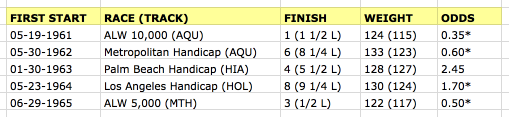
The one year Kelso won his first start back as reigning Horse of the Year was 1961, when he made his 4-year-old debut in a seven-furlong allowance race at Aqueduct, carrying 124 pounds to runner-up Gyro’s 115. “Drew out with ease,” reads the chart note.
His 1962 return in the Metropolitan Handicap was a stiffer test, with 1961 Kentucky Derby winner Carry Back among the nine starters. Carry Back, making his ninth start of the year, won brilliantly, equaling the track record time. It was the “greatest race of his career,” wrote Joseph Nichols in the New York Times of the 4-year-old’s effort. Kelso, however, coming off a lengthy layoff in which he had been recuperating from injuries suffered while finishing second in the 1961 International, was termed no threat. Carrying 133 pounds to Carry Back’s 123, the gelding “showed no inclination to run, even with Willie Shoemaker to urge him.” Of the race, Shoemaker said, “No excuses at all. That 133 pounds on him and his idleness made the difference.” In his next start, Kelso won a Belmont allowance, then finished second in the Suburban. He didn’t win his first stakes race of the year until the Stymie Handicap in September, which he followed with a win ten days later in the Woodward and another win three weeks later in the Jockey Club Gold Cup.
In 1963, off a brief eight-week rest, Kelso returned in the seven-furlong Palm Beach Handicap at Hialeah, finishing fourth to the favored Ridan, who was the runner-up to Jaipur in the 1962 Travers and a horse believed best at shorter distances. The results were considered unremarkable all around, and Kelso soundly defeated Ridan by 2 3/4 lengths in his next start two weeks later, the nine-furlong Seminole Handicap at Hialeah.
On his return in 1964, Kelso lost again, this time in the Los Angeles Handicap at Hollywood, a race in which he lugged 130 pounds to the 124 carried by winner Cyrano. “Dull effort,” notes the chart. He came back in the Californian two weeks later, finishing sixth by eight lengths as the 1.40-1 favorite.
This was the year that rumblings Kelso might be finished began, as he followed the Californian with a win in a $15,000 handicap at Aqueduct (toting 136 to the runner-up’s 114) and then seconds in the Suburban Handicap and Monmouth Handicap. In the Brooklyn Handicap, won by Gun Bow, he finished fifth by 14 lengths after stumbling badly as he came out of the starting gate. Disappointed, trainer Carl Hanford packed Kelso away for a few weeks on the farm, a respite that seemed to restore the 7-year-old gelding, who came back to win an allowance over the Aqueduct turf, and then — “in the most emotion-packed horse race since the opening of Aqueduct in 1959,” as Nichols wrote in the Times — defeated Gun Bow by three-quarters of a length in the Aqueduct Stakes, paying $6.40 to loyal backers. Second by a nose to Gun Bow in the Woodward, his next start, Kelso came back to win the Jockey Club Gold Cup by four lengths, setting two records — all-time money-earner and a new track time of 3:15 1/5 for two miles — in doing so.
From the Thoroughbred Record, November 7, 1964:
“You really think he won’t run here no more?” the fat man asked. “They said that about Carry Back and all them others, but they run again. Hell, it won’t seem like Saturday without Kelso, will it?”
Kelso was not supposed to run in 1965. The campaign he closed with an annihilating 4 1/2 length victory over Gun Bow in the 1964 International at Laurel was to be his last, but his late-season dominance had Hanford and owner Allaire duPont wavering in their plan to retire the gelding. And so Kelso, Horse of the Year for the fifth consecutive year, came back on June 29, finishing third in an allowance at Monmouth. He returned to win the Diamond State at Delaware, flashing a bit of his old form. Lightly raced that summer, the 8-year-old ended the year with an eight-length win in the Stymie on September 22, and for the first time since 1959, another horse would be named the year’s best. Or rather, two would be — Horse of the Year was shared in 1965, going to the undefeated 2-year-old filly Moccasin and Jockey Club Gold Cup winner Roman Brother.
The champion made only one more start, in a six-furlong allowance at Hialeah in March 1966 in which he finished fourth. Suffering a minor sesamoid fracture, Kelso was retired with more than $1.9 million in earnings and a career record of 63-39-12-2, his losses — and perhaps especially those incurred in his intense rivalry with Gun Bow — as much a part the story of his greatness as his many accomplishments.
Video of the 1964 International from the British Pathé archive:
From the archives: Readings: Alexander and Kelso at Aqueduct.
About
Jessica Chapel writes and edits in Massachusetts. Railbird is a Thoroughbred horse racing blog published from June 2004 to July 2019. More / Contact
Elsewhere
Find Jessica on Pinboard and Instagram, Railbird on LibraryThing and Twitter.
Etc.
Links
Search
Boston Racing
Spreadsheets/Data
Copyright © 2000-2023 by Jessica Chapel. All rights reserved.
