Preakness Stakes
The top three finishers in the Preakness Stakes were making their 10th or 11th career starts — it’s been a while since anything like that’s happened in a Triple Crown race, as Superterrific confirmed by compiling 2007-2013 results. What will be interesting to see, going forward, is how this year’s classic contenders perform over the next few months (will they stick around for fall campaigns?), and if this is the beginning of a trend toward more starts for classic prospects.
Left at the Gate posted a Preakness Stakes pace analysis that you should read in full, but the upshot is that on a slow track Oxbow:
… was a running fool and bottomed them all out, the way I see it.
Which is why Oxbow’s Preakness Beyer speed figure is 106, something Bill Oppenheim writes about in today’s Thoroughbred Daily News:
When I first saw the time of Saturday’s Preakness S. — 1:57:2/5, the slowest in 51 years … I thought the Beyer speed figure was sure to come back in the nineties. But when I looked at the times for the other dirt races — 1:10 and change for two six-furlong stakes, and 1:46 and change for and older filly-and-mare Grade III — it did look like the track was slow, and Andy Beyer confirmed there was a stiff headwind against the horses in the stretch.
Oppenheim also publishes a table (PDF), with data provided by Andrew Beyer, of the Beyer speed figures for all the Triple Crown races from 1987 to 2013 (minus this year’s Belmont Stakes, of course), documenting the decline in figures over those years, and in particular, the sharp decline in figures over the past five years, especially in the Belmont Stakes. “That has to be the result of lack of stamina in pedigrees,” Beyer tells Oppenheim.
Trends in breeding can’t be ignored, but the data suggest that there may be additional factors at work, such as changing training practices and the elimination of routine steroid use. If you look at the Belmont Stakes figures, until 2005, the Belmont speed figures are generally in line with or higher than the figures for the Kentucky Derby and Preakness. Starting in 2006, the Belmont Stakes figure is consistently lower than both the Kentucky Derby and the Preakness figures; from 2006-2012, no Belmont winner earns a higher Beyer than the winner of the Derby or the Preakness.
The most striking thing about the table, though, is that Belmont Stakes figures essentially collapse in 2008. That was the year Da’Tara earned a 99 after Big Brown faltered; no winner has been given better than 100 since. It may be chance, but the period beginning with 2006 coincides with a fresh-is-best training approach to the Triple Crown and a string of Kentucky Derby winners with two preps, and the period beginning with 2008 coincides with a Kentucky Derby winner weaned off Winstrol and an industry-wide steroids ban.
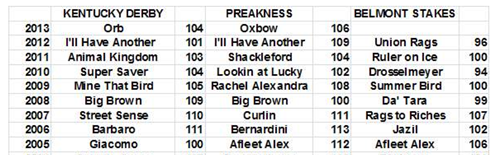
3:45 PM Addendum: Dick Jerardi explains how the 106 given Oxbow was determined: “The key horse in the Preakness was Itsmyluckyday …” (He was given a Beyer of 103 for finishing second.)
Post-Preakness, Marc Attenberg started a conversation on Twitter about the historical significance of Orb’s off-the-board finish by asking:
Last time a sub even-money Derby winner failed to hit the board in the Preakness? Not in 20 years or more? Anyone got the answer?
Swale was the answer. The 1984 Kentucky Derby winner, running second for much of the Preakness to pacesetter Fight Over (who held on for third), failed to kick in the stretch and finished seventh as the 4-5 favorite, beaten seven lengths by Gate Dancer (fifth in the Kentucky Derby*). Steven Crist, reporting for the New York Times, described Swale’s stunning defeat as:
the worst by any odds-on favorite in the history of the Preakness and the worst by any favorite since First Landing finished ninth in 1959.
No excuses were made for Swale, who would win the Belmont Stakes. “It was the consensus of most of us in the barn,” the colt’s groom Michael Klein wrote in his memoir, Track Conditions:
that Swale was running the race only because the Preakness was a jewel in the Crown, and to fulfill a theoretical obligation, he had to make a showing. The last jewel — the Belmont Stakes — was much more to his taste, both in terms of distance and quality of racing surface.
We’ll find out in a little less than three weeks, if Orb starts in the Belmont, whether the same can be said of him.
Below, Preakness winners and beaten Kentucky Derby winners, 1984-2013:
Preakness winners 1984-2013, where they finished in the Kentucky Derby, and their Preakness odds / Kentucky Derby winners, where they finished in the Preakness, and their Preakness odds / * = Preakness post-time favorite
Worth noting — Oxbow is the highest-priced Preakness winner of the past 30 years, confirming that the second leg of the Triple Crown hasn’t been the best race to look for longshots (the Belmont, though, is another matter).
*Fourth, actually, but the eccentric colt was disqualified and placed fifth for interference. It was the first DQ in Kentucky Derby history.
Oxbow spoiled nothing winning the Preakness, writes Bill Dwyre, because he put trainer D. Wayne Lukas back in the spotlight:
In this age of owners looking for quick prominence and quick return on investment, a Triple Crown winner offers a nice temporary buzz before disappearing into the breeding shed. Lukas coming back, with plenty left in the tank, should have his sport counting its lucky stars.
It has been a few years since Lukas was at the center — the last Triple Crown race he won was the 2000 Belmont, with Commendable.
If Orb’s Kentucky Derby victory was a win for the old school, then Oxbow’s Preakness Stakes upset was a win for the old timers.
“The experience thing is huge in these races,” said trainer D. Wayne Lukas, 77, speaking of the Triple Crown series at Pimlico on Friday. “And [the Preakness] may be more of a jockey’s race than the other two.”
Gary Stevens, 50, proved his point. The Hall of Fame jockey, who came out of a seven-year retirement in January, let Oxbow settle in front and lead through an opening quarter of :23.94 and a half in :48.60 (chart).
“At the half-mile pole, I said, ‘Are you kidding me?’”
The race was over. Orb was on the inside, looking uncomfortable and too far off the pace. He finished fourth, nine lengths behind the winner. Itsmyluckyday and Mylute, on the outside, rallied for second and third.
Oxbow’s final time was 1:57.54, the slowest since Carry Back’s in 1961. The time might not be notable, but the win is for another reason — Oxbow gave Lukas his 14th score in a Triple Crown race, the most of any trainer in history.
“I get paid to spoil dreams,” said Lukas.
“I’m disappointed, but I know how the game works,” said Shug McGaughey. (Let’s pause for a moment to mourn Orb’s lost crown along with his trainer.)
As for the Belmont Stakes? The Preakness winner is likely. The Kentucky Derby winner is possible. And trainer Todd Pletcher is considering a filly or two.
5/19/13 Addendum: David Grening has a terrific bit of detail on how Stevens rode in this year’s Preakness: “Stevens said he tried the same move he made all those years ago with Winning Colors, attempting to bust the race open with three furlongs to go.” (Winning Colors going wire to wire in the 1988 Kentucky Derby was pretty great.) Oxbow earned a Beyer speed figure of 106.
About
Jessica Chapel writes and edits in Massachusetts. Railbird is a Thoroughbred horse racing blog published from June 2004 to July 2019. More / Contact
Elsewhere
Find Jessica on Pinboard and Instagram, Railbird on LibraryThing and Twitter.
Etc.
Links
Search
Boston Racing
Spreadsheets/Data
Copyright © 2000-2026 by Jessica Chapel. All rights reserved.
