Statistics
March 30, 2019 Update: Hello, and thanks for visiting. If you’ve landed on this page via Horse Racing Datasets, or after reading “The Skeptical Handicapper,” by Barry Meadow, please note that while the post below was published in 2010, the spreadsheets referred to have been updated through 2017. You can view the current Google Doc or download an Excel file.
– – – – –
Noting that Kelso went to post as the favorite in four out of five of his returns as reigning Horse of the Year, commenter o_crunk remarked:
It makes me wonder if returning champions who go off favored in their return beat the average win percentage of favorites?
It turns out that, yes, favored returning champions do beat the average.
Champions from 1971-2008 (excluding steeplechase horses) made 210 first starts back the year after being honored, going to post favored in 177 of those races (84%) and winning 105 times (59%), a rate well above the standard 33.3% (or the 2009 average of 36.6%) As usual, the public is astute: All returning champions averaged odds of .97-1, but favored returning champions averaged odds of .68-1. Betting $2 to win on each favored champion would have returned $321.10 $285 to $354 wagered.
(View the spreadsheet/download the spreadsheet.)
A few observations based on quick analysis:
Thirty-nine champions returned in ALW/AOC company, winning 26 (66%) of those races. No champion not favored — with the exception of 2008 juvenile champion Midshipman, returning in a 2009 Belmont AOC — won at this level.
Fifty-two champions returned in ungraded stakes, winning 30 (57%) at average odds of .84-1. Only two, out of five, not favored won, but betting $2 to win on those five would have returned $13.20 to $10 wagered.
Most champions returned in graded stakes, winning 49 (41%) of 119 starts. Of the 98 that were favored, 44 won (45%) at average odds of .80-1.
Including Rachel Alexandra, returning Horses of the Year since 1971 (see chart below) made 20 starts. Favored in 19 races, they won 15 (79%) at average odds of .40-1. Betting only favored HOTYs would have returned $41.40* for $38.
*Only with a little luck would a player be on the plus side. John Henry, the highest-priced favored returning Horse of the Year, finished second in the 1982 Santa Anita Handicap and was bumped to first by the disqualification of Perrault. If the results had stood, favored come-back HOTYs would have won 14 (74%) out of 19 starts and returned $36.80 for $38.
Congratulations to Linda Rice on securing the 2009 Saratoga training title with 20 winners, one more than runner-up and six-time title holder Todd Pletcher, with one race remaining in the meet. The honor is a first for the conditioner, who started her stable in 1987 and currently has 50 horses, and for racing history — Rice is the first woman to win a training title at Saratoga or, it’s believed, at any major thoroughbred track.
Final numbers below:
A couple things to note about the stats, not least how well Rice did with a smaller barn largely filled with NY-bred turf horses. She sent out slightly more than half as many starters as Pletcher and yet still scored a win percentage almost twice as high, and did so with all of her wins coming in races carded for the grass. And while Pletcher placed and showed 28 and 20 times, Rice did so four and eight times — her stock was well spotted and ready, for the most part. As for money, Pletcher earned considerably more, racking up purses totaling $1,403,043 (through September 6) compared to $784,779 for Rice, but on average, each Rice starter earned $11,053 compared to $10,961 for each Pletcher starter. Rice was also good to bettors, with an ROI of $2.84 and a median price of $7.20; Pletcher delivered a mere $1.39 and $6.70.
“Maybe if some people notice that I can make my horses effective with what I have, maybe I’ll get the opportunity to train better horses,” said Rice last week. Here’s hoping that after what she’s achieved this summer, and more than proving her abilities, the trainer gets the opportunity she seeks.
Kentucky Derby 2009 bump chart, from Charts and Graphs:
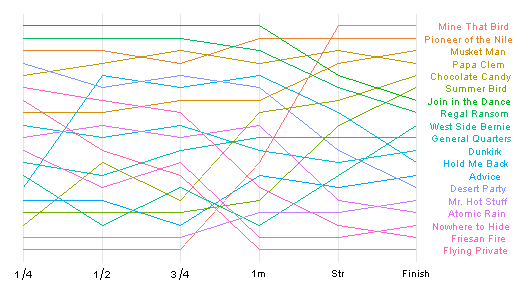
Created with ggplot2 for R. More from Learning R on its construction.
Mine That Bird’s rail dash looks no less improbable graphed, while Pioneerof the Nile’s even run looks better. Too bad there’s no Trakus data, which would make for a busier, but surely richer and more revealing, chart.
Noticed while skimming the Derby PPs, updating the historical criteria chart …
– Since 2002, every Derby winner has worked a bullet in their penultimate or final workout; since 1998, eight of 11 winners have done so. (Kennedy, helpfully, has real stats on this.) This year, six starters have bullet works: Friesan Fire, Regal Ransom, I Want Revenge, Atomic Rain, Dunkirk, and Summer Bird. The last time Friesan Fire worked a bullet was before winning the Louisiana Derby; Dunkirk has worked three straight bullets since the Florida Derby. The anti-bullet? Pioneerof the Nile: In his four works at Santa Anita listed on the pps, every one was the fastest or second-fastest at the distance. His two works at Churchill were fourth and eleventh, both at five furlongs.
– The game of musical jockeys continued through Tuesday, ending with 10 rider changes — seven of those new pairings: Chocolate Candy (Mike Smith), Desert Party (Ramon Dominguez), General Quarters (Julien Leparoux), Mine That Bird (Calvin Borel), Mr. Hot Stuff (John Velazquez), Nowhere to Hide (Shaun Bridgmohan), Flying Private (Robby Albarado). That’s the most since 2003, when six horses, all longshots, went to the post with new riders. Between 2003-2008, 22 horses, none at final odds of less than 10-1, started with new riders on Derby day. Of those, none won, and only two — Bluegrass Cat, second in 2006, and Imperialism, third in 2004 — finished in the money.
About
Jessica Chapel writes and edits in Massachusetts. Railbird is a Thoroughbred horse racing blog published from June 2004 to July 2019. More / Contact
Elsewhere
Find Jessica on Pinboard and Instagram, Railbird on LibraryThing and Twitter.
Etc.
Links
Search
Boston Racing
Spreadsheets/Data
Copyright © 2000-2026 by Jessica Chapel. All rights reserved.
