Triple Crown
Byron Rogers in Thursday’s TDN (PDF):
Without milkshakes and steroids the horses that have been selected for and trained as “classic types” by bloodstock agents, owners and trainers are now exposed for the sprinters that they genetically are.
I speculated about something similar in 2013, after Oxbow won the Preakness Stakes in a slow time and Bill Oppenheim brought up the trend of declining Beyer speed figures in the spring classics. Commenting on the Belmont Stakes figure collapse that began with Da’Tara in 2008, I wrote:
[T]he data suggest that there may be additional factors at work, such as changing training practices and the elimination of routine steroid use.
Rogers reports data, in the form of a genetic study done by his pedigree consulting practice on 1500+ horses, that found “the North American breeding population has the second highest percentage of horses that have been genetically selected for sprinting,” and concludes that there’s no reversing that trend, which began decades ago, without “significant structural changes.” If that happened, in his view, the game likely wouldn’t see a renewed emphasis on breeding for distance expressed in speed figures for at least 15-20 years. That’s probably more time than interests the market.
For a sense of how much things have changed (beyond the classic races), consider these statistics tweeted by @o_crunk last fall (via Sid Fernando):
Percentage of US races longer than 1M on dirt and synth:
1991 – 19.91%
1996 – 16.78%
2001 – 15.57%
2006 – 14.31%
2011 – 13.46%
Percentage of US races on dirt and synth at 6F or less:
1991 – 54.24%
1996 – 51.30%
2001 – 50.31%
2006 – 50.58%
2011 – 49.71%
Percentage of US dirt and synth races at less than 6F:
1991 – 13.27%
1996 – 15.15%
2001 – 17.92%
2006 – 21.60%
2011 – 23.25%
So, shortening the Kentucky Derby to nine furlongs from 10, and the Belmont Stakes to 10 furlongs from 12, as Oppenheim suggests in his most recent column (PDF), would more closely align the classic races with the realities of contemporary American racing and breeding. Whether that’s a worthy goal or not, I’ll leave to breeders and pedigree experts to debate.
The way the Preakness Stakes is shaping up, California Chrome won’t meet many of those he beat in the Kentucky Derby again until the Belmont Stakes. That’s the race the Derby winner is most vulnerable, writes Sam Walker:
It is hard to be positive about the Belmont after [his Derby] run. Off such an ideal pace it would have been nice to see that margin of superiority extend ever further to the line, or at least hold true. But the fact is it diminished and over another furlong he might not have won.
The last Belmont quarter can be a killer. Just look at the recent sectional times:
Days before the 140th Kentucky Derby was run, Steve Coburn, the co-owner and breeder of California Chrome, made a prediction: “With a good break and a clean trip,” he said, “I think it’s a done deal.”
What was brash on Wednesday became fact on Saturday, as the Derby field rounded the stretch turn and the 5-2 post-time favorite put his head in front and then began to draw away. He got a clean break. He got a clean trip. (The same can’t be said of several other Derby starters.) He even got a reasonable pace to rate off when Uncle Sigh, wearing blinkers for the first time, took the early lead from Chitu and ran the first three-quarters in 1:11.80 (chart).
What he didn’t get was a triple-digit Beyer speed figure for winning the Derby. With a final time of 2:03.66, California Chrome was given a 97, “the lowest for any Derby or Preakness winner since Andrew Beyer has been making figures,” tweeted Randy Moss. His TimeformUS figure also came up slow — chief figuremaker Craig Milkowski gave him a preliminary 104. Both numbers are well off his previous 108 Beyer and 113 TFUS highs. [5/5/14 Update: TFUS has since revised his Derby figure to 110.]
Maybe that the Derby came up slow is part of a trend toward lower figures in classic races, but it was more likely a strong wind. Gene Kershner notes:
[There] was a fairly strong headwind going against the runners down the stretch, which when counting the first run to the clubhouse turn is approximately 40% of the race running …
Byron King also points out that the track (DRF+):
… appeared much drier than for early races and may not have been as well watered as it had been earlier in the day. There was a gap of 2 hours, 43 minutes from the preceding dirt race, the Churchill Downs Stakes.
The Derby fractions from DRF Formulator are interesting:
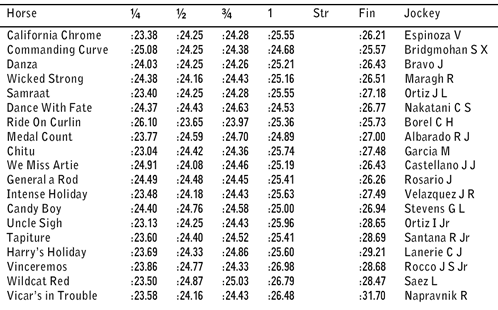
Runner-up Commanding Curve and seventh-place finisher Ride on Curlin are the only two running sub :26 final quarters, despite the moderate early pace. It’d be easy to be disappointed by California Chrome’s closing :26.21, except the fraction doesn’t match the visual. Watching the replay, he accelerates to take the lead at the top of the stretch, then jockey Victor Espinoza eases up (and puts away his whip) in what looks like a comfortable final sixteenth:
It was an utterly dominant performance not accurately measured by the final margin; California Chrome drew out to a five-length lead with less than an eighth of a mile to run before jockey Victory Espinoza geared him down, rising in the irons two strides before the wire and waving his crop in the air, much as he had done aboard War Emblem 12 years ago.
Going into the Preakness, there’s a case to be made that California Chrome comes out of the Derby a more formidable contender for the second leg of the Triple Crown in two weeks — after his big efforts winning the San Felipe and Santa Anita Derby, the Kentucky Derby wasn’t a peak performance, at least as expressed in figures. Maybe it didn’t need to be.
Much will depend on how the colt does over the next two weeks and who shows up at Pimlico. Trainer Art Sherman said on Sunday that California Chrome came out of the Derby in good shape, although he did leave a “handful” of grain in his feed tub and that, “He got a little tired, but not too bad.” Alicia Wincze reports his condition as “feisty” this morning.
The Derby winner will stay at Churchill Downs for a few days before heading to Baltimore. His schedule won’t be taxing. “We can light train him over here for a couple of days, kind of just jog him,” Sherman tells Jennie Rees.
Coburn is already looking ahead, past the Preakness, to the Belmont Stakes, his confidence confirmed. California Chrome was the first California-bred to win the Kentucky Derby since Decidedly in 1962. “When he wins the Triple Crown,†said Coburn, “he’ll be the first California-bred to do it.”
– – – – –
About those bad trips … Candy Boy was hard checked on the first turn after fourth-place finisher Wicked Strong crossed his path. Rider Gary Stevens was none too happy after the race, as quoted by the Churchill Downs press office:
“I had a horrible trip. On the first turn Rajiv Maragh came over on Wicked Strong and shut me off. Then he shut [Corey] Nakatani off, causing me to steady again. We’re both lucky we didn’t fall.”
Nakatani was on Dance with Fate, who recovered enough to finish sixth. Candy Boy was 13th; the race is a throw-out for him, whenever he starts next.
Third-place finisher Danza also interfered with Medal Count, veering into his path in the stretch. Sid Fernando helpfully illustrates.
About
Jessica Chapel writes and edits in Massachusetts. Railbird is a Thoroughbred horse racing blog published from June 2004 to July 2019. More / Contact
Elsewhere
Find Jessica on Pinboard and Instagram, Railbird on LibraryThing and Twitter.
Etc.
Links
Search
Boston Racing
Spreadsheets/Data
Copyright © 2000-2023 by Jessica Chapel. All rights reserved.
