Triple Crown
Early Kentucky Derby fave Uncle Mo has been branded by owner Mike Repole as a Great One, and in that, at this stage in the colt’s career, he’s less reminiscent of Seattle Slew — a Repole-favored comparison — than he is of Man o’ War, the most lauded horse of the early 20th century, still counted among the top three of all-time by most racing historians.
Much as the superlatives have been heaped on Mo, anointed this year’s Triple Crown hope, so the praise was on Man o’ War. The excitement for the Fair Play colt built early during his 2-year-old campaign, and was barely slowed by his famous half-length loss to Upset in the 1919 Sanford Stakes. At the end of the season, in which he went 9-for-10, often carrying a highweight of 130 pounds, the colt was deemed the greatest juvenile to have ever appeared in in the country. After Man o’ War won the 1920 Preakness Stakes, in his first start of the year, the argument began in earnest over whether he was greatest American thoroughbred ever to run, and it became something of a challenge to find starters willing to face the 3-year-old star. In his 10 starts following the Preakness, he never raced against more than three others. In several, such as the Lawrence Realization Stakes in which he set a world record of 2:40 4/5 for 1 5/8 miles, he raced against only one other.
Man o’ War, by this time frequently called “the horse of the century,” handily defeated 1919 Triple Crown winner Sir Barton in his final start, the 1920 Kenilworth Park Gold Cup, but few of his competitors from that year have names still familiar. In a bit of historical who’d-he-beat, the sparse fields of Man o’ War’s sophomore season have become reason to question his standing.
In his favor, though, Man o’ War never shirked. He was pointed to the top stakes of his time — among his wins are the Belmont Stakes, Travers Stakes, and Jockey Club Gold Cup — and he could only run against those with connections brave enough to face him. He was put into conditions to be tested. To say he was great wasn’t a mere opinion — it was a truth, as defined by what he consistently accomplished at the highest level.
With luck, Mo has many races ahead. He’s undeniably talented and fast, and his name, before long, may join the greats his record and speed so far recall. But there’s a difference between Uncle Mo and Man o’ War, between him and so many others cherished as great ones, and it’s not only his owner’s fervent, public dream for the colt’s near future, accepted by so many:
Uncle Mo may, indeed, be the next Seattle Slew and live up to the lofty expectations placed on him. The words Triple Crown were uttered here all afternoon by rival trainers, pedigree experts and breeding farm owners who are tracking the Uncle Mo camp as if they were coaches sizing up a basketball recruit. Every farm in central Kentucky wants to be the one to land the breeding deal for the first Triple Crown champion since Affirmed in 1978.
“I think the great ones know they’re great,” said Repole after Uncle Mo won the first running of the ungraded one-mile Timely Writer at Gulfstream. The great ones also prove their greatness on track, and not in races written for them.
Hong Kong is losing out to offshore bookies. “Engelbrecht estimates annual revenue for illegal bookmakers from Hong Kong horse races is equivalent to between one-third and 100 percent of the Jockey Club’s receipts.”
With ESPN’s exit, NBC is poised to pick up the Belmont Stakes.
Sounds as though Bill Mott should look for a new rider for To Honor and Serve: “I would be pretty surprised if Johnny would not be riding Uncle Mo.”
Bob Baffert says he’ll wait until the 1 1/16-mile San Felipe Stakes on March 12 to start Jaycito. “I don’t want to run him short.”
What the Life at Ten debacle could mean for the NTRA Safety Alliance.
Andrew Beyer sees potential in new microbets, although he’s not wild about the lottery-like Gulfstream Rainbow Six. “It is, in my view, a sucker bet.” Is the new Pimlico Slider less of one, with its four-race sequence, 50-cent minimum, 18% takeout, and a “staggering” number of combinations?
In a morning matinee at a downtown Boston multiplex, I watched “Secretariat” on Saturday, and as Vic Zast wrote last month in his informal review of the film, “I couldn’t wait for it to end.” I knew, going in, to expect schmaltz and historical inaccuracies. I didn’t expect to be bored.
Plenty has been written elsewhere, so I’ll only make a couple observations:
Several reviewers have noted as inaccurate an early scene in which horses are saddled in the barn area, horse laundry and manure pits in the background. I don’t believe that was an error — for a movie about the well-to-do and the well-bred, in which the final, stirring scene ostensibly takes place at one of America’s grandest tracks (and was actually filmed at one of the prettiest), “Secretariat” goes to great lengths to show Penny Chenery and the rest of the characters in rundown or rough settings when they’re on track. Paddocks are of brick and concrete, backstretches lined with tractors and sheds, tunnels dank. The racetrack visuals in “Secretariat,” minus those of the Churchill Downs clubhouse and Kentucky Derby winner’s circle, overwhelmingly create an impression of the track as primarily a working class milieu, bolstering the film’s portrayal of Chenery as a scrappy everywoman.
I’ve been trying to figure out what exactly wasn’t quite right about the racing scenes — other than the gimmicky angles and strange lack of energy — and think it has something to do with the sense of smallness that pervaded the movie. Everything about the story — the low stakes, the settings, even Secretariat — came off as minor and incidental. Nothing was ever truly at risk.
I did appreciate one touch of authenticity. When Lucien Laurin returns to his car after meeting Chenery for the first time, he pulls from his trunk a book and flips to an ad for The Meadow. He’s looking at the “Blood-Horse Gold Anniversary Edition,” published in 1967; the ad appears on page 488.
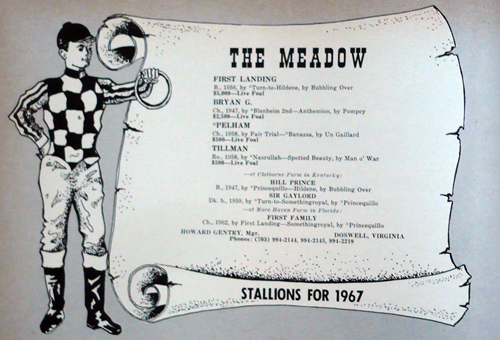
10/12/10 Addendum: Bill Doolittle nails one thing the movie did well: “The movie isn’t just true to the tale, it’s true to the turf, getting just right the special dynamic that exists between the people of horse racing — the trainers and owners and jockeys and fans — and the horses.”
10/15/10 Addendum: But Steve Davidowitz expresses more of my feeling re: the movie, days after viewing: “At the bottom line, those of us who love racing for the uniqueness of its champion horses and for its beautiful venues and for the sheer pleasure of playing the best game man has ever invented, will have to swallow down hard to go with the flow of this distorted, over hyped waste of a great cinematic opportunity.”
About
Jessica Chapel writes and edits in Massachusetts. Railbird is a Thoroughbred horse racing blog published from June 2004 to July 2019. More / Contact
Elsewhere
Find Jessica on Pinboard and Instagram, Railbird on LibraryThing and Twitter.
Etc.
Links
Search
Boston Racing
Spreadsheets/Data
Copyright © 2000-2023 by Jessica Chapel. All rights reserved.
