Simulcasting Expires
Because state lawmakers couldn’t agree on how long to extend the Massachusetts simulcasting law and track owners couldn’t agree on the number of races each was allowed to show, the legislature adjourned Friday without renewing the simulcasting law, which means simulcasting expired in the state at midnight Friday. Up to 80 employees may be laid off from Suffolk Downs, which will be closed at least through Monday, and Massachusetts racing fans won’t be able to bet on Saturday’s Florida Derby at either Suffolk or Plainridge.
Slots and simulcasting are closely linked in the state right now, and some slots supporters think that the simulcasting shutdown will put pressure on House members to vote yes when the slots bill comes up for debate on Wednesday. Revere representative Kathi-Anne Reinstein sees just such a political silver lining in the situation:
”It’s going to bring more people to the State House to show people that they need to be employed,” Reinstein said. ”There’s no other way to do that than to have them out of work.
”I never hoped it would come to this, but, now that it has, I want everyone at the State House,” she continued.
Suffolk spokesman Chip Tuttle said the Florida Derby is usually a big day, with more than $1 million wagered, and expressed concern for workers:
”There are lots of employees who live paycheck to paycheck, and the idea that they’re going to be out of work for four or five or six days, with no certainty of when they come back to work, is disturbing,” he said. ”They’re very disappointed.”
When House speaker Sal DiMasi called Massachusetts racing a “dying industry” he was right. Look at the the revenue numbers for 2002-2004: Every source of handle is in decline. And when union representative Louis Ciarlone asserts that the industry isn’t dying, “it’s an industry that’s being killed,” he’s right too. Until the simulcasting bill is renewed by the legislature, significant dollars will be lost by tracks that can ill afford to lose any money. But there’s plenty of blame to go around. As this latest snafu illustrates so well, the state’s racing industry is doomed as much by the track owners as it is by the lawmakers.
Mass. Slots Watch
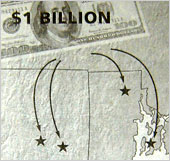 With April 5 set as the date for the Massachusetts House to debate a slots bill passed by the Senate last fall, both sides are advocating their positions with increasing vigor. The New England HBPA and the track employees’ union took out a quarter-page ad on the Boston Globe editorial page this morning (click the image to view the ad in full) that iterates the argument that gambling money leaving the Commonwealth now could be recaptured, while House speaker Sal DiMasi has officially come out as a slots opponent. The Boston Herald reports that the speaker’s “top lieutenants” are pressuring individual lawmakers to vote no on the bill: “The fix is in. It’s just like the old days,” said one Beacon Hill insider. “The word has gone out. He doesn’t want it.”
Speaking to the Greater Boston Chamber of Commerce today, DiMasis said, “I look at what has been going on in the racing industry, and it seems to be a dying industry,” and predicted that the slots bill would be defeated in the House. “I don’t think the support’s there that people think there is.”
That DiMasi has broken the silence he’s maintained on the slots issue for the last 18 months with such strong statements this week has deflated slots supporters who thought there was a strong chance for the bill to pass this year:
”If this is a vote that’s free and clear, we do have the votes to win it on the floor,” said Representative Kathi-Anne Reinstein, a Revere Democrat whose district includes Wonderland. ”If there is influence, of course, we lose.”
Supporters estimate that 90 out of 160 legislators in the House may vote yes on the bill, which falls short of the 106 that’s needed to override governor Mitt Romney’s expected veto. But it’s likely overriding a veto won’t be a concern after April 5. If the influential speaker of the House predicts that a bill won’t pass, “you can pretty much well … bet on it not passing.”
More: Slots legislation archive
Mass. Slots Watch
More than 100 racetrack employees, horse owners, and local politicians rallied in front of the Massachusetts State House on Monday in support of a bill passed by the Senate last fall that allows up to 2,000 slot machines to be installed at each of the state’s four racetracks and which has languished in the House since. Legislators are meeting today to set a date “to formally debate” the bill, which was to have been voted on in March according to an agreement made last December. It’s now expected that the legislature will take action on April 5, a delay that’s angered some slots supporters.
More slots links: Suffolk Downs is now maintaining a news page with links to relevant articles from newspapers across the area.
Mass. Voters Back Slots
Massachusetts racetrack owners could get the slots they wish for this spring. The state Senate passed a bill allowing slots machines last fall, and a vote on the issue is due to come up in the House next week. Supporters claim a narrow majority in the House, with an estimated 86 of the 160 members ready to say yes to slots (although, it must be noted, that’s not enough to override governor Mitt Romney’s anticipated veto). Even Massachusetts voters are getting on the slots bandwagon. According to a Boston Globe poll:
Fifty-three percent of voters surveyed said they were in favor of legalizing slot machines, and 41 percent said they were opposed, while 6 percent said they were neutral.
The poll also showed that out-of-state travel (to casinos like Foxwoods and Mohegan Sun in Connecticut) for the purpose of gambling is quite real:
Nearly a third of all respondents said they had traveled outside Massachusetts in the past year specifically to visit a casino or gaming facility.
While things are looking good for those who favor expanded gaming, the outcome of the House vote — whenever it’s scheduled — is hardly certain. Anti-gambling state representative Dan Bosley “is rallying his troops” to stop the legislation, and House speaker Sal DiMasi’s attitude towards slots could be called noncommittal at best.
—
Racetrack employees are planning a rally at the State House next Monday to show support for the slots bill.
—
More on slots from the 3/16 edition of the Boston Globe: An opinion piece by Steve Poftak argues that the proposed $25 million licensing fee each track would have to pay to install slots is too low:
If we assume that each slot machine generates revenues at a rate of $285 per day, which was the figure used by the Maryland Legislature during their deliberations on a similar casino bill, the net present value of income, after the state’s share and expenses, tops $600 million. This suggests that a recurring fee of $85 million per license would be closer to the true value.
Poftak makes a lot of the same points that an article in the Boston Herald did a couple of weeks ago, which also took note of what happened in Pennsylvania, where slots licenses were granted for a $50 million fee:
… some of the world’s biggest gambling companies have since paid hundreds of millions to gain control of the tracks and the slot licenses — far more than the $50 million charged to the state. The winners, in these cases, were not taxpayers, but racetrack owners who benefitted hugely because the industry bid up the value of their gaming licenses.
That sounds like bad news for taxpayers, but is it for racing?
Slots May Have a Shot
Massachusetts slots supporters believe legislation allowing the machines at the state’s four racetracks has the best chance of passing in years:
“My sense of this vote is we have a really good chance — the best chance we have ever had,” said Louis Ciarlone, president of Local 123 of the International Brotherhood of Electrical Workers, which represents 200 Suffolk Downs workers. “This is the World Series.”
A vote on the slots bill passed by the Senate last fall (or one very like it) has been scheduled in the House for the week of March 20. The Senate bill was approved by a veto-proof majority; the same is not expected of the House vote.
More: Opponents worry slots will infringe on lottery revenue:
State Treasurer Timothy P. Cahill, who opposes slot machines at the racetracks, said it’s an open question how much the lottery would be affected. But he’s convinced it will suffer.
A report from Christiansen Capital Advisors in January concluded that it wouldn’t.
About
Jessica Chapel writes and edits in Massachusetts. Railbird is a Thoroughbred horse racing blog published from June 2004 to July 2019. More / Contact
Elsewhere
Find Jessica on Pinboard and Instagram, Railbird on LibraryThing and Twitter.
Etc.

Links
Search
Boston Racing
Spreadsheets/Data
← Home
Copyright © 2000-2026 by Jessica Chapel. All rights reserved.