Aqueduct, Saturday
All that’s great and terrible about racing was fully on display Saturday. The great, of course, was Horse of the Year Invasor overcoming a troubled trip to win the Donn Handicap by two lengths. The terrible was the ugly accident in Aqueduct’s fifth that left two horses dead and one jockey injured.
Every breakdown is shocking, but Cadillac Cruiser’s was especially disturbing. A 5-year-old gelding with a record of 15-6-3-0, Cadillac Cruiser was running for $7500 three weeks after finishing fifth as the favorite in a $25,000 starter handicap. He’d won at the same level two weeks before and won a $35,000 claimer five weeks before that. On Saturday, though, he was running for a fifth of his value. The connections were offering what looked like a competitive horse at a rock-bottom price, and the reason for that was suggested by the front bandages Cadillac Cruiser showed up in the paddock wearing for the first time in all his starts in trainer Rene Araya’s barn: The gelding was sore or getting there, and owner and trainer wanted to unload him fast.
That Cadillac Cruiser would break his right front leg and fall in front of the pack going around the clubhouse turn and that another horse, Jimmy O, would fall over him, dying instantly of a broken neck, was hardly the guaranteed outcome of his starting on Saturday, but it also wasn’t an entirely unpredictable risk. If any good can come of Saturday’s sad spectacle, let it be that track officials and vets ask more questions when horses drop so precipitously in class and that such horses are given more pre-race scrutiny.
Small Change, Big Difference
There’s something different about Santa Anita’s saddle cloths this year:

The numbers are strikingly sharp and legible. Slightly larger than those on most saddle cloths and in a typeface that’s crisp and heavy, the numbers are now much easier to pick out while watching races, even when the field’s running down the backstretch.
Weeks Have Passed
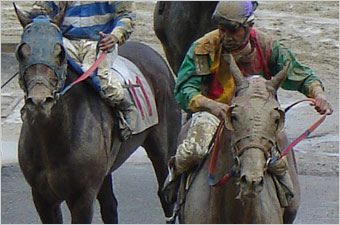
Since I last posted, but I have a great excuse: A new job, at a certain racing publication, for which I and the racing companion must relocate to New York in a few days. So, things have been busy around here, although time was found this weekend for a visit to a muddy, messy Suffolk Downs on Saturday:
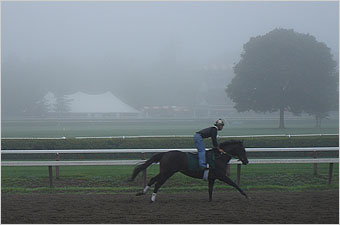
And a quick trip to Saratoga, where I watched horses work in the fog Monday morning:
Regular posting will resume, eventually. In the meantime, I highly recommend my fellow TBA bloggers and an exciting new venture from Alan of Left at the Gate: Racing Saratoga.
Paying for Housing
I lived in one of the backstretch dorms at Saratoga last summer, sharing a 9 x 11 room with two other women. We kept our cramped room tidy — there wasn’t enough space for anyone to get messy — but the common areas of the dorm quickly fell into filth. Muddy puddles stagnated in the moldy shower room. Trash overflowed the too small buckets placed in the bathrooms, and the toilets clogged so often that people threw their used tissue into stall corners rather than risk flushing (until the cleaning crew started leaving a plastic bag in the corner, which made the situation slightly more tolerable). The cleaning staff came intermittently — there were times they would come two or three days in a row and then then they wouldn’t come for another three or four days. The women’s dorm was also unsecured, and it wasn’t unusual to step out of the bathroom and find a man lurking in the hall.
Unfortunately, those unclean and unsafe conditions aren’t limited to the Saratoga backstretch. So, that Barbaro’s owner Gretchen Jackson is even bringing the issue up is a good thing — backstretch workers deserve safe, well-maintained housing — but Jackson is very, very wrong about who should be reaching into their wallets to pay for this housing:
“This needs to be brought out, not with the wagging of fingers at people, but more like, ‘Look what’s happening,’ ” Jackson said. “If everybody who went to the track reached in their wallet and spared five dollars instead of placing a bet and put it in for new living quarters for grooms.”
Why should bettors, who already provide for little things like purses by wagering, donate to the cause of better backstretch housing? While I’m sure many would if appealed to, housing really isn’t their concern. Those who most directly benefit from the cheap labor provided by backstretch workers — owners, trainers, and tracks — are the ones who should be reaching into their wallets and sparing some money for decent accommodations. And there should be finger wagging, lots of finger wagging: Racetrack executives should be ashamed of the barely habitable living conditions offered on many backstretches, and trainers and owners should be ashamed that the hotwalkers and grooms who labor seven days a week year round caring for their animals often live worse than those animals.
Jackson, much to her credit, has been using her recent media prominence to speak up about some of the darker issues that haunt racing — not just backstretch conditions, but horse slaughter.
Quiet, and Kind of Creepy
In other words, a typical weekday at the track:
I went out to Bay Meadows recently — my first visit to a track in years, I admit — and things were so sedate I thought I’d lost my hearing. Most bets are placed at electronic touch screens now, so there were no wishful last words or giddy collection scenes at the windows, no general clamor or charge. It was more like some horse-theme mall, with gift shops and ATMs. What I took to be Bay Meadows habitues were seated at long tables near a vacant bar in isolated cones of silence, like men at an old porno movie house, their glazed eyes trained on banks of television screens that relayed the labors of horses at distant tracks — Hollywood Park, Belmont, Churchill Downs.
About
Jessica Chapel writes and edits in Massachusetts. Railbird is a Thoroughbred horse racing blog published from June 2004 to July 2019. More / Contact
Elsewhere
Find Jessica on Pinboard and Instagram, Railbird on LibraryThing and Twitter.
Etc.

Links
Search
Boston Racing
Spreadsheets/Data
← Home
Copyright © 2000-2026 by Jessica Chapel. All rights reserved.