A Dapper Man
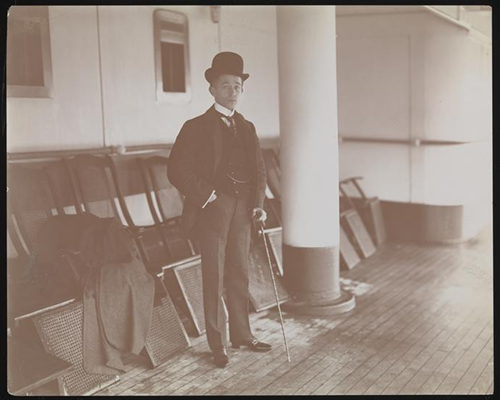
Tod Sloan, “great jockey, famed rounder, spender, one-time friend of millionaires and occasional toast of royalty,” on his return from Europe, 1898. The portrait is part of the Museum of the City of New York’s photography collection, much of which was recently published online. A quick search turns up approximately 150 photos of New York racing — including Sheepshead and Belmont racetracks — from the late 19th and early 20th century (via Kottke).
Odds and Ends
Reactions to the updated equine fatality rates released by the Jockey Club yesterday on Twitter: An experiment with Storify. If there was a theme to the chatter, or to the comments left on this post, it’s that the fatality stats aren’t enough on their own going forward. Now that we know there’s a statistically significant difference between dirt and synthetics, deeper analysis is wanted.
Horse owner Ted Grevelis raises a couple of excellent questions about the TJC stats: “If we don’t know the fatality rates at each racetrack, how can there be any action taken on the results of the study or, more importantly, how can horsemen decide where to perhaps avoid racing in the future?”
Over on R2, Dean considers where storefront OTB bettors will go, and the possibility that many will stop playing. An NYC OTB board member suggested illegal bookies would make a comeback, telling WNYC: “It’ll be a local bookmaker or, from what I understand, they now have a lot of places offshore. But it’s not gonna go away.” The AP seems to have picked up on that, reporting in passing, “That betting apparently is headed to illegal bookmakers, regional OTBs that can now handle city bets more easily, and foreign-based Internet bookmakers.” Apparently? Evidence, please, that bookies and offshores are gaining when legal ADWs and outlets are available. If NYRA does open teletheaters in the city — an opportunity arising from NYC OTB’s closure — it seems even more likely that money will stay in the pool.
A field of ten for the Hollywood Futurity on Saturday, the final graded stakes of the year for juveniles. JP’s Gusto has to prove he can go the distance.
Statistically Significant
With two years of data in the Equine Injury Database, the Jockey Club is out today with updated fatality rates. The overall rate declined to 2.0 per 1000 starts from the 2.04 reported earlier this year. By surface, the rates are 2.14 on dirt (unchanged), 1.74 on turf, and 1.55 on synthetics (down from 1.78):
Parkin noted that the change in the overall fatality rate stemmed from cumulative two-year data that revealed a statistically significant difference in the prevalence of fatality on both turf and synthetic surfaces versus dirt. The difference in the prevalence of fatality between synthetic and turf surfaces was not statistically significant.
Confirms the impression that synthetic surfaces are safer (although the usual caveats apply re: uncertainty of factors such as new track bases, improved vet checks, anecdotal reports of increased non-fatal hind injuries, etc.).
12:55 PM Update: More from Thoroughbred Times: “… horses racing on a synthetic surface were 27.6% less likely to break down …“
Raises? Yes!
Are you kidding me? Of all the things to complain about when it comes to New York racing, NYRA giving 327 non-union employees average pay raises of 3% is pretty far down the list. In any other year or any other industry, such a raise would be a run-of-the-mill annual cost-of-living increase. But in New York, and at NYRA, it’s an outrage! It’s arrogance! Especially because NYC OTB just closed! The New York Post, which breathlessly reports that “top managers” are getting raises and fraudulently invokes the specter of a state bailout for NYRA, gives space to grandstanding politician Assembly Racing and Wagering Committee chairman Gary Pretlow to denounce NYRA as “bloated” and the raises as “an irresponsible act.” The Sarotogian headlines an editorial today, “Raises? Really?” and calls NYRA “tone deaf.” Nick Kling writes:
Non-union employees may get their additional money, but in the process NYRA has generated enough bad feeling to guarantee it will come back to bite the association when it wants something in the future.
That’s absurd. Here’s the thing: 3% — or even the average 5.5% given to 10 employees — isn’t that much money. NYRA president Charles Hayward, who defended the raises as the first given non-union workers since January 2008, told the Blood-Horse that the raises will cost NYRA approximately $600,000 in added payroll next year. That works out to around $1835 a year (or $153 a month, $35 a week) per employee, which raises the average salary of those workers from approximately $60,000 a year to around $62,000 a year. That’s $62,000 in one of the most expensive cities in the world, and at a time of great challenge to NYRA — with NYC OTB closing last week, and the Aqueduct racino opening in 2011, NYRA needs to retain its workers (and it really needs its workers to feel good about their jobs) if it’s not only going to survive what’s ahead, but come out thriving. Giving end-of-the-year raises to the rank-and-file is a strategic and morale-boosting move at a crucial moment in the organization’s history. Sorry, but there’s nothing outrageous about that.
The Flying Fairy
“She’s not the biggest filly in the world … but she’s got the biggest heart in the world,” the Guardian quotes trainer Ed Dunlop saying of Snow Fairy after the 3-year-old filly won the Hong Kong Cup on Sunday by a neck with a startling display of late speed. The Telegraph estimates just how fast she was:
The split times for the Hong Kong Cup make astonishing reading. The time for the leading horse is taken every two furlongs of the 10 furlong race, and they highlight the amazing power of Snow Fairy’s stunning final flourish. The times for yesterday’s race were : 25.98s – 25.19s – 25.38s – 23.48s and 22.93s. Considering that she was a good eight lengths behind the leader at the two furlong marker, Snow Fairy must have covered the final two furlongs in around 21 seconds.
I get a stellar :21.8 timing her run from the replay:
Check out Hong Kong’s awesome “Race Running Position Photos,” which shows the filly second to last coming into the stretch (via Equidaily).
Snow Fairy is a name to know for 2011. Dunlop confirmed the globetrotting filly, who won four G1s this year in four different countries, will stay in training as a 4-year-old and could start in the Dubai World Cup.
About
Jessica Chapel writes and edits in Massachusetts. Railbird is a Thoroughbred horse racing blog published from June 2004 to July 2019. More / Contact
Elsewhere
Find Jessica on Pinboard and Instagram, Railbird on LibraryThing and Twitter.
Etc.


Links
Search
Boston Racing
Spreadsheets/Data
← Home
Copyright © 2000-2026 by Jessica Chapel. All rights reserved.