Part two of a six-part series on drugs in racing by Ryan Goldberg for the TDN considers the current, not-so-pretty situation (PDF):
It seems a trainer would have to be crazy to use illegal drugs when so many legal ones are at his disposal. Before the days of pharmacological drugs, the goal was to “hop ‘em or stop ‘em,†but what the picture looks like now is an everyday practice of using drugs to manage pain and other complications to get a horse to post. Since the majority of horses race for tags, it makes sense. “The claiming game does not protect the horse,†Scollay says. “It’s like day- trading on the stock market.â€
The respiratory drug clenbuterol, its anabolic properties, and the widely differing state-by-state guidelines for its use get particular attention; Massachusetts is among the states listed in Goldberg’s piece as offering no guidelines. That was the case through the 2012 Suffolk Downs meet — since then, though, Massachusetts has joined seven other states in adopting the Mid-Atlantic Uniform Medication Program, which allows for 24 therapeutic drugs and sets guidelines for their use, and the Massachusetts Gaming Commission began the process of incorporating the new rules in January 2013 (PDF). Under the new guidelines, clenbuterol will no longer be permitted within 14 days of racing. Corticosteroids won’t be allowed within seven days.
Posted by JC in Racing on 05/10/2013 @ 8:57 am / Tagged Clenbuterol, Drugs in Racing, Equine Health, Massachusetts, Regulations, Suffolk Downs, TDN / Follow @railbird on Twitter
Sometimes I miss the Thoroughbred Times, and not just for their reporting and analysis, but because TT staffers and contributors were some of the few in racing media who pushed back on the Paulick Report and its unethical aggregation practices. Since its launch in 2008, the Paulick Report has succeeded by publishing its own original content — and by aggregating the original work of others, rewriting and condensing that work into 1-5 paragraph summaries with a link to the original source at the end. The summaries appear on pages with comments and ads, and for most visitors, it’s one-stop racing reading. PR has been so successful with its approach that people regularly say of something that was actually published in Blood-Horse, Daily Racing Form, a major newspaper, or on a small blog that they “saw” it on the Paulick Report, giving PR credit for content it had no hand in producing.
Aggregation doesn’t have to be that way — aggregation can be ethical. Equidaily links directly to publications with headlines and short excerpts. Raceday 360 Wire — the aggregator I built, now owned by Hello Race Fans — links directly to sources with headlines and the first few words.
But there are reasons the Paulick Report way works. If you’re a visitor, it’s a convenient way to skim headlines and get some commentary or reporting you won’t see anywhere else. It has a lively community. If you’re a publisher, of any size, it’s not worth it — legally — to tangle over fair use, a hazily defined and easily abused standard. The traffic is supposed to be consolation — and for small publishers, it can be — the people who click through a PR summary to the full piece may not be as many as you’d like, but it’s probably more than would have seen your site without their link.
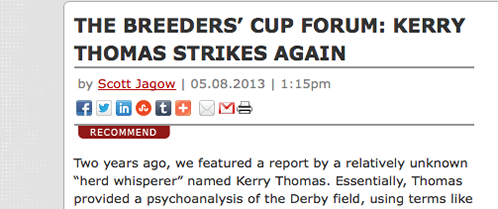
Featured: Screenshot from 5/9/13, 9:00 AM. No credit, no link to the original, and one misleading word.
It helps, too, that Paulick and company don’t usually misrepresent the nature of what they’re doing. Except, when they do, as in the opening sentence of a great interview Scott Jagow did with Kerry Thomas about his Kentucky Derby profiles. (Seriously, it’s an excellent interview with Thomas about his process and analysis. You should read it.) “Two years ago, we featured a report by a relatively unknown ‘herd whisperer’ named Kerry Thomas,” Jagow writes. What he means by “featured” is that they aggregated the report from the now defunct Kentucky Confidential (it can be read here in its entirety, if you’re interested). The report wasn’t “featured,” with all that implies about original publication and presentation — it was given the typical Paulick Report treatment. If the opening sentence of the interview reflected that accurately — if Jagow had used a word such as “linked,” or a phrase such as, “called attention to,” all I’d have to say here is, read that great interview with Thomas.
Because of that word, though, I emailed Paulick and Jagow with a request to change it. Paulick’s response to me was that since I didn’t complain about the aggregation of Thomas’ analysis for Kentucky Confidential in 2011, and agreed to a business relationship between Kentucky Confidential and the Paulick Report in 2012 (PR sold the KYC sponsorships; KYC linked to PR with a “Presented by …” banner on the header of every page), I shouldn’t protest “featured” now. But there is a difference between aggregating original work and misrepresenting the presentation of that aggregated work. The former may or may not be theft, but the latter is most certainly a lie.
5/11/13 1:50 PM Addendum: Sid Fernando, who curates a selection of daily racing “newspapers” on paper.li, thoughtfully expands on the issues of aggregation in a post today on his website.
Posted by JC in Media on 05/09/2013 @ 10:11 am / Follow @railbird on Twitter
Preakness winners 2001-2012, where they finished in the Kentucky Derby, and their Preakness odds / Kentucky Derby winners, where they finished in the Preakness, and their Preakness odds / * = Preakness post-time favorite
About a dozen have been declared as likely starters in the Preakness Stakes, with seven plus Orb coming out of the Kentucky Derby. Looking at the last dozen runnings of the Preakness, one of that group is most likely to beat Derby winner Orb (if he can be beaten). Non-Derby starters have won the Preakness only twice since 2001, both in years of exceptional circumstance.
Kentucky Derby winners have a mixed record over the period listed above, with one DNF, six losses, and five wins. Assuming Orb is the favorite in the Preakness as he was in the Derby, the odds tilt back in his favor with the performance of Derby favorites as Preakness favorites since 2001 — three of the four in that group (Point Given, 1.80 KYD; Smarty Jones, 4.10 KYD; Street Sense, 4.90 KYD; and Big Brown, 2.40 KYD) won the second leg of the Triple Crown. Street Sense finished second to Curlin, the eventual 2007 Horse of the Year. All to say, if you like Illinois Derby winner Departing for the Preakness upset — well, you have to hope Orb’s former Claiborne pasture buddy proves exceptional in more ways than one.
Posted by JC in Racing on 05/08/2013 @ 12:19 pm / Tagged Favorites, Kentucky Derby, Odds, Orb, Preakness Stakes, Triple Crown, Wagering / Follow @railbird on Twitter


