Handicapping
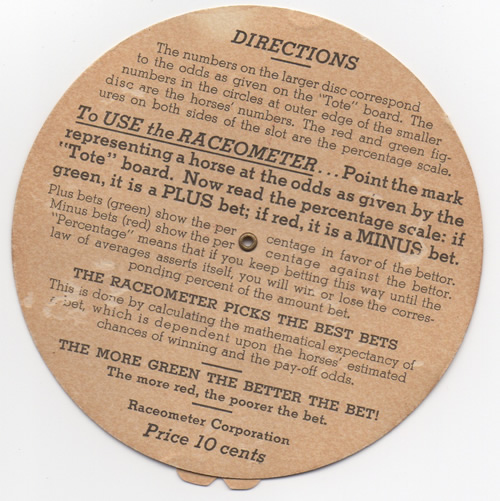
Bill Christine’s search for a Kelco put me in mind of my favorite piece of handicapping ephemera, a volvelle for assessing value called the Raceometer:

“The more green the better the bet!” Handy, but at 10 cents a race, pricey.
I’ve been on the lookout for more Raceometers, but all I’ve found so far is a similarly named wheel chart, the Race-o’Meter (note the odd apostrophe), produced by the Southern California Research Company in 1948:

Unlike the Raceometer, a tool for betting, the Race-o’Meter considers eight factors to create individual horse ratings. “Be sure you have a racing form before you when use you the Race-o’Meter,” advises the instructions:

It’s science! Beginning in the 1930s and continuing into the 1970s, “scientific” and “scientifically” were favored adjectives of marketers hawking handicapping systems and methods. In 1933, as defined in “Systology: The Science of Wagering Upon Horse Races,” a compendium of eight chart-heavy betting systems, “scientific” meant the complete eradication of individual judgment. “By the use of ‘Systology,’ the human equation is removed from wagering,” wrote the authors. “It leaves nothing to the imagination.” (How dull.) In 1961, “Science in Betting” assured its readers that it would tout no “miraculous betting-system,” instead, it would teach bettors how to use “scientifically collected” data, “which if applied intelligently can work consistently and accurately.” Just like the Race-o’Meter claimed, and most likely, the Kelco.
As racing secretaries scramble to fill cards, under pressure from year-round racing and declining horse populations, deciphering complex race conditions is becoming more difficult for handicappers, writes Bob Fortus:
Little by little, claiming races with restrictions started creeping into the programs. The ‘B’ races, which started on the East Coast several years ago, are the latest form of restricted claiming. In those races, it can be particularly difficult to single out horses as serious contenders.
Optional claiming/allowance races are common everywhere, too. Handicappers suddenly are confronted with questions they rarely would have encountered just a few years ago, such as, Can a sharp and capable 3-year-old with only two victories in his career beat a tough, old claiming horse with several career victories.
Steve Davidowitz wrote about how to spot live horses among “gobbledygook” conditions in a 2009 DRF+ column (via HRF). For more in-depth treatment, nothing beats James Quinn’s “The Handicapper’s Condition Book.”
From the January 15, 2011 Santa Anita stewards’ report (PDF):
Trainer PETER MILLER came to the office this morning to review the last race from Sunday [race nine on January 9, 2011] in which his horse seemed to suffer some interference. This was a race down the hillside turf course with the rail at 24 feet on the main portion of the course. This configuration creates a unique problem in American racing in that the inside lanes tend to disappear after crossing the dirt course.
Something to keep in mind when handicapping the downhill turf.
Mike Maloney on how he plays superfectas:
I’ll structure bets with my key horses in third and fourth. There’s probably as much probability in the third and fourth spots as in the first and second. If you’re lucky enough where you get a price horse to win along with a key horse for third and fourth that is also a price — and a lot of them are — you’ve got a great chance to cash a monster ticket. Sometimes a dime super can pay into the thousands.
That’s from an interview with the noted big bettor in last fall’s Horseplayer Magazine, available as a PDF via HANA. Looking past the top two for wagering value is also an approach I enjoy, as I wrote on Hello Race Fans last year.
The work of replacing Santa Anita’s synthetic surface with dirt has begun:
“We just started to take the synthetic material off today,” Malloy said on Monday. “We’ve had skip loaders out on the track, piling it up and we’ll start hauling it off tomorrow. We anticipate it’ll take about two weeks to remove all of the synthetic material.”
The project is expected to be completed mid- to late-November.
With the return of dirt, owner and CHRB member Jerry Moss predicts:
“It’ll be a rebirth of California racing at the highest form and a successful, happy, nondivisive meet.”
Such optimism. Because, as with injuries, the surface is the only issue?
I realize I’m in the minority, but I’ll miss the Santa Anita synthetic. Although more handicappers caught on during this year’s Kentucky Derby prep season, the synth-to-dirt/SA-to-east angle was a profitable one during its existence. And I didn’t regret the Pro-Ride during the 2008 and 2009 Breeders’ Cup, not after the slop at Monmouth in 2007. There was not one breakdown in those four days, no George Washington to haunt our collective memories.
Elsewhere and unrelated: A short piece on public handicappers for HRF.
About
Jessica Chapel writes and edits in Massachusetts. Railbird is a Thoroughbred horse racing blog published from June 2004 to July 2019. More / Contact
Elsewhere
Find Jessica on Pinboard and Instagram, Railbird on LibraryThing and Twitter.
Etc.
Links
Search
Boston Racing
Spreadsheets/Data
Copyright © 2000-2026 by Jessica Chapel. All rights reserved.
