New York
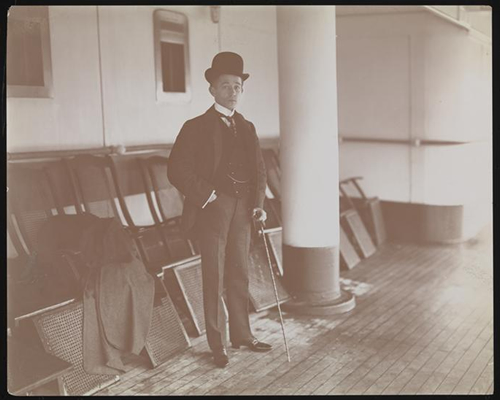
Tod Sloan, “great jockey, famed rounder, spender, one-time friend of millionaires and occasional toast of royalty,” on his return from Europe, 1898. The portrait is part of the Museum of the City of New York’s photography collection, much of which was recently published online. A quick search turns up approximately 150 photos of New York racing — including Sheepshead and Belmont racetracks — from the late 19th and early 20th century (via Kottke).
Reactions to the updated equine fatality rates released by the Jockey Club yesterday on Twitter: An experiment with Storify. If there was a theme to the chatter, or to the comments left on this post, it’s that the fatality stats aren’t enough on their own going forward. Now that we know there’s a statistically significant difference between dirt and synthetics, deeper analysis is wanted.
Horse owner Ted Grevelis raises a couple of excellent questions about the TJC stats: “If we don’t know the fatality rates at each racetrack, how can there be any action taken on the results of the study or, more importantly, how can horsemen decide where to perhaps avoid racing in the future?”
Over on R2, Dean considers where storefront OTB bettors will go, and the possibility that many will stop playing. An NYC OTB board member suggested illegal bookies would make a comeback, telling WNYC: “It’ll be a local bookmaker or, from what I understand, they now have a lot of places offshore. But it’s not gonna go away.” The AP seems to have picked up on that, reporting in passing, “That betting apparently is headed to illegal bookmakers, regional OTBs that can now handle city bets more easily, and foreign-based Internet bookmakers.” Apparently? Evidence, please, that bookies and offshores are gaining when legal ADWs and outlets are available. If NYRA does open teletheaters in the city — an opportunity arising from NYC OTB’s closure — it seems even more likely that money will stay in the pool.
A field of ten for the Hollywood Futurity on Saturday, the final graded stakes of the year for juveniles. JP’s Gusto has to prove he can go the distance.
Are you kidding me? Of all the things to complain about when it comes to New York racing, NYRA giving 327 non-union employees average pay raises of 3% is pretty far down the list. In any other year or any other industry, such a raise would be a run-of-the-mill annual cost-of-living increase. But in New York, and at NYRA, it’s an outrage! It’s arrogance! Especially because NYC OTB just closed! The New York Post, which breathlessly reports that “top managers” are getting raises and fraudulently invokes the specter of a state bailout for NYRA, gives space to grandstanding politician Assembly Racing and Wagering Committee chairman Gary Pretlow to denounce NYRA as “bloated” and the raises as “an irresponsible act.” The Sarotogian headlines an editorial today, “Raises? Really?” and calls NYRA “tone deaf.” Nick Kling writes:
Non-union employees may get their additional money, but in the process NYRA has generated enough bad feeling to guarantee it will come back to bite the association when it wants something in the future.
That’s absurd. Here’s the thing: 3% — or even the average 5.5% given to 10 employees — isn’t that much money. NYRA president Charles Hayward, who defended the raises as the first given non-union workers since January 2008, told the Blood-Horse that the raises will cost NYRA approximately $600,000 in added payroll next year. That works out to around $1835 a year (or $153 a month, $35 a week) per employee, which raises the average salary of those workers from approximately $60,000 a year to around $62,000 a year. That’s $62,000 in one of the most expensive cities in the world, and at a time of great challenge to NYRA — with NYC OTB closing last week, and the Aqueduct racino opening in 2011, NYRA needs to retain its workers (and it really needs its workers to feel good about their jobs) if it’s not only going to survive what’s ahead, but come out thriving. Giving end-of-the-year raises to the rank-and-file is a strategic and morale-boosting move at a crucial moment in the organization’s history. Sorry, but there’s nothing outrageous about that.
New York City OTB was big, but it paid peanuts for simulcasting rights, and not just to NYRA (which gets about 50% more from out-of-state ADWs than it did from NYC OTB). In the Courier-Journal, Gregory Hall reports:
The New York City system wagered $9.6 million on Turfway Park races in 2009, resulting in $169,000 in revenues that were split between Turfway and its horsemen through purses, said Bob Elliston, president of the Florence, Ky. track. This year, with fewer Turfway racing dates, the total so far is just over $5 million, resulting in $87,000 in revenue split between Turfway and horsemen, he said.
That’s about 1.75 cents per dollar wagered. Turf Paradise had a slightly better deal, but NYC OTB still wasn’t adding much to the pot, reports DRF:
Vince Francia, the general manager of Turf Paradise, said on Friday that New York City OTB bettors had wagered $3.7 million on Turf’s signal since the track opened on Oct. 1, or about $77,000 a day. Because of New York City OTB’s bargaining power, Turf Paradise only kept 2 percent of that money as the simulcast fee, Francia said, for total revenue of $1,540 a day, an amount that was split with horsemen.
Yikes.
12/21/10 Addendum: New York breeders aren’t missing NYC OTB much either after two years of not receiving payments. “If you’re not getting anything it’s hard to feel like you’re losing something.”
NYRA keeps up its efforts to capture displaced OTB bettors, adding dark day simulcasting at Aqueduct and more bus routes from the city to the track. According to DRF, another 74 NYRA Rewards accounts were opened on Thursday, bringing the number of new accounts opened over the past couple weeks to 300. Friday’s on-track handle (which includes money bet through NYRA’s ADW) was $572,687, or $36,327 more than Thursday’s on-track handle; $22,125 more than the previous Friday. Slow, but steady gains? They must be hoping the pace picks up a little. Adding streaming video to the service would be a boon, but making that little change is tied up in the NYSRWB and, quite possibly, the legislature. Brooklyn Backstretch has been keenly following that part of the story.
Meanwhile, on Friday, the state senate Republicans announced the newly formed Task Force on the Revitalization of the Racing Industry in New York. Said task force member senator John Bonacic: “Racing is more than about people sitting in betting parlors. It is about the sport — making the tracks viable as racing entities — not just places where VLTs are played. We need to focus on helping the breeders and horsemen since they are the infrastructure that develops a successful racing product. We then need to market racing in a manner which brings fans to the track and generates interest in the sport overall.” Good luck, New Yorkers. [12/13/10 Addition: Over on ESPN, Paul Moran comments: “But wherever there is a New York politician, there is never the lack of calamity.”]
Juvenile graded stakes racing winds down for the year with the Hollywood Starlet, which drew eight fillies, today and the Hollywood Futurity next Saturday. “A field of 13 or 14 is shaping up for the 30th running of the race,” including JP’s Gusto and Delta Jackpot winner Gourmet Dinner. Joe Talamo, back from injury, will be on JP’s Gusto once again. The jockey rode the horse through his first three starts. Pat Valezuala then had the mount through the Breeders’ Cup, winning the Del Mar Futurity and Best Pal with JP’s Gusto.
What a process, getting Zenyatta settled into farm life.
About
Jessica Chapel writes and edits in Massachusetts. Railbird is a Thoroughbred horse racing blog published from June 2004 to July 2019. More / Contact
Elsewhere
Find Jessica on Pinboard and Instagram, Railbird on LibraryThing and Twitter.
Etc.
Links
Search
Boston Racing
Spreadsheets/Data
Copyright © 2000-2026 by Jessica Chapel. All rights reserved.
