Triple Crown
Days before the 140th Kentucky Derby was run, Steve Coburn, the co-owner and breeder of California Chrome, made a prediction: “With a good break and a clean trip,” he said, “I think it’s a done deal.”
What was brash on Wednesday became fact on Saturday, as the Derby field rounded the stretch turn and the 5-2 post-time favorite put his head in front and then began to draw away. He got a clean break. He got a clean trip. (The same can’t be said of several other Derby starters.) He even got a reasonable pace to rate off when Uncle Sigh, wearing blinkers for the first time, took the early lead from Chitu and ran the first three-quarters in 1:11.80 (chart).
What he didn’t get was a triple-digit Beyer speed figure for winning the Derby. With a final time of 2:03.66, California Chrome was given a 97, “the lowest for any Derby or Preakness winner since Andrew Beyer has been making figures,” tweeted Randy Moss. His TimeformUS figure also came up slow — chief figuremaker Craig Milkowski gave him a preliminary 104. Both numbers are well off his previous 108 Beyer and 113 TFUS highs. [5/5/14 Update: TFUS has since revised his Derby figure to 110.]
Maybe that the Derby came up slow is part of a trend toward lower figures in classic races, but it was more likely a strong wind. Gene Kershner notes:
[There] was a fairly strong headwind going against the runners down the stretch, which when counting the first run to the clubhouse turn is approximately 40% of the race running …
Byron King also points out that the track (DRF+):
… appeared much drier than for early races and may not have been as well watered as it had been earlier in the day. There was a gap of 2 hours, 43 minutes from the preceding dirt race, the Churchill Downs Stakes.
The Derby fractions from DRF Formulator are interesting:
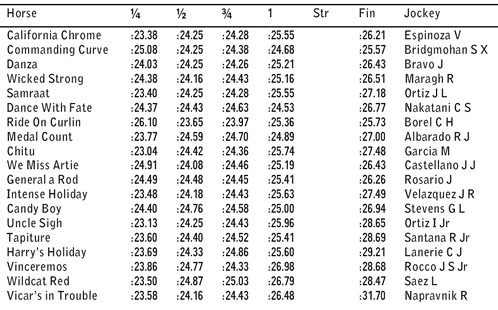
Runner-up Commanding Curve and seventh-place finisher Ride on Curlin are the only two running sub :26 final quarters, despite the moderate early pace. It’d be easy to be disappointed by California Chrome’s closing :26.21, except the fraction doesn’t match the visual. Watching the replay, he accelerates to take the lead at the top of the stretch, then jockey Victor Espinoza eases up (and puts away his whip) in what looks like a comfortable final sixteenth:
It was an utterly dominant performance not accurately measured by the final margin; California Chrome drew out to a five-length lead with less than an eighth of a mile to run before jockey Victory Espinoza geared him down, rising in the irons two strides before the wire and waving his crop in the air, much as he had done aboard War Emblem 12 years ago.
Going into the Preakness, there’s a case to be made that California Chrome comes out of the Derby a more formidable contender for the second leg of the Triple Crown in two weeks — after his big efforts winning the San Felipe and Santa Anita Derby, the Kentucky Derby wasn’t a peak performance, at least as expressed in figures. Maybe it didn’t need to be.
Much will depend on how the colt does over the next two weeks and who shows up at Pimlico. Trainer Art Sherman said on Sunday that California Chrome came out of the Derby in good shape, although he did leave a “handful” of grain in his feed tub and that, “He got a little tired, but not too bad.” Alicia Wincze reports his condition as “feisty” this morning.
The Derby winner will stay at Churchill Downs for a few days before heading to Baltimore. His schedule won’t be taxing. “We can light train him over here for a couple of days, kind of just jog him,” Sherman tells Jennie Rees.
Coburn is already looking ahead, past the Preakness, to the Belmont Stakes, his confidence confirmed. California Chrome was the first California-bred to win the Kentucky Derby since Decidedly in 1962. “When he wins the Triple Crown,†said Coburn, “he’ll be the first California-bred to do it.”
– – – – –
About those bad trips … Candy Boy was hard checked on the first turn after fourth-place finisher Wicked Strong crossed his path. Rider Gary Stevens was none too happy after the race, as quoted by the Churchill Downs press office:
“I had a horrible trip. On the first turn Rajiv Maragh came over on Wicked Strong and shut me off. Then he shut [Corey] Nakatani off, causing me to steady again. We’re both lucky we didn’t fall.”
Nakatani was on Dance with Fate, who recovered enough to finish sixth. Candy Boy was 13th; the race is a throw-out for him, whenever he starts next.
Third-place finisher Danza also interfered with Medal Count, veering into his path in the stretch. Sid Fernando helpfully illustrates.
If a horse swept the spring classics, writes Tim Layden:
A Triple Crown would be a moment — a beautiful, lingering, memorable moment. But on the Sunday morning following the Belmont in which the Triple Crown drought ended, racing would awaken precisely where it was a month before the Derby.
And that would be okay. We’re onward to the second season, regardless.
Palace Malice earned a Beyer speed figure of 98 for winning the Belmont, continuing the trend of 100 or lower Belmont BSFs that began in 2008.
Nick Kling notes an unintentional tribute in the race’s final time of 2:30.70:
Secretariat’s winning final time of 2:24 was at least 31-lengths better than what Palace Malice did Saturday.
Every quarter of the 2013 Belmont was slower than the one before, with Palace Malice running the final quarter in :27.58 (chart). That’s the slowest Belmont quarter (any quarter) of the past 10 years — the next slowest is the :26.98 final quarter of the 2004 Belmont, won by Birdstone. The fastest final quarter of the past 10 years was recorded in the 2007 edition, when Curlin (Palace Malice’s sire) and Rags to Riches dueled down the stretch in :23.83.
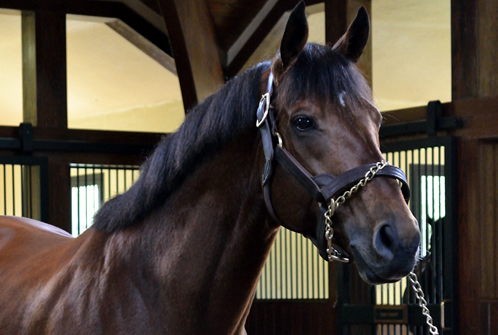
Big Brown at Three Chimneys in May 2012.
Looking back, it’s easy to see Big Brown’s loss in the 2008 Belmont Stakes as the point where the unraveling of IEAH began, and to marvel at how closely that outfit’s rise and fall paralleled the global subprime bubble and 2008 financial collapse, from slick talk and shady deals to ruin. Michael Iavarone and company boasted that they were bringing Wall Street to the racetrack, and in the worst way, they succeeded — all that’s left now of their ambitions, as Ryan Goldberg reports in his detailed, must-read story on Deadspin, is an empty equine hospital and a decrepit sign honoring Big Brown outside what was trainer Rick Dutrow’s Aqueduct barn. The horse, at least, is living the high life of a stud at Three Chimneys Farm, which has “all the charm of a quaint, leafy village, but with the perks of an executive suite” (via).
Turning to happier Belmont memories, what a remarkable moment:
We asked Chenery and Turcotte to watch the 1973 Belmont together. As the video played, as Chick Anderson’s legendary race call began, as the pair saw the timeless race unfold again, with Secretariat shooting up a gap near the rail, Turcotte told his former owner that he could feel the big horse’s heartbeat during the race, that he could feel the horse’s rhythmic breathing through his legs.
Hello Race Fans picks for Belmont day are up. Good luck, everyone!
Unlimited Budget is among the 14 contenders entered in the Belmont Stakes. Someone should read “Lean In” to the filly before Saturday, apparently:
“It takes a special filly [to win a Triple Crown race], one that is willing to stare down the boys and say, ‘No, this one is mine,’ †said Dr. Mary Scollay, the equine medical director for the Kentucky Horse Racing Commission. “It’s so much about personalities and intimidation when these horses match up. I think it’s the same reason women don’t have as much, and the same kind of success, as men in the workplace.â€
Three fillies have won the Belmont, out of 22 starters. That’s not such a bad record — only 141 colts or geldings have won, out of more than 1200.
Rosie Napravnik has the mount on Unlimited Budget, which makes her the first female jockey to ride in all three Triple Crown races in the same year. That’s wonderful, if also a reminder of the progress still to be made, on the eve of the 20th anniversary of Julie Krone’s history-making Belmont win.
Meanwhile, at Suffolk Downs —

Elusive Son (inside) outfinishes Step Brother in the first turf race of the meet.
Tammi Piermarini, the leading rider at Suffolk for the past three years, tops the jockey standings again after three days of racing, with five wins from 19 starts. Gary Wales and Andria Terrill are tied for second with four wins apiece. Piermarini’s first win of the meet came in race two on opening day with Broadway Hat, shipping in for trainer David Jacobson. The once-pricey auction purchase obviously found his level, taking the maiden $5K by four lengths. Trainer Ambrose Pascucci made the claim, the only one so far this summer.
Piermarini’s second win came in race six on the same day with Elusive Son, whose thrilling by-a-neck victory over Step Brother withstood a stewards’ inquiry into a little stretch bumping. The first of her two wins on Wednesday’s card offered a different kind of thrill — Mister Dixie, a 5-year-old gelding making his first start since July 2012, won race two by 12 1/2 lengths in :57 3/5, a tick off Rene Depot’s 1972 :57 2/5 track record for five furlongs.
Another rider, Jordano Tunon, scored the biggest upset of the meet yet when he won race six on Wednesday with Lapantalones Fance, the longest shot in a field of 10, paying $87.20 to win. While that might have been the highest win price of the week, it wasn’t the first time since Saturday that exotic payouts have been high enough to trigger the new, onerous 5% tax on winning bets paying over $600 instituted by a 2011 change in Massachusetts law (and affecting only Massachusetts residents). “[T]his is a dealbreaker for Mass. horseplayers,” tweeted one. Per a notice in the Suffolk program, track management is working on a fix. Get in touch to support their effort.
6/7/13 Addendum: Jay Hovdey on the 1993 Belmont Stakes: “It has been 20 years since Colonial Affair emerged from the gloom of a rainy New York afternoon to carry Julie Krone and the colors of Centennial Farms to victory in the 125th running of the Belmont …”
Orb is confirmed for the Belmont Stakes after a sharp work in company at Belmont on Sunday, joining Oxbow and what might be as many as many as 13 other starters in the final leg of the Triple Crown — neither the Kentucky Derby nor the Preakness winner is scaring anyone away. Of the two, history suggests Oxbow is more likely to win — in the 21 times that the Derby and Preakness winners have met again in the Belmont, the Preakness winner has come out on top nine times, the Derby winner five, and the last time that happened was in 1984, when Swale redeemed himself after a historically bad Preakness loss (one that’s only been matched by Orb). Derby-Preakness winner exactas aren’t too common either, as Steven Crist points out in his discussion of Derby-Preakness winner rematches:
Only twice [since 1973] have the winners of the first two legs accounted for the Belmont exacta: Tabasco Cat-Go For Gin in 1994 (that exacta paid $19.20), and Hansel-Strike the Gold ($39.20) in 1991.
In recent years, the Belmont has been a rewarding race for longshot players, with bombs galore. The upcoming edition promises to keep the payouts up.
About
Jessica Chapel writes and edits in Massachusetts. Railbird is a Thoroughbred horse racing blog published from June 2004 to July 2019. More / Contact
Elsewhere
Find Jessica on Pinboard and Instagram, Railbird on LibraryThing and Twitter.
Etc.
Links
Search
Boston Racing
Spreadsheets/Data
Copyright © 2000-2026 by Jessica Chapel. All rights reserved.
