ICYMI: Reading Racing 2016

Aqueduct is on hiatus, Santa Anita doesn’t open until December 26, and Eclipse voters are taking to Twitter to talk about their ballots. It’s the perfect time, in other words, to give one last glance back at 2016 and catch up on any reading about racing that you might have missed. The links below are to some of my favorite, and some of the best, turf writing this year.
Start with John Cherwa’s story in the Los Angeles Times about the 50th anniversary of jockey Johnny Longden’s retirement. His last ride was a winner: “It took them 30 minutes to put up the sign, it was almost a dead heat.”
What happened to Shergar? Milton Toby revisited the unsolved kidnapping for Blood-Horse. (The horse’s rider Walter Swinburn died this month at 55.)
Carly Kaiser went to Eagle Rock Downs in March. Click for the photos.
When Pat Mahoney retired from NYRA, it was the end of an 111-family history in tote wagering. “We managed the money at 11 of the 36 Triple Crown champion races,†Mahony said. “We were in the betting rings year in, year out through world wars and the Depression. That is something to be proud of.†Joe Drape tells the Mahoney family story in the New York Times.
Drape’s biography of the 2015 Triple Crown winner came out in the spring. “American Pharoah: The Untold Story of the Triple Crown Winner’s Legendary Rise” ends the year on the longlist for the PEN/ESPN award for sports writing.
Speaking of American Pharoah, Monte Reel of Bloomberg visited Ashford for the start of his stud career and Bob Ehalt wrote a behind-the-scenes story about tensions in the Pharoah camp for Thoroughbred Racing Commentary:
“He knows he’s coming to the end of his career and wanted to cash in and I could understand that. He just didn’t know where to draw the line. He wanted a patch on every inch of his body. On Dancing with the Stars they dressed him like they were making fun of him. I was worried they were treating him like a circus act and they would shoot him out of a cannon, and I needed him to win the Breeders’ Cup Classic.”
Amanda Duckworth’s feature on Ken Ramsey was another fun piece from TRC:
“I am so devastated and disappointed that my crew could not get me a win over there this year … I had four trainers trying to get a win. I have given them strict instructions: Either you get me a win at Royal Ascot, or you can find your happiness someplace else.”
Why people handicap, why people bet — Eric Banks meditated on horses, luck, and playing the races for Lapham’s Quarterly:
But what a strange skill to have, and how long the apprenticeship! I have been at it as a handicapper with varying levels of seriousness and success for most of my adult life. It was more than twenty-five years ago that I first started going to the track and began to think that there was some rational way to order the raft of digitized information that every horseplayer grapples with in any track program or the pages of the Daily Racing Form, and I still happily devote an inordinately large amount of my time to following and betting the horses. There’s nothing particularly original about my autobiography: I’ve had some terrific scores, and I’ve had long fallow periods where nothing worked. I’m not a really large bettor, and I’ve had both exceptionally good days and alarmingly awful ones. I’ve hit bets that paid in the very low five figures; I also once blew through a $5,000 bankroll in a couple of weekends betting at small racetracks in Iowa and Oklahoma, figuring wrongly that I was a sharper player than the rubes and rustics who followed those races. But one of the remarkable things about gambling on horses is that losing leads more to humility than to disillusionment.
For Vice, Dave Hill spent Kentucky Derby weekend in Vegas with a whale.
Everyone loves a gray, but what do you know about the gray Thoroughbred genetics? Andrew Caulfield traced “the often precarious grey line” that runs more than two centuries from Master Robert to The Tetrarch to Tapit in TDN.
Tony Leonard’s photo collection was almost lost. For the Paulick Report, Natalie Voss wrote about the ongoing work of scanning and cataloging the racing photographer’s historic, decade-spanning collection of negatives and prints: “This is really cool right now, but I think it’ll be even more cool in another 50 years or 100 years,” said Shiflet. “This will be an interesting collection years and years after I’m gone.”
Some familiar names signed off in 2016. Dosage creator Steve Roman didn’t hold back in his farewell, posted to his website:
Suffice it to say that my perception of a decline in the quality and diversity of American Thoroughbred racing along with the industry’s continual (and, I believe, intentional) inability to deal effectively with the abusive nature of the game has taken its toll. American racing’s ongoing decline is real and I am not alone in this view.
Steven Crist formally retired in July. Mike Watchmaker wrote an appreciation for his career, which included stints at the New York Times and NYRA, the founding of the Racing Times, and a revival of the Daily Racing Form:
… where Crist really left an indelible mark was in matters concerning the horseplayer, enriching our experiences in ways you might not be aware of, or have imagined. And this holds true no matter which way you engage in racing this weekend, whether it be at the track, or at a simulcast facility, or betting in your underwear from your living room.
Andrew Beyer retired too, and he really seems to be enjoying himself.
Suffolk Downs continued to hold on, running six days this year, inspiring Watchmaker to revisit memories of the New England circuit that used to be:
Suffolk was referred to as the “Oceanside Oval,” which I guess it technically is, but it was never to be confused with Del Mar. The old Rockingham was called the “Saratoga of New England.” The Rockingham Park prior to the 1980 blaze that took it down was really very nice, but it wasn’t Saratoga. And I never had a vivid enough of an imagination to picture Narragansett as host of the famous match race between Alsab and Whirlaway, but it was. Nevertheless, these were great old places.
The very first day I received my driver’s license, I commandeered by dad’s car and drove to the Brockton Fair to play the card. And I was there with my dad the last day Berkshire Downs, which at one time claimed Frank Sinatra and Dean Martin as part owners, ever raced. It had to be the last day. There was a giant sinkhole on the track apron that appeared to be expanding so quickly that, given another day, it might have claimed the actual grandstand.
Rockingham Park was sold for redevelopment, closing for good in August. Paul Daley captured the nostaglia of those who passed through the old track.
We’re not saying goodbye to California Chrome just yet — following his win in the Los Alamitos Winter Challenge on Saturday, he ships to Gulfstream for the Pegasus World Cup next month. But Tim Layden has written the best profile yet of the likely 2016 Horse of the Year, telling the story of his connections and unlikely career for Sports Illustrated on the eve of the Breeders’ Cup.
More good stuff: Chris Rossi (@o_crunk) wrote about racing data. Eliza McGraw, author of “Here Comes Exterminator!,” wrote about early women jockeys, Joan Pratt, and Joyce Goldschmidt for Raceday 360. (Who? Read the stories.) Finally, take 20 minutes to enjoy this ESPN short film about Haru Urara, the 0-113 racehorse who became a phenomenon in Japan, and be inspired by this 43-year-old apprentice jockey at Turf Paradise.
12/22/16 Update: Published too early and missed out on T.D. Thornton’s marvelous remembrance of neighborhood bookies in TDN:
By age 12, I knew that at funerals among members of our small town’s gambling community, the most elaborate flower arrangements were always sent by the neighborhood bookies. I also knew that at Christmas, if you were a longtime customer, betting debts were likely to be forgiven. This holiday courtesy was extended not so much out of seasonal cheer and joy, but because it made good marketing sense–Gus and the other bookies were quite confident they’d rake it all back, and more, once football playoffs started.
I also neglected to mention Holly’s Kruse’s insightful “Off-Track and Online: The Networked Spaces of Horse Racing,” which covers the social, cultural, and technical aspects of wagering and how those intersect in public and online spaces. I talked to Kruse about her book in June.
See you in 2017 — happy new year!
#BC16 Links, Etc.
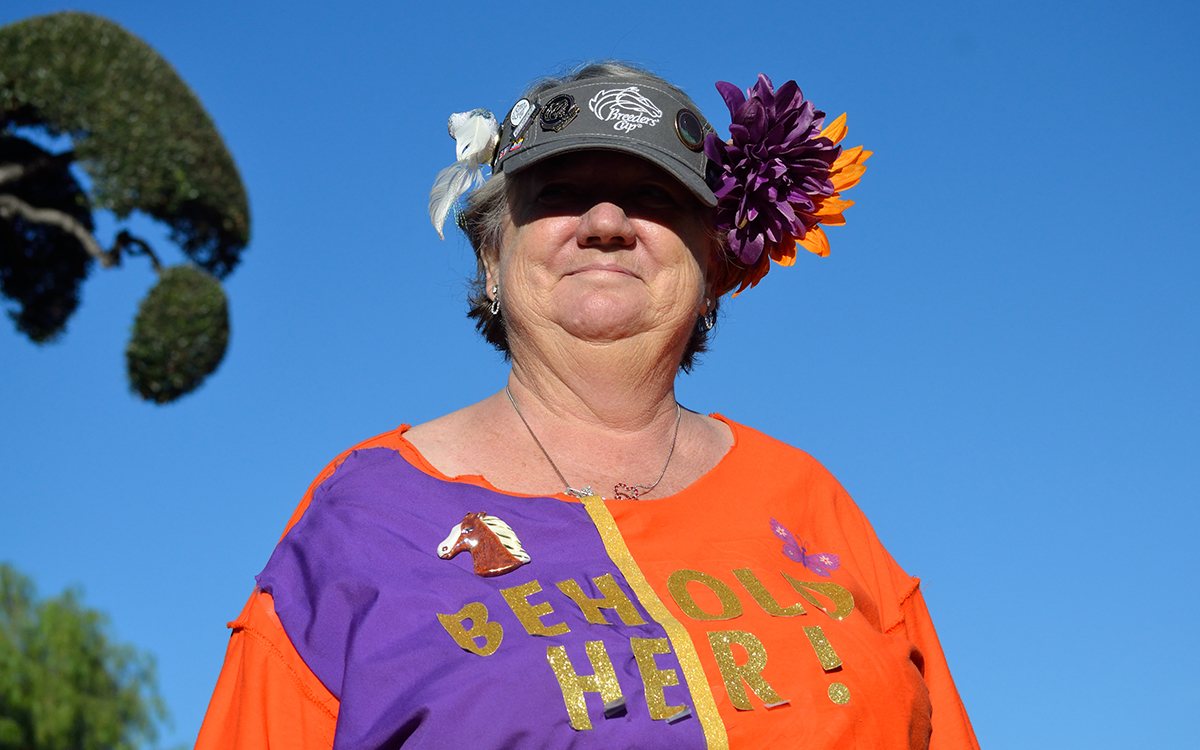
Breeders’ Cup 2016 is here! And I have links: First, to the big HANA Monthly Breeders’ Cup issue (PDF). Stats, Q&As, and my Distaff pick (clue in the photo above). Then, to the Hello Race Fans BC Friday picks grid. Look for HD replays of every BC race on the 2016 Breeders’ Cup YouTube playlist. Replays should be up within minutes after each race.
I’m hanging out on Twitter and Instagram this weekend, live from Santa Anita.
11/5/16 Update: And Breeders’ Cup Saturday picks are up.
Super Eli
I loved this moment so much that I had to GIF it:
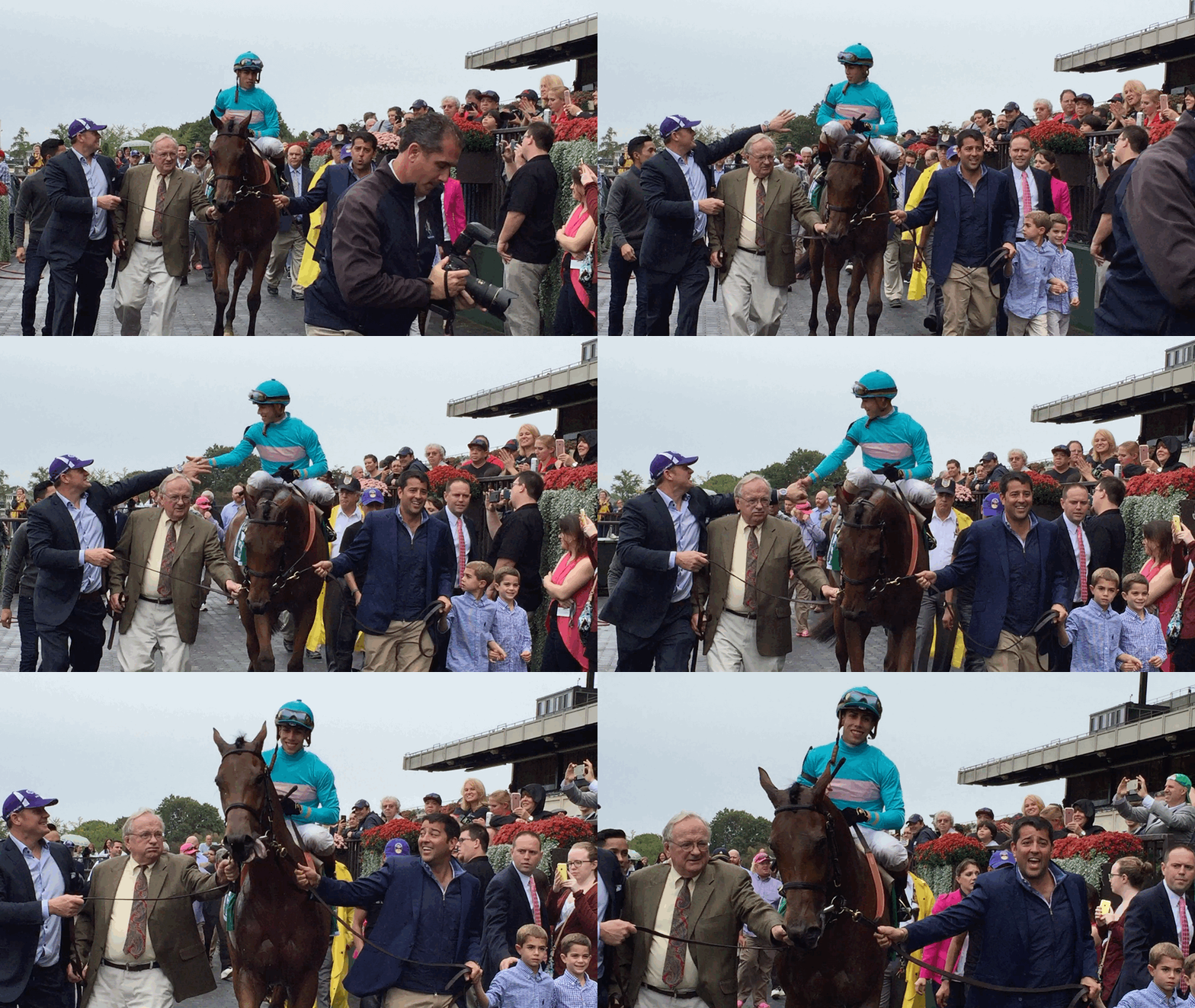
Lady Eli enters the Belmont winner’s circle to applause after the Flower Bowl — the champion’s second start back after beating laminitis. “It takes such a rare horse to overcome what she has,” said trainer Chad Brown. “I think she’s one of the all-time great turf mares.” It’s onward to the Breeders’ Cup.
Spa Babies
Saratoga opens Friday, and that means some very well bred, very high-priced, and very interesting juveniles will be running, such as this one (DRF+):
Perhaps the most intriguing colt on the grounds from a pedigree standpoint is Brooklyn Bobby, trained by Brian Lynch. Brooklyn Bobby, named in honor of the late Bobby Frankel, is a son of the undefeated European champion Frankel out of the Grade 1 winner Balance, who is a half-sister to Zenyatta. Brooklyn Bobby has worked well on dirt and had a decent work on turf this week.
Lynch said Brooklyn Bobby could debut on turf Aug. 6.
“He’s the sort of a horse if he was guy, you’d want to hang out with him because he’s a cool, cool horse,†Lynch said. “He’s got a great demeanor, and he’s very unexcitable. He seems to take everything in.â€
Frankel is off to a good start as a sire, with seven winners from nine runners through July 11: “The verdict so far is favourable. Mostly.”
The Saratoga juveniles spreadsheet will return this year (the 2015 edition.)
9/6/16 Update: The complete 2016 Saratoga juveniles spreadsheet.
Brockton Delays

Planned racing at the Brockton Fair has been pushed back to August:
The property owner and the association both said that more time was needed to budget for administrative costs and to fix the inner rail of the track, which was damaged by a vandal last year who stole about 1,000 feet of the metal barrier to sell for scrap.
“We would have hoped to start a little bit sooner,†said Bill Lagorio, president of the Massachusetts Thoroughbred Horsemen’s Association. “We are hoping, with all things considered now, we’ll race in August, September and October. … We don’t mind going a little further into the fall because it’s nice racing weather anyway.â€
If a meet at Brockton happens this year, training and racing will take place over four months on the five-furlong dirt track. Lagorio addressed safety concerns raised by observers about that plan:
Lagorio also responded to criticism of the track, which he said is mostly being leveled by a rival horse racing association that is participating in the six races at Suffolk Downs this year. Lagorio said that some people unfairly point to the injury of one horse when racing last took place at the Brockton Fairgrounds in 2001, but he said the sport inherently has its risks.
“There’s nothing not safe about Brockton,†Lagorio said.
Count me among the worried, and not because of anything that happened 15 years ago. Thanks to greater attention on safety issues, ongoing research, and the Equine Injury Database, we now know more about track surfaces, injuries, and risks than we did a decade ago. We know that dirt tracks consistently register more fatalities than turf or synthetic tracks, averaging 2.07 fatalities per 1000 starts from 2009-2014, compared to 1.65 for turf and 1.22 for synthetics. Over the same six years, races at distances less than six furlongs averaged 2.25 fatalities per 1000 starts, compared to 1.82 for races six to eight furlongs, and 1.74 for races longer than eight furlongs.
The work of Dr. Mick Peterson has yielded clues into how track maintenance and moisture content affects safety. Dr. Tim Parkin, studying the EID, has identified factors that may make a horse more vulnerable to fatal injury, including past injury, time between starts, drops in claiming price, and age.
For what Dr. Parkin’s work means in practice when it comes to a vulnerable horse population, read Dr. Jennifer Durenberger’s Thoroughbred Racing Commentary piece about reducing the fatality rate at Suffolk Downs in 2014:
Let’s look first at the catastrophic injury rate for the meet: 1.24 per thousand starts. This is down from 1.73 in 2013 — a nearly 30 percent reduction. While I maintain that this particular metric tells only a small part of a much bigger story about the job we do protecting the overall safety and welfare of our equine athletes, it’s still the easiest number for us as an industry to obtain and compare across jurisdictions — both major league and minor league. Thanks to the Jockey Club’s Equine Injury Database (EID), which captures data from an amazing 93 percent of all flat racing days, we know that the average catastrophic injury rate in 2013 was 1.9 per thousand starts. That includes all horses – young and old, graded stakes competitors and seasoned claimers, sprinters and routers, turf specialists and mudders. When we separate that by surface, we see a nationwide average of 1.63 catastrophic injuries per thousand turf starters and 2.08 per thousand dirt starters. At Suffolk Downs in 2014, the turf rate was 1.44 and the dirt rate was 1.20 – less than 60 percent of the national average.
Thanks to some of Dr. Tim Parkin’s comprehensive epidemiological analysis of five years of EID data, we know that there are certain risk factors associated with catastrophic injury. Nine have been identified with statistical significance, including older horses, horses making “numerous starts within the past 1-6 months,†and horses entered in claiming races for a tag less than $25,000. It’s no secret that the vast majority of horses competing at Suffolk Downs fit squarely within this profile. For years, Suffolk has welcomed equine athletes in the later stages of their careers and helped transition them once the race was over. Our catastrophic injury rate was achieved amongst a population of some of the highest-risk horses in the country — competing for some of the lowest purses in the country.
High-risk horses competing for small purses — that’ll be racing at Brockton.
And those horses will be training and racing on a bullring that’s five furlongs with a chute. Last month, at the Grayson-Jockey Club Welfare and Safety of the Racehorse Summit, Dr. Peterson addressed an issue that should interest anyone considering running at Brockton — what are the musculoskeletal effects of turning? You can watch the archived video of his presentation — it’s less than 20 minutes long, and begins at approximately 1:12. The upshot — turning is stressful, and more so on dirt surfaces, due to their variability. He raises a provocative question — “Do traction limited horses [as those running on dirt may be] have a certain number of allowable turning strides?”
The causes of racing injuries are complex, and safety can never be absolute — but the conditions that horses will be asked to race under at Brockton, and the kind of horses who will be entered to race, are higher risk.
One last thing — Brockton, as a condition of the racing license approved by the Massachusetts Gaming Commission last fall, only has to make a good faith effort to earn NTRA Safety Alliance accreditation.
Horses first, says the Massachusetts racing office. For all involved, racing at Brockton will put that motto to the test.
7/19/16 Update: The Brockton request for Race Horse Development Fund money for purses is back on the agenda for the July 21 MGC meeting.
About
Jessica Chapel writes and edits in Massachusetts. Railbird is a Thoroughbred horse racing blog published from June 2004 to July 2019. More / Contact
Elsewhere
Find Jessica on Pinboard and Instagram, Railbird on LibraryThing and Twitter.
Etc.

Links
Search
Boston Racing
Spreadsheets/Data
← Home
Copyright © 2000-2026 by Jessica Chapel. All rights reserved.