Left Out
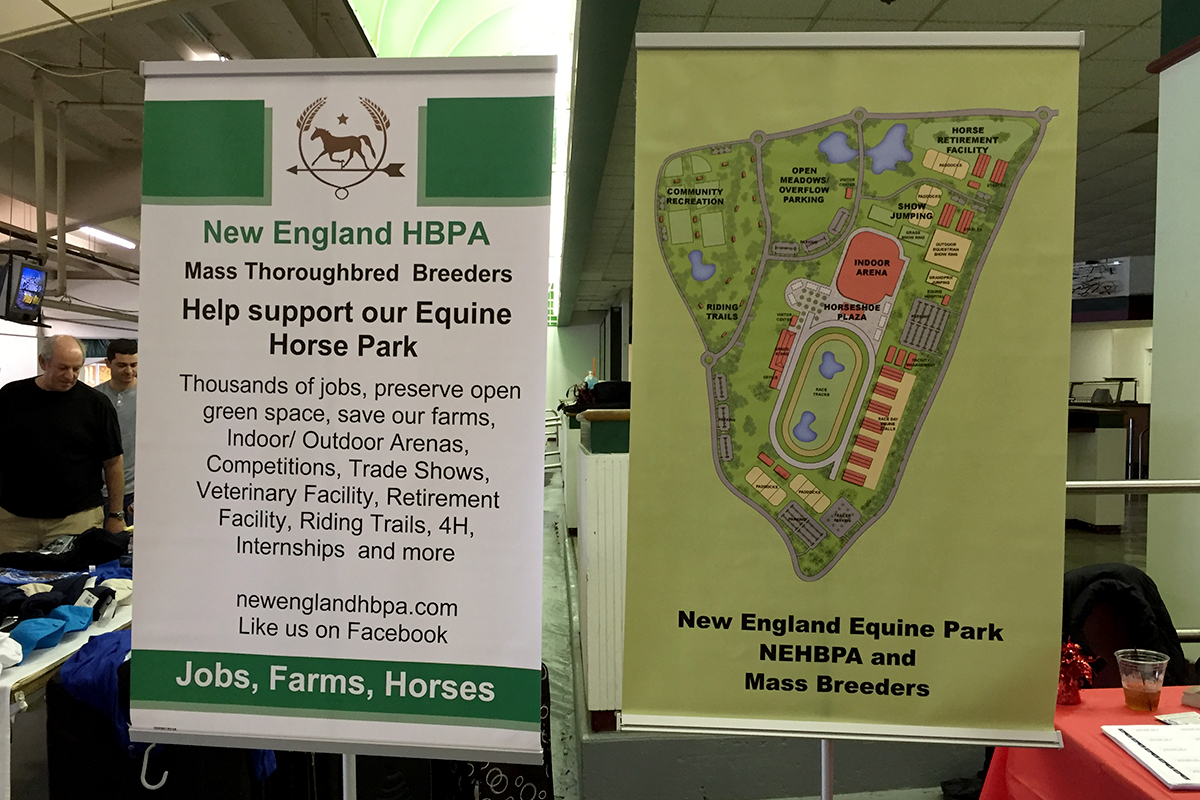
Let’s talk about the New England HBPA proposal for a non-profit horse park, a multi-use complex comprising a racetrack, an equestrian center, and a retirement farm. The group released a feasibility study authored by the Center for Economic Development at the University of Massachusetts-Amherst late last week (PDF), which concluded that such a facility — a “truly unique” model — would have an annual economic impact of $98.9 million on the Massachusetts economy. More than $66 million would come from the Thoroughbred racetrack, $31.7 million from the equestrian center. More details about the equestrian center and the proposal’s numbers can be found in the Blood-Horse and Daily Racing Form articles about the study.
I’m a racing fan, and what I most want to know — when Suffolk Downs is gone, and the horse park is where I have to go to get my local racing fix — is what the racing will be like. The study sketches out a simple vision:
Page 4 —
[The economic impact totals] are built on the following assumptions: 75 racing days during a typical season between May and October; 9 races per day; 800 horses in residence throughout the season; an average of 3,000 spectators per race day; and an out-of-state attendance rate of 20 percent.
Page 7 —
The center will feature a one-mile dirt oval racetrack designed for the safest possible racing of Thoroughbred horses for a 60-90 day season per year. This track could also serve as a venue for Standardbred horse racing if there is interest. Within the oval is a 7/8 mile turf course. Overlooking the track will be a viewing stand capable of seating 4,000 patrons. Within this facility will be restaurants and local wagering areas.
Page 25 —
We estimate that the new facility will attract 225,000 spectators per year … [have a] relatively smaller grandstand … a typical racing day will draw somewhere between 2,000 and 3,000 visitors, while special events (such as the MassCap) can draw up to 10,000. [The MassCap lives!]
Page 29 —
We assume that the present purse subsidies and breeding program established under the Expanded Gaming Act of 2011 will continue in their present form.
Page 30 —
[Purse and breeder incentives] will likely increase the share of Massachusetts horses racing at the new track. We use the conservative estimate that 400 active horses (or half of the assumed 800 horses on-site) will be from Massachusetts. In time, we expect an even larger share of horses racing at the new racetrack will be from in state …
So, a conventional track (aside: if you’re building a new racetrack “designed for the safest possible racing of Thoroughbred horses,” shouldn’t the main track be a turf course?), with a smaller grandstand (realistic) and a lot of Mass-bred racing supported by Race Horse Development Fund-subsidized purses.
This is an underwhelming vision, and that matters because Massachusetts racing and breeding is not isolated from the larger national market, and because financing the horse park development will depend on bonds backed by the state’s Race Horse Development Fund (legislation pending). There’s compelling public interest, in other words, in proposing a racetrack that reaches for the highest level, in the same way that the proposal does for the equestrian center, described in the report as “a first-class facility,” “capable of hosting elite national events.” Modeled on the Virginia Horse Center and Kentucky Horse Park, it’s supported by a Rolex Kentucky case study.
No racetrack case study is included in the report. There isn’t even an aspirational mention of an elite track such as Keeneland or Saratoga — although, as models, both have something to offer a new track proposal, particularly in what they do to draw spectators (one of the goals of the horse park) and to support state breeding programs and horse sales (another goal).
I don’t want to leave the impression that I’m down on the NEHBPA proposal — it’s interesting and full of potential, especially for drawing together equestrian and racing interests. But it’s an odd thing to read a study promoting a horse park for the good of horse racing (and breeding and jobs) that makes you wonder — why is there horse racing? And gives you the answer — because that’s the mechanism for accessing Race Horse Development Fund money. Horses race because the RHDF pays, the RHDF pays to keep horses racing. There’s no customer, no horseplayer, and no fan or handle growth in that perfect little circle of horsemen and state money. It’s not enough.
One other note about the study — page 30 discusses the sale of Mass-breds, and projects that out of the increased crop:
… the remaining 10 percent of foals are sold out-of-state at the national average auction price. Over the past three years, the average sale price from two-year old horses was approximately $70,000 per horse according to statistics from the U.S. Jockey Club. Thus, we include an addition $805,000 per year for expanded out-of-state horse sales.
Average prices being skewed by the market’s top end, the median price may be a better measure of how Mass-breds might do at auction. For 2-year-old horses in the past three years, the median has run around $31,000-$32,000, which would equal approximately $364,205 in expanded out-of-state sales.
1:15 PM Addition: Pedigree and sales expert Sid Fernando tweeted* about the sales assumptions in the study, adding some context to the discussion:
using a 2yo sale for projecting sales is not realistic. A yearling sale should be used, because 2yo sales are specialist events.
no one, in other words, breeds horses to sell at 2yo sales. Sellers of 2yos are usually second owners of horses.
usually state programs stimulate capital expenditure (buying stallions) by creating sire awards as adjunct to breeder awards…
…this, in turn, means more stud farms, more mares and more foals. State-bred foals are not typically commercial and have most…
…to horsemen in those programs because they race in restricted races. This stimulates local industry, for sure, but not…
…necessarily quality of horses produced because they are mostly the produce of local stallions. I think authors of paper didn’t
…have enough expertise to explain the mechanisms of all of this, good and bad, real and perceived.
economic impact to state must also capture amount of time mares are in state, for example. If a mare is sent to KY to be bred and
and returns by October, say, to qualify her resulting foal as MA-bred, that’s a mare 5 months out of state vs a mare bred to …
…local stallion. That’s why states incentivize local stallions, to keep mares in state.
He also pointed out:
btw, one area where [the study authors] underestimated economic impact: they said extra 115 foals would mean extra 115 mares, but in state …
programs fertility rates are about 50-55%, so need to effectively double mares to get 115 foals.
Additional mares would boost the estimated job and farm spending figures.
*Fernando’s account is private. He gave permission to quote the tweets above.
Back to the Downs
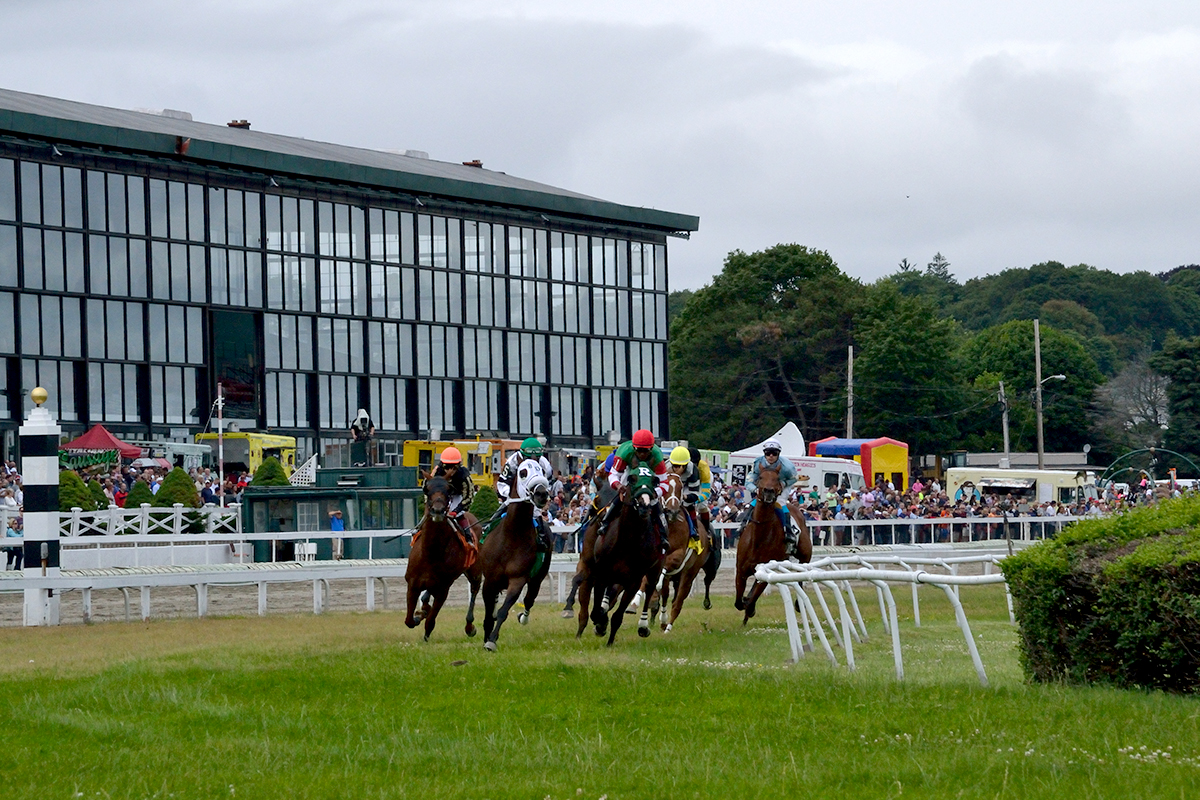
Rounding the clubhouse turn in race eight on Saturday.
It was a weekend of familiar names and familiar faces (and a familiar voice in the announcer’s booth), but you couldn’t call the first two days of racing this year at Suffolk Downs dull — not with three state-bred stakes and a bridge jumper and a horse running off (just to start).
“It feels so good to be back and see how excited the fans are. After all, no matter where you go, your roots are your roots,” Tammi Piermarini told the Daily Item. The jockey was at Suffolk with a broken nose — which she told the Boston Globe she set herself after an accident at Finger Lakes — this weekend.
Piermarini began Saturday well, with a 15 3/4 length win aboard 1-9 favorite Dr. Blarney in the day’s first flat race, the African Prince Stakes for Mass-breds. The track’s four-time leading rider got her second win of the weekend in Sunday’s fourth race with Cotton Pickin. Later that afternoon, she rode Miss Wilby in the Isadorable Stakes. More than $30,000 in a $34,000 show pool was wagered on the 4-year-old filly, a winner of three state-bred stakes at Suffolk in 2015 and a stakes winner at Gulfstream earlier this year. She and Piermarini finished fourth, triggering show payouts of $8.80 on back-to-back Isadorable winner Navy Nurse, $21.20 on runner-up Chasing Blue, and a whopping $84.20 on third-place finisher Lucky Sociano.
Sunday’s other Mass-bred stakes, the Rise Jim, went to Silk Spinner, who rushed up late to catch 2015 Rise Jim winner Worth the Worry by a neck. The finish wasn’t all that was dramatic about the race — rider Dyn Panell’s mount Im Kwik was a late scratch after the 6-year-old gelding ran off in the post parade, circling the track twice before tiring. “Pull the chute,” someone in the crowd shouted at the jockey as he tried to pull up his speeding horse.
The jockey who had the best weekend was Pedro Cotto, winner of five races, including Saturday’s feature, the Jill Jellison Memorial Dash. Forest Funds, entered off a second in a stakes at Monmouth Park last month, opened up in the stretch to win the turf sprint by 1 3/4 lengths over Harp N Halo, paying $9. Favorite Ruby Notion, making her first start since a 13th-place finish in the Breeders’ Cup Juvenile Fillies Turf last October, was fourth.
There was a touching scene in the winner’s circle after the race, as trainer Bobby Raymond presented the Jellison Memorial trophy to Cotto and winning trainer Jorge Navarro, surrounded by several members of Suffolk’s jockey colony. The race was named to honor the late rider, at one time the leading active female jockey, who got her start in New England with Raymond in the 1980s and died of breast cancer in July 2015. Everyone agreed, Jellison would have approved of Cotto and and Forest Funds’ run — coming from off the pace with a late kick was how she liked to win.
Photos from the weekend:
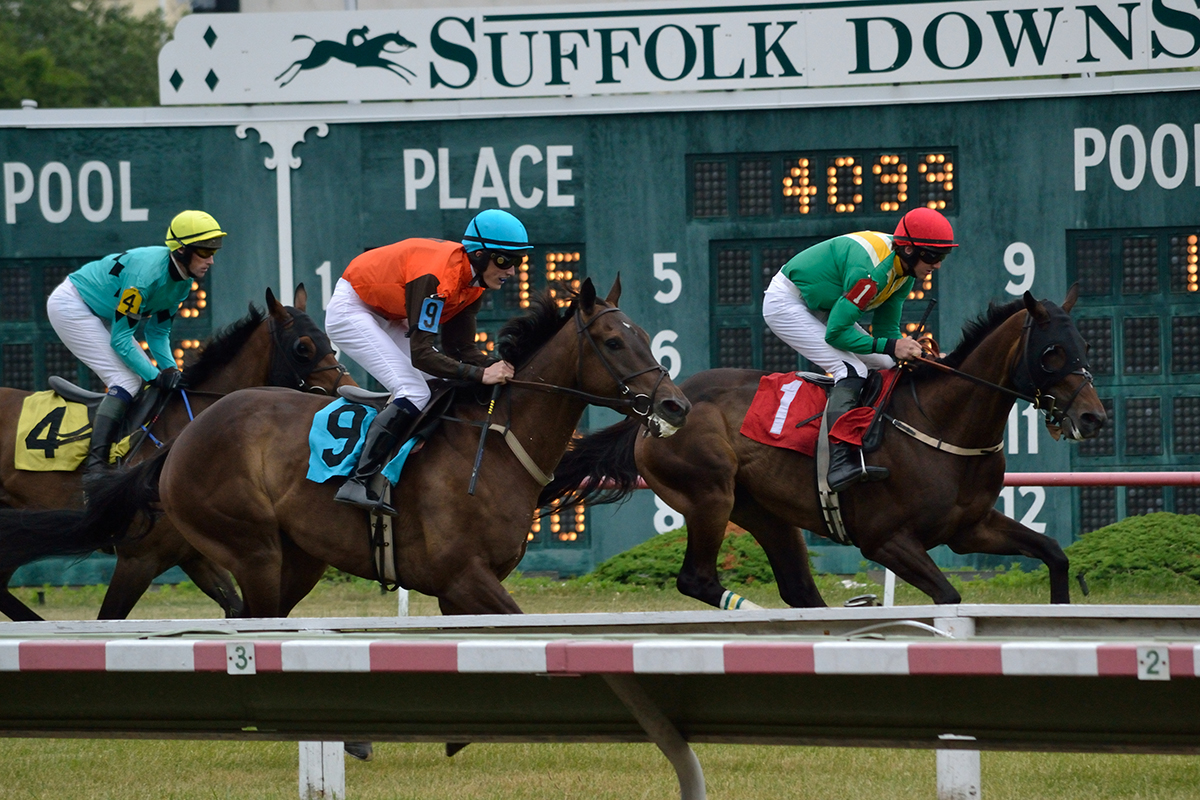
The field for the first race on Saturday, a 2 1/16 mile maiden hurdle, passes through the stretch for the first time. Silver Lime, a 7-year-old gelding, suffered a catastrophic right hind leg fracture going over the ninth, and final, jump. Reporter, ridden by Kieran Norris, won the race.
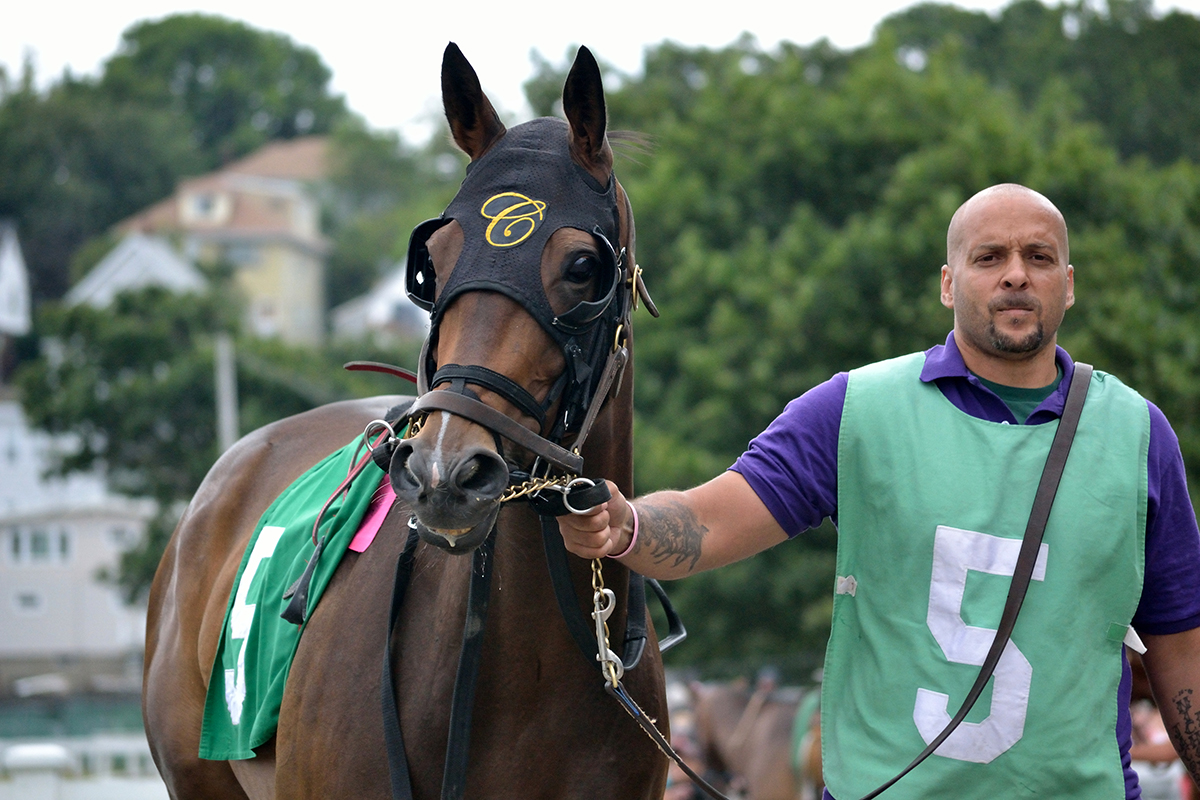
Maggiesfreuddnslip in the paddock before Saturday’s feature race, the Jill Jellison Memorial Dash. The 6-year-old mare finished third in the turf sprint.
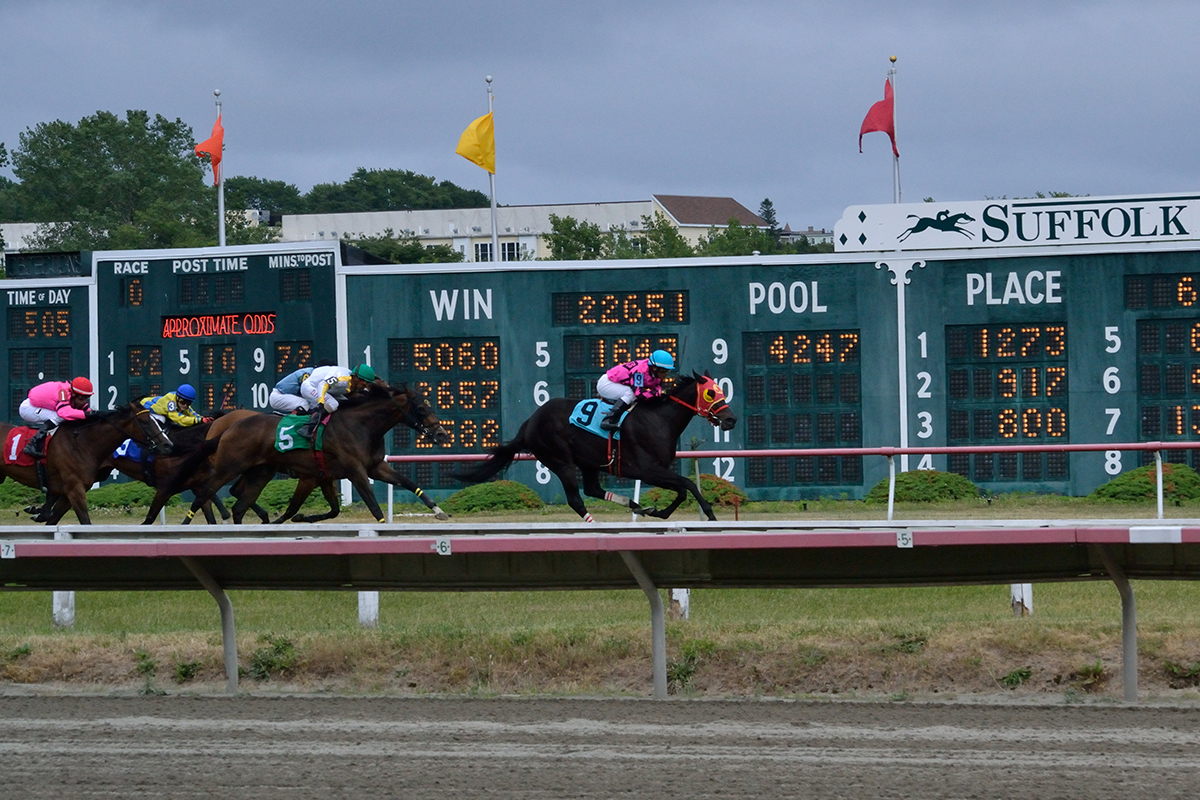
Forest Funds and jockey Pedro Cotto win the Jill Jellison Memorial Dash.
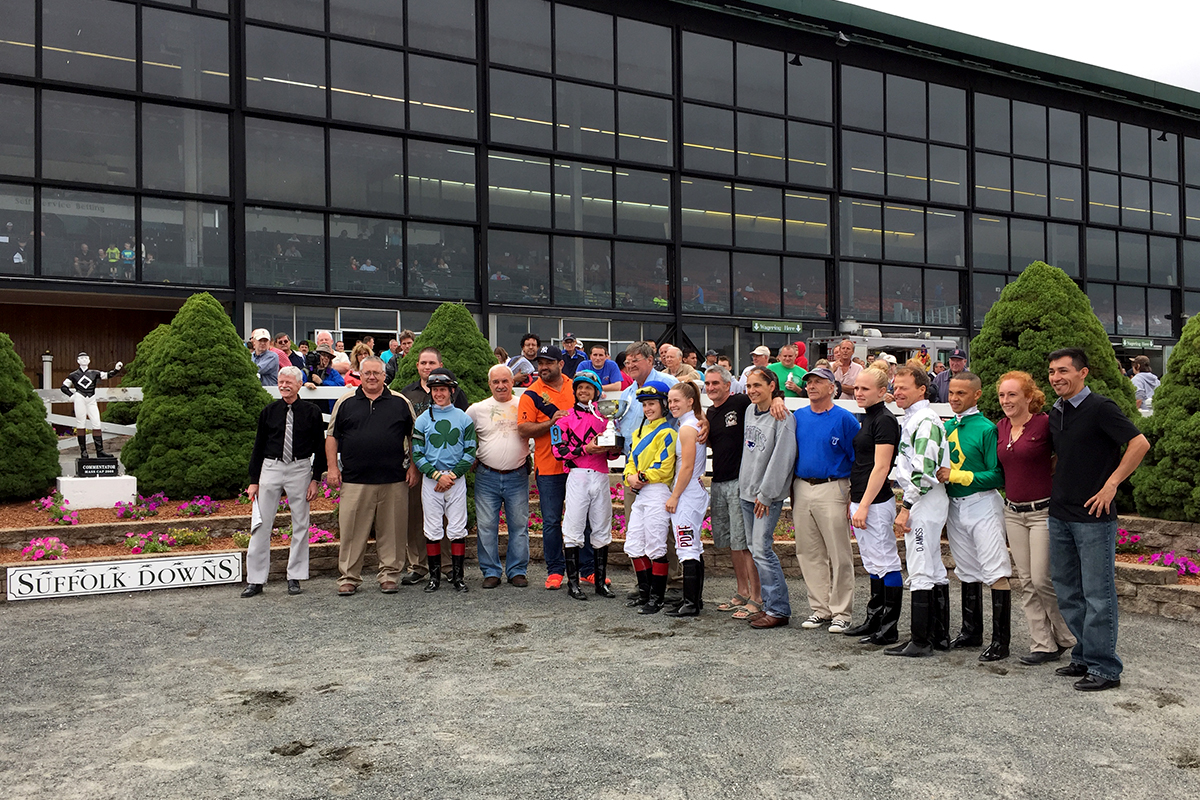
Trainer Bobby Raymond presents the trophy for the Jill Jellison Memorial Dash.

Piermarini had trouble getting Take It Inside to leave the paddock before Sunday’s fifth. She and the outrider ended up backing the mare out to the track after Take It Inside refused to otherwise walk down the ramp.
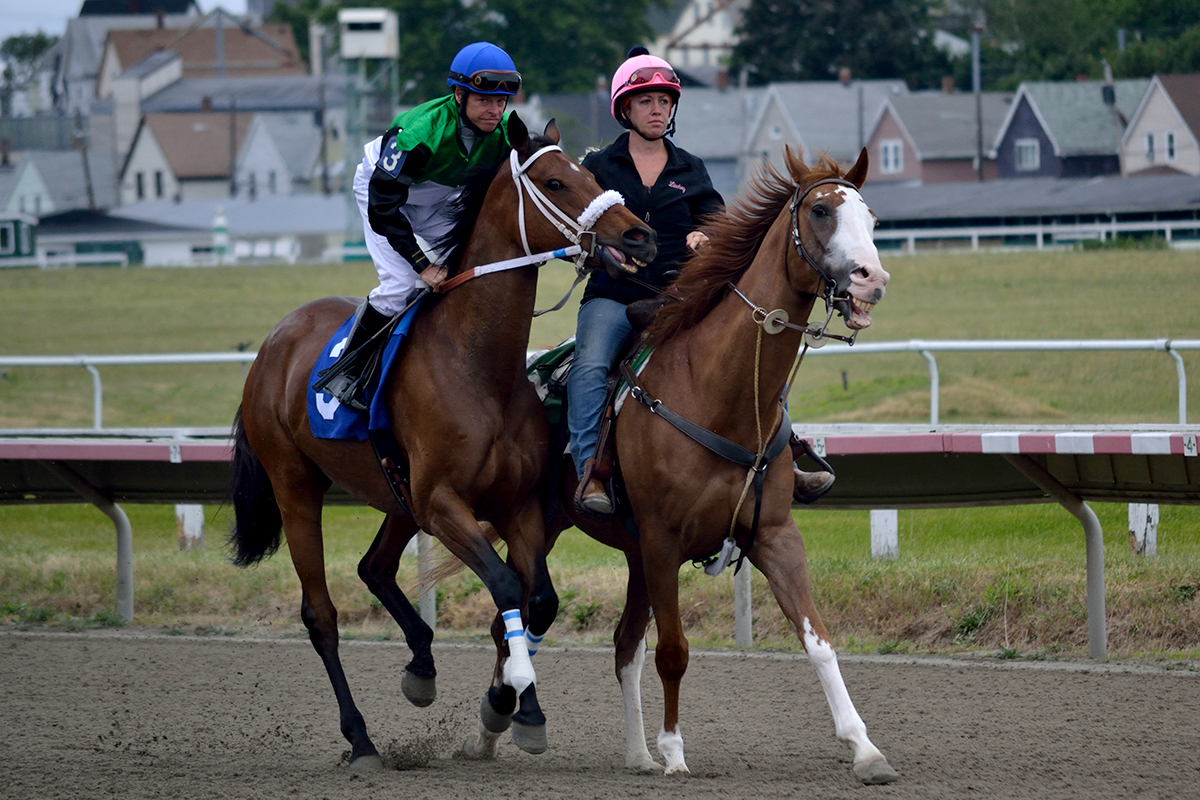
Navy Nurse and rider David Amiss on track for the Isadorable. The 2015 winner came back to win again this year, paying $8.60 as the second favorite.

Chris DeCarlo and Dancetrack, trained by Bill Mott and owned by Juddmonte, gallop back after winning the ninth race at Suffolk Downs on Sunday.
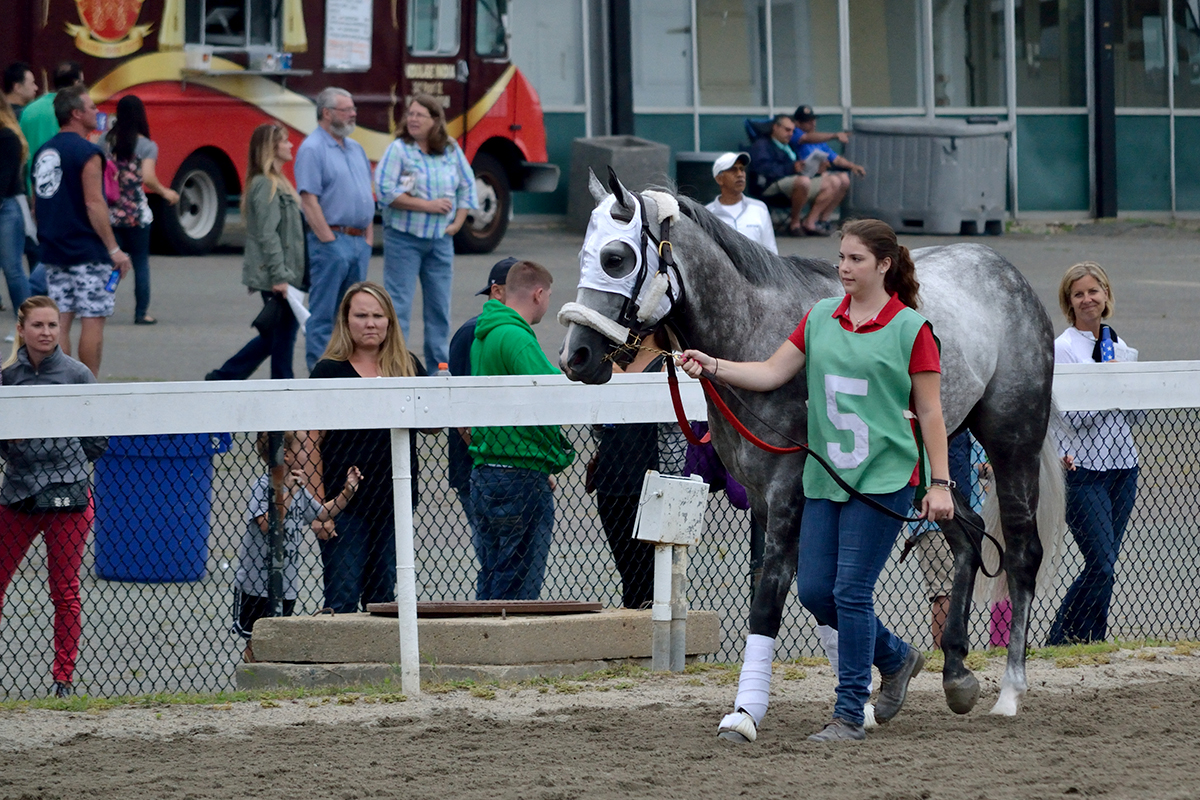
Simply Mas walks over for the Rise Jim Stakes on Sunday.
Suffolk Draws 192 Entries, Miss Wilby Returns

Miss Wilby and rider Tammi Piermarini after winning the Louise Kimball Stakes at Suffolk Downs on October 3, 2015.
Entries are up for July 9 and 10 at Suffolk Downs. The first weekend of three scheduled for racing this year drew 192 starters for 22 races — including two steeplechase and three state-bred stakes — attracting a mix of horses who raced at the track in 2014-2015, Mass-breds, and out-of-state shippers from big name barns. Take note, horseplayers: Takeout is 15% across the board.
Saturday’s feature, the Jill Jellison Memorial Dash Stakes, honors the late jockey, a pioneering female rider prominent in the Suffolk colony. The $75,000 five-furlong turf sprint drew a field of 10, including Ruby Notion, a 3-year-old filly trained by Wesley Ward, making her first start since finishing 13th in the Breeders’ Cup Juvenile Fillies Turf at Keeneland on October 30, and the Steve Asmussen-trained Lindisfarne, winless this year, but third to Queen Mary Stakes winner (and Nunthorpe runner-up) Acapulco in her last start, the Unbridled Sidney Stakes at Churchill Downs on May 14.
The first Mass-bred stakes of the weekend, the African Prince, follows the two steeplechase events that open Saturday’s card. In a short field of six, Dr. Blarney — coupled with Dr. Ruthless, both trained by Thomas McCooey — looks the obvious choice coming off an 8 1/2 length win in a Mass-bred allowance at Finger Lakes on June 11. In that start, the 3-year-old Dublin gelding defeated the 2015 Rise Jim Stakes winner Worth the Worry, who returns to Suffolk Downs to defend his victory on Sunday.
Also of interest on Saturday is Street Strut, a 3-year-old half-sister to graded stakes winner America by Street Cry. Trainer Bill Mott sends the first-time starter for race five, a maiden special weight turf route.
Two Mass-bred stakes highlight the Sunday card. Miss Wilby, winner of three state-bred stakes at Suffolk Downs in 2015, returns in the Isadorable Stakes (race eight) for trainer Marcus Vitali and is reunited with rider Tammi Piermarini. The Rise Jim Stakes (race 10) drew not only last year’s winner Worth the Worry, but 2014 winner and 2015 third-place finisher Victor Laszlo.
Rebuilding Brockton
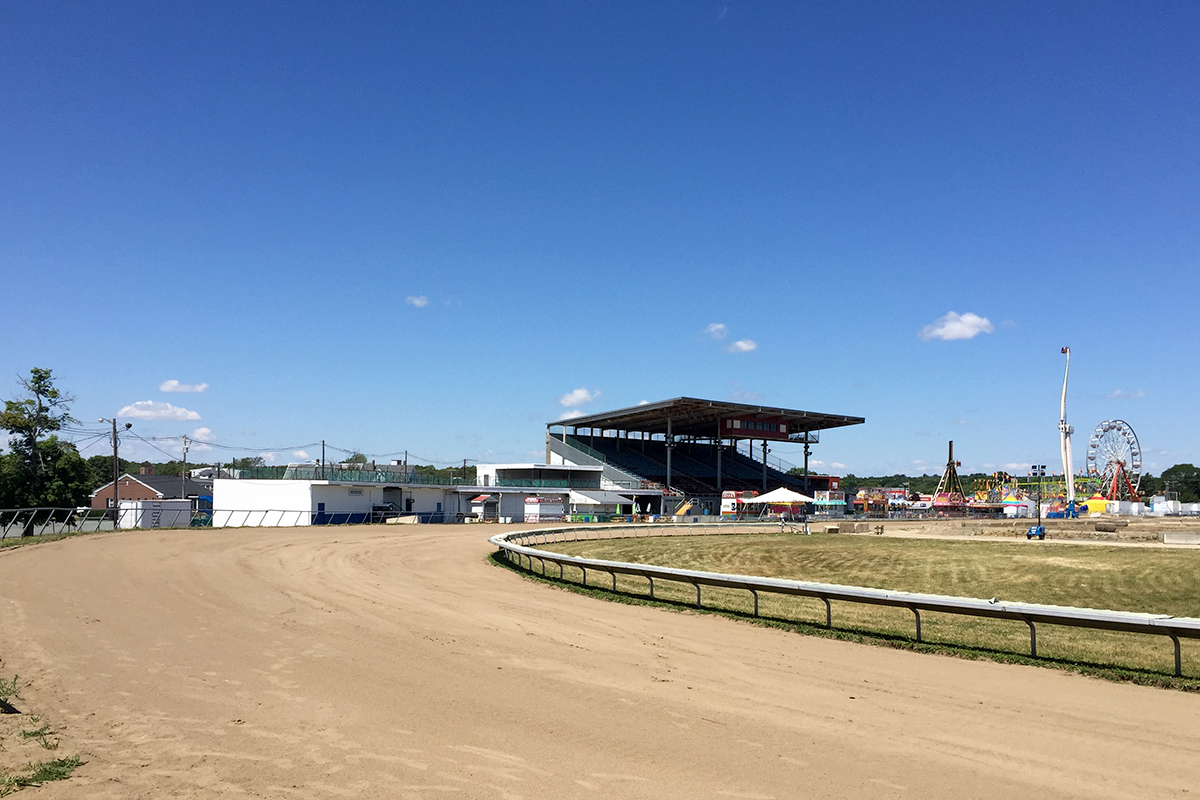
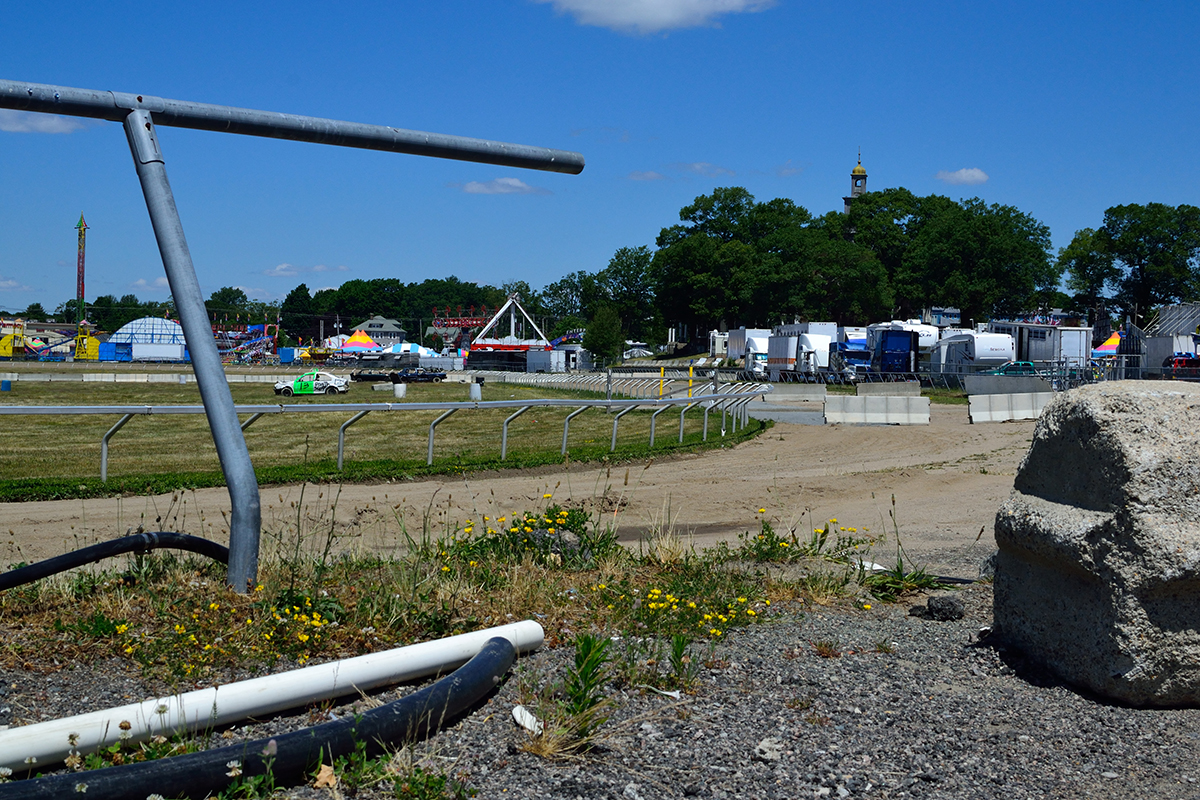
Construction began at Brockton Fair several weeks ago to restore the racetrack for a planned Thoroughbred racing meet there this year, the first since 2001. Extensive work is required — it includes rebuilding the track surface and installing a new rail — and days for the meet have yet to be set. What was projected in May as a July 2 start was bumped back to mid-July and now, late July, while a request for up to $150,000 a day in purse money from the Race Horse Development Fund was dropped from the Massachusetts Gaming Commission’s June 23 meeting, to be rescheduled on a date to be determined.
“I couldn’t get it all together in time. There was just so much crammed in,” Chris Carney, whose family owns the fair property, told Lynne Snierson:
“I’m still working on the track, doing the rail, and taking care of a lot of other things.”
Carney said he plans to go back to the MGC in the middle of July in the hope of starting the meet July 30, but will have a better idea of how many race-ready horses remain in the area after Suffolk Downs starts the first of its one weekend per month, six-day 2016 meet the weekend of July 9-10. Suffolk will not race again until the weekend of Aug. 6-7.
“This is a minor setback,” Carney said. “If the rail from before hadn’t been stolen and I had a safety rail in place, I wouldn’t have a problem now. I have barns already set up for 150 horses and I’m working on the other barns. It’s just a matter of time.”
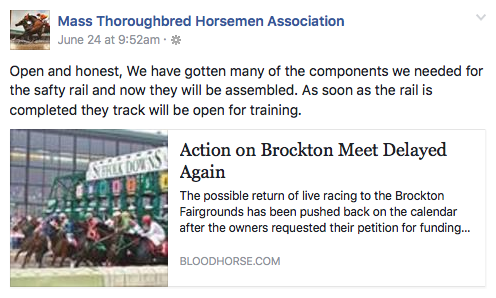
According to a Massachusetts Thoroughbred Horsemen Association Facebook post from June 24, the track will open for training when the new rail is up:
Brockton is a five furlong track, wide enough for a maximum of eight horses in each race. Stall applications are open, via the MTHA’s website. A condition book — like the racing calendar — has not been released.
I visited the grounds on July 3 to see the track restoration in progress.
Photo of the grandstand from the first turn:
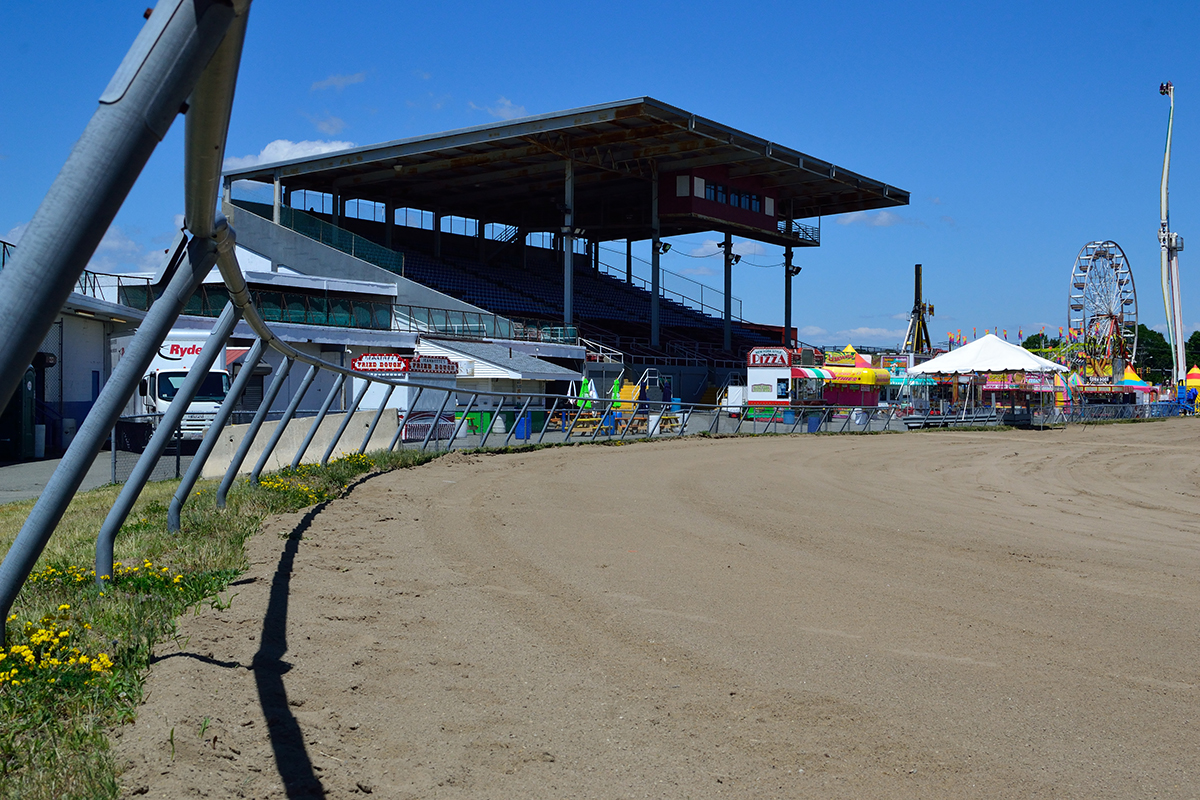
(Flashback: Horses racing on the clubhouse turn in 2001.)
View from the turn onto the backstretch:
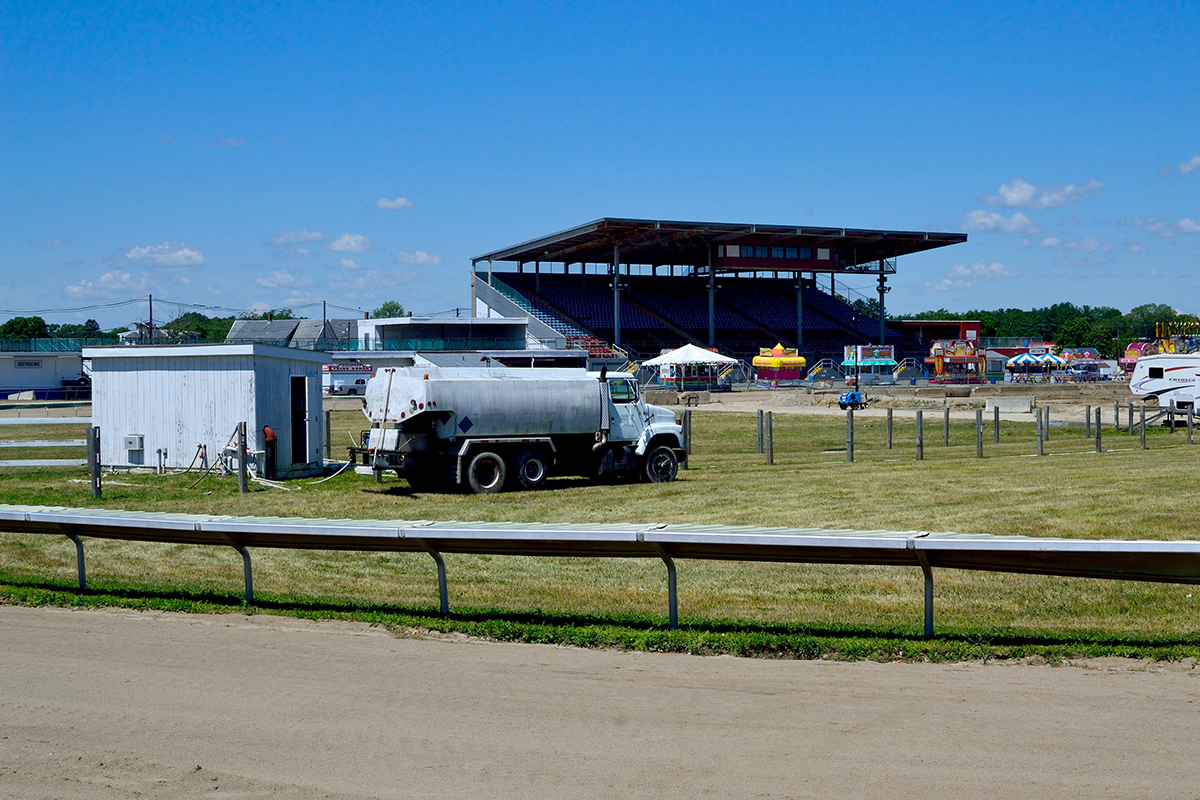
And the view down the backstretch:
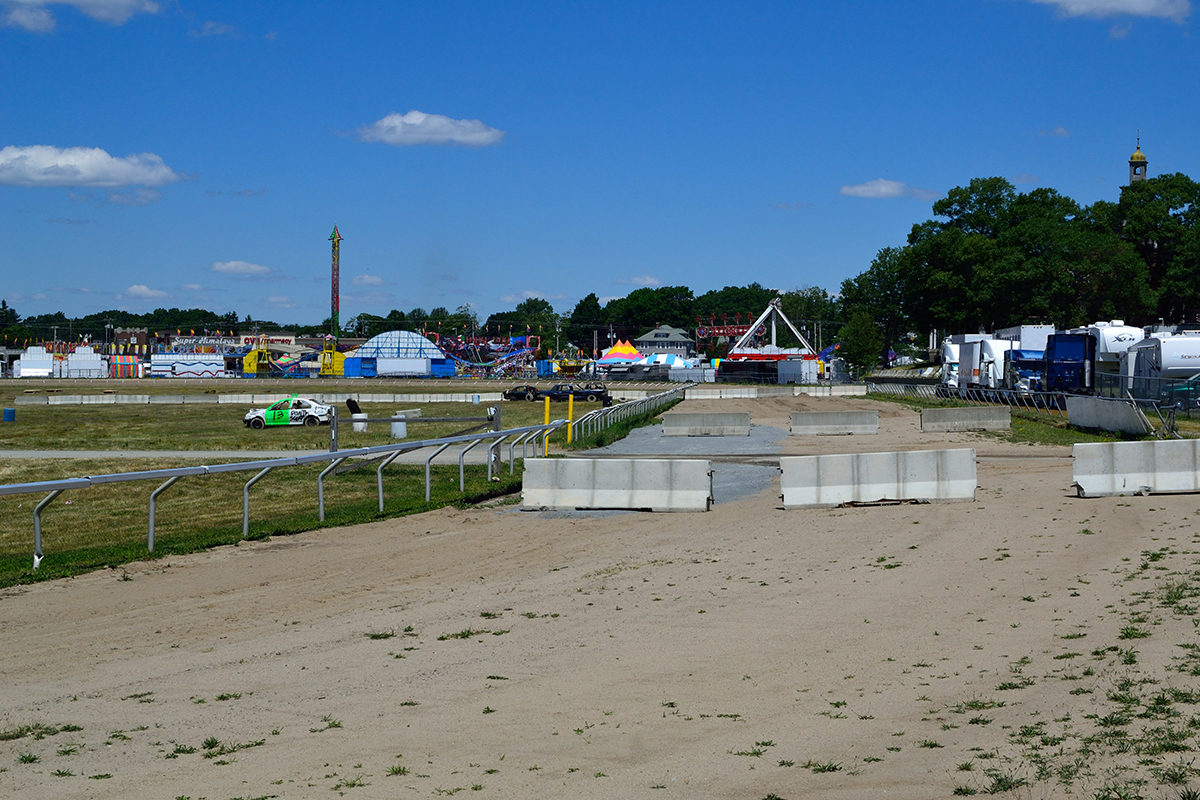
You can see that much of both rails are in place, with some bits to fix:
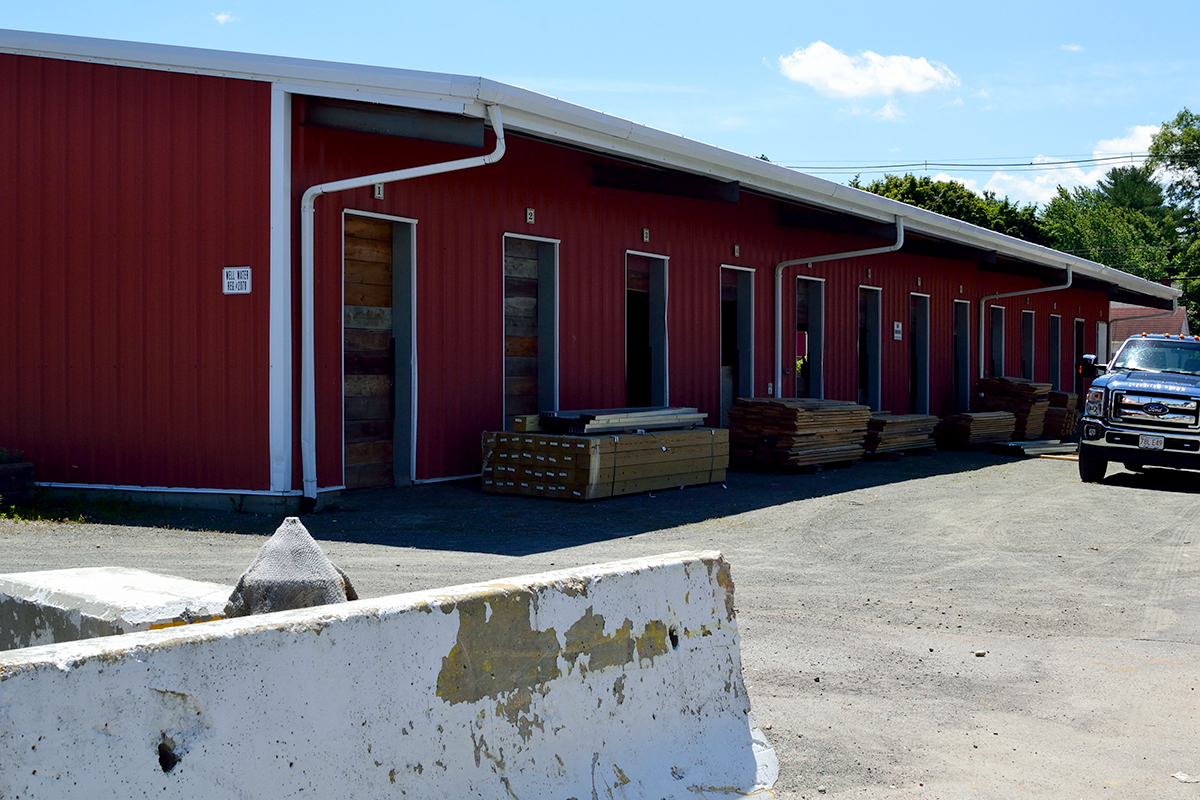
The paddock, looking toward the barns:

Piles of wood in place for the barn refurbishment that’s underway:
Baze Retires
Russell Baze, the winningest rider of all time, retired without much fanfare on Sunday. After Wahine Warrior finished in a dead heat for second in the 10th race on the last day of the Golden Gate Fields spring meet, the jockey told his agent that his 42-year career was over.
It’s impossible not to dwell on his phenomenal record: From his first winner in 1974, Baze racked up 12,842 wins from 53,578 mounts, for earnings of $199.3 million (three years ago, he was profiled as racing’s $186 million man). He’s won more than 100 riding titles, ridden more than 400 winners in a year 13 times. He’s in the Hall of Fame. He was the subject of an award-winning multimedia profile in the New York Times.
He was also the regular rider of 2005 sprint champion Lost in the Fog, one of the most exciting horses of the early aughts, and one of the best to emerge from Northern California. He and Baze won the 2005 King’s Bishop:
“It’s like being a roadie for a rock star. Everybody knows Lost in the Fog,” Baze said after the colt, who was then 9-for-9, won his first Grade 1.
The 2005 Swale Stakes was Lost in the Fog’s first graded win, and he looked so good, scoring by five lengths after a stalking trip, that trainer Greg Gilchrist considered trying him around two turns in the Florida Derby:
Baze’s record number of wins will likely stand. Other jockeys may not even get the chance to build the sort of remarkable journeyman career he had:
So with North American race dates shrinking, the number of annual races in a freefall, and entire circuits dropping off the grid entirely, will jockeys in the future be able to choose to remain in one place to build decades-long portfolios of accomplishments? Will the next generation of riders like Gall (who rode primarily at Fairmount Park near St. Louis), Ouzts (who currently rides the mid-level tracks in Ohio and Kentucky), and Carl Gambardella (a retired stalwart of the defunct but gritty New England circuit) be able to achieve top-20 lifetime rankings while competing close to home?
Best wishes to Baze. He won’t be forgotten any time soon.
6/25/16 Addendum: Take the time to read Jon White’s recap of Baze’s career (first win, all the big horses, Shoemaker and Pincay).
About
Jessica Chapel writes and edits in Massachusetts. Railbird is a Thoroughbred horse racing blog published from June 2004 to July 2019. More / Contact
Elsewhere
Find Jessica on Pinboard and Instagram, Railbird on LibraryThing and Twitter.
Etc.

Links
Search
Boston Racing
Spreadsheets/Data
← Home
Copyright © 2000-2026 by Jessica Chapel. All rights reserved.