The East Boston Connection
Furthering my half-joking homer theory that everyone in American racing has a connection to Suffolk Downs is this story of jockey Edgar Prado:
In 1988, one of Bob Klesaris’ jockeys at Boston’s Suffolk Downs was suspended. Too aggressive a ride, too tight, the trainer was told. Klesaris challenged the decision. It was his first appeal at the racecourse. He was confident the stewards would see, as he did, that his jockey was “100 percent in the right.”
They didn’t, and when Klesaris returned to the barn area, he spotted the offending jockey.
“Listen, I’m going to send you to Maryland,” he recalled telling him.
Edgar Prado, who over the next decade in the state would become its leading jockey six times, turned to Klesaris. Not knowing much about the nation’s geography, he asked: “What country is that?”
Suffolk racing returns for the first of three weekends this year on July 9-10.
Stars Aligning
The Pegasus World Cup is coming to Gulfstream on January 28, 2017, and to get a spot in the 12-horse starting gate, owners will have to buy an entry for $1 million, which will go into the purse, making the $12 million Pegasus the world’s richest Thoroughbred race. (Somewhere, Sheikh Mohammed’s gritting his teeth at this trumping.) The money doesn’t only guarantee entry, though:
All entrants will not only be competing for the world’s largest purse, but they will also share equally in 100% of the net income from pari-mutuel handle, media rights, and sponsorships from the Pegasus World Cup, according to The Stronach Group announcement.
Aspects of the Pegasus plan, which allows owners buying an entry to also lease a starter or sell their place in their gate, immediately reminded me of Fred Pope’s star vision from 2011. You might remember this idea:
Maybe, just maybe, the system we have been using for compensating our talent in racing has become a problem, a big problem. This year, if things go well, Uncle Mo’s races could have total wagering handle of more than $200 million. With average takeout of twenty percent, the wagering revenue generated by Uncle Mo’s races, $40 million, will go somewhere else.
Of that $40 million, about $10 million (5% of the $200 million wagered) will go to the host tracks where the races are held and be split between track operators and future purses. The remaining $30 million (15% of the total wagered) will go to those simply taking bets on Uncle Mo’s races. Why?
Why can’t the top finishers in Uncle Mo’s races receive the $20 million in purses due from wagering on their races? Our stars need to be compensated for the revenue they generate. That’s how the real world works.
Racing’s welfare system is not working for those putting on the show, thus it is not working for Uncle Mo, and the other brands in the sport. Racing needs the same distribution model as the Apple brand, where Apple sells customers direct, through bricks and mortar outlets and through on-line vendors.
The Pegasus World Cup is selling direct. Even if it doesn’t upend the current economic structure of racing, it’s a step in that direction.
5/19/16 Addendum: I missed this Tom LaMarra story in January, which quotes Frank Stronach addressing the business model experiment angle:
“The basic idea is how can racing compete with other great sports?” Stronach said. “We’ve got to make things exciting, things the press will write about. We want to tell people that love horse racing that we say, ‘Look. We want to establish a new business.’ We would lease Gulfstream for one day and call it a new business.”
He was cagier about it when asked by T.D. Thornton last week:
TDN: If the profit-sharing concept works with a race of this magnitude, could the concept be scalable? By that I mean could you see profit-sharing trickling down as a way of funding other types of races or even entire racing programs or race meets?
FS: That’s possible. But smaller races are less interesting, right?
The Distaffer
T.D. Thornton’s story of Jefferson Downs race caller Ann Elliott sparked an idea that I’ve been carrying around since at least Claire Novak’s Isabel Dodge Sloane profile, or maybe since my post about trainer Mary Hirsch, into action — women have always played a role in horse racing, yet their stories have a habit of getting lost. More attention should be paid.
Introducing The Distaffer — a newsletter of horses, history, and heroines arriving in your mailbox once or twice a month. We’ll explore the legacies of racing women past and meet the women shaping the game now. There will be stories of great racehorses, too, and related links, and maybe an occasional GIF. Subscribe — the first issue goes out on Tuesday, May 31.
“Whole new, fun world”
First impressions of the Betfair New Jersey exchange wagering platform:
The one thing that is striking to me is that I’m more engaged in betting throughout the entire process of activity in a race when liquidity begins to show up. So when trades begin in a race, I’m keeping my eye on that activity throughout the entire process. Because this is fixed odds wagering, there are opportunities to “middle†out of positions and lock up small profits in these fluctuations, if that’s your thing. This is way different than waiting 30 minutes between races to see when the real late money comes in to react. The exchange allows you be engaged in a race at any time, real action *way* before the race. The other side of this is that you can just name your price well ahead of time and just leave it there to be matched.
The exchange opens on Tuesday. Disclosure — I’m freelancing with the agency handling marketing and public relations for the company’s U.S. exchange launch. But if you’re a New Jersey bettor and you’re interested in the platform, then reading this player’s post about his beta experience is worth your time.
5/16/16 Addendum: More early players’ impressions are linked here.
Respect
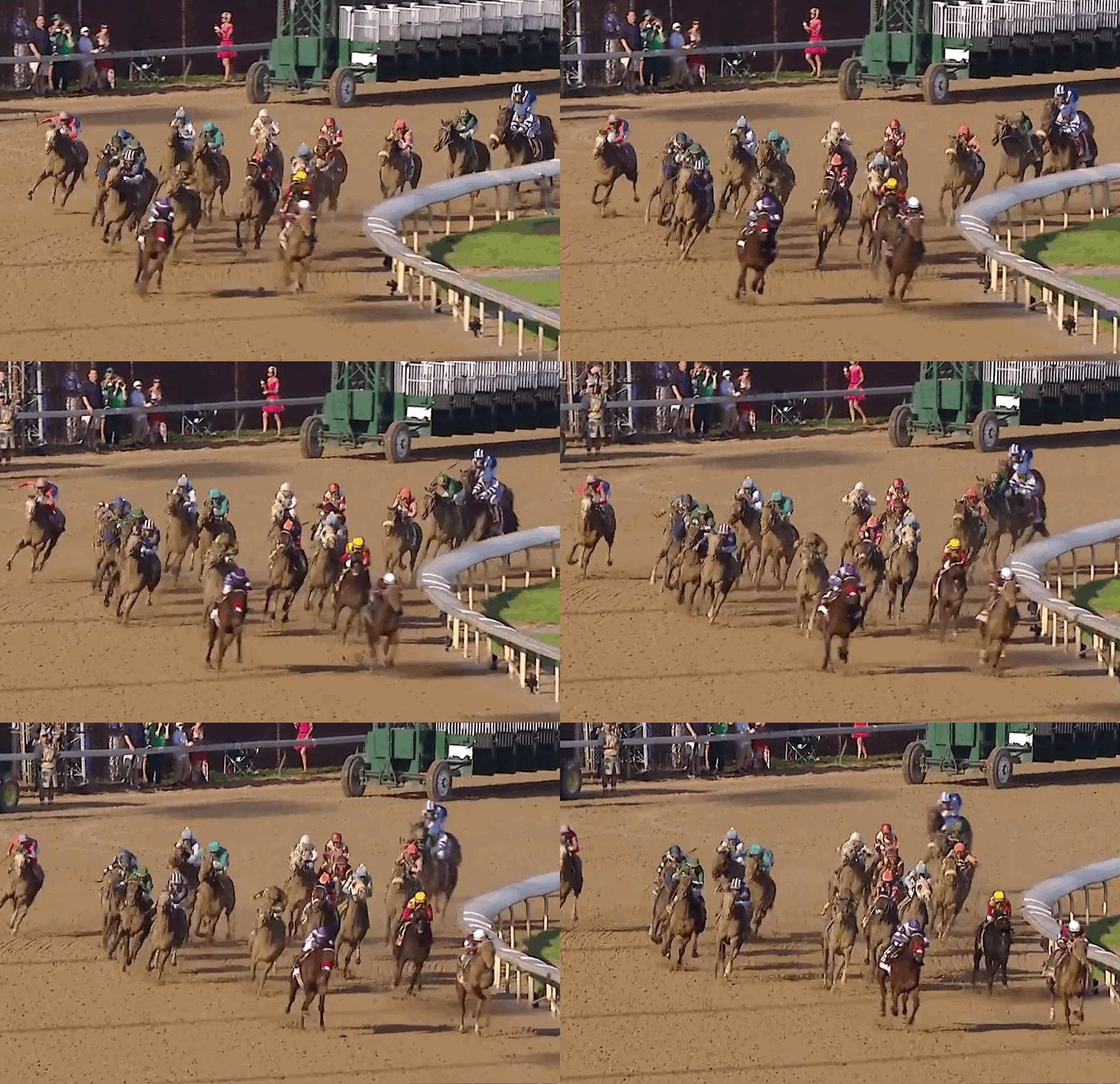
Turning into the stretch of the 2016 Kentucky Derby.
Nyquist earned a Beyer speed figure of 103 for winning the Kentucky Derby, the highest Beyer of his career; his TimeformUS speed figure came up 123. However you measure his performance on Saturday, it was a peak, and trainer Doug O’Neill looks like a pretty smart guy for bringing his Uncle Mo colt to Churchill Downs in condition to move forward off two prep races, only one of which was around two turns. I thought Nyquist would come up short for that very reason, especially if the early pace as as strong as projected.
Just like Ed DeRosa, though, running down what he got right and wrong about this year’s Derby, I have no regrets:
RIGHT: Nyquist was the best two-year-old and best three-year-old. This might sound like a funny brag considering I didn’t pick him to win the race, but at 2-to-1 keying a 14-to-1 exacta I have no regrets about opposing him on top because even if I had picked him to win I still wouldn’t have won anything on the race at that price with (my actual pick) Exaggerator second. But the respect for Nyquist’s talent was clearly there. I just gambled against it trumping the rest of the group.
WRONG: Picking against Nyquist. From a horseplayer perspective, it’s easy to forgive the pick against—especially considering how well Exaggerator ran—but the fact is everyone wants to pick the Derby winner, and I had my chance after having Nyquist on top all year.
The winner went to post at a price of 2.30 and paid $6.60 — Nyquist’s odds were the lowest for a favorite since Point Given in 2001, and lower than the odds of the three winning favorites since 2013 — Orb’s price was 5.40 that year, California Chrome’s 2.50 in 2014, and American Pharoah’s 2.90 in 2015.
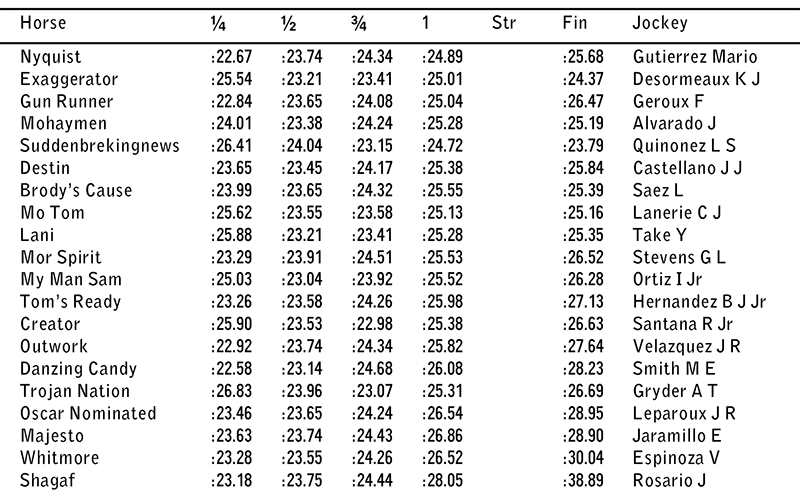
Here are the incremental fractions for the Derby from the DRF chart:
View the official Equibase chart (PDF).
Danzing Candy hustled to the front and led the field through the first three quarters in times of :22.58, :45.72, and 1:10.40 before yielding his position to eventual third-place finisher Gun Runner and then Nyquist, who assumed the lead entering the stretch and wrapped up the 1 1/4 mile Derby in 2:01.31. He did run his final quarter three seconds slower than he did his first, but that he was in front at all is what’s impressive, as Mike Watchmaker points out:
He was the only true survivor of a Derby pace that completely fell apart, and Nyquist did much more than merely survive.
Every other horse involved in the Derby pace either collapsed, or out and out disintegrated. But not Nyquist. He kept on with dogged determination the way champions so often do, and he safely turned back a runner-up in Exaggerator who had this race set up for him …
Watch the replay:
Derby recaps: Now Nyquist has real respect as he sets out to exorcise a Triple Crown demon … Nyquist wins the Kentucky Derby … Nyquist answers call, reignites Triple Crown chase with Derby win … Nyquist stays perfect with Kentucky Derby victory. He ships to Pimlico on Monday for the Preakness.
About
Jessica Chapel writes and edits in Massachusetts. Railbird is a Thoroughbred horse racing blog published from June 2004 to July 2019. More / Contact
Elsewhere
Find Jessica on Pinboard and Instagram, Railbird on LibraryThing and Twitter.
Etc.

Links
Search
Boston Racing
Spreadsheets/Data
← Home
Copyright © 2000-2026 by Jessica Chapel. All rights reserved.